
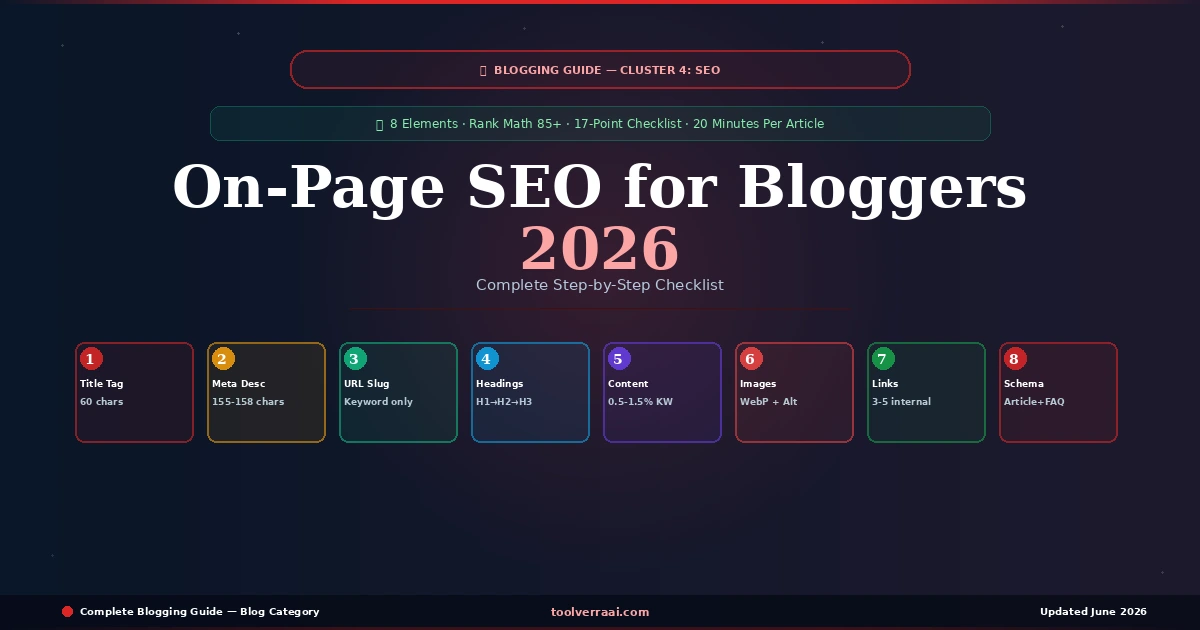
- What Is On-Page SEO for Bloggers?
- Element 1: Title Tag
- Element 2: Meta Description
- Element 3: URL Slug
- Element 4: Heading Structure (H1-H3)
- Element 5: Content Optimization
- Element 6: Image Optimization
- Element 7: Internal & External Links
- Element 8: Schema Markup
- Rank Math SEO — Target Score 85+
- Complete Pre-Publish Checklist
- FAQ
On-page SEO for bloggers in 2026 covers everything you control directly on your article page that influences how Google ranks it. After completing keyword research and writing your article, on-page SEO for bloggers 2026 is what tells Google: what your page is about, why it should rank, and why users will benefit from clicking it. This complete on-page SEO for bloggers 2026 guide covers all 8 critical elements with specific rules for each.
The honest reality about on-page SEO for bloggers in 2026: most of it takes under 20 minutes per article using the Rank Math SEO plugin. The difficulty is not technical complexity — it is consistency. Bloggers who apply the same on-page SEO checklist to every article consistently outrank bloggers who optimize sporadically. This guide gives you that checklist in a format you can use every single time.
🔍 What Is On-Page SEO for Bloggers 2026?
On-page SEO for bloggers in 2026 refers to all the optimizations you make directly on your web page — as opposed to off-page SEO (backlinks) or technical SEO (site speed, crawlability). On-page SEO for bloggers 2026 includes your title tag, meta description, URL structure, heading hierarchy, content quality, image alt text, internal linking, and schema markup. These are the signals Google reads to understand what your page is about and how relevant it is to a specific search query.
1️⃣ On-Page SEO Element 1 — Title Tag
Your title tag is the clickable headline that appears in Google search results. It is the single most important on-page SEO element for bloggers in 2026. The title tag tells Google exactly what your page covers and tells searchers whether your result is worth clicking.
- ✅ Include primary keyword at the beginning (not the end)
- ✅ Keep under 60 characters (Google truncates beyond this)
- ✅ Add a benefit or power word — “Complete”, “Step-by-Step”, “Free”
- ✅ Write for humans first — must make sense and create click desire
- ❌ Never repeat the keyword more than once in the title
- ❌ Never stuff multiple keywords — one primary keyword per title
| Title Version | Characters | Quality |
|---|---|---|
| “How to Start a Blog in 2026 — Complete Beginner Guide” | 52 ✅ | ⭐ Excellent |
| “How to Start a Blog” | 21 ✅ | Too vague |
| “How to Start a Blog in 2026 and Make Money Blogging Online for Free” | 69 ❌ | Too long |
2️⃣ On-Page SEO Element 2 — Meta Description
The meta description is the 155-158 character text snippet beneath your title in search results. It does not directly affect rankings — but it directly affects click-through rate (CTR). Higher CTR sends a behavioral signal to Google that influences rankings indirectly. Think of your meta description as your article’s 158-character advertisement.
- ✅ Stay between 155-158 characters (Google truncates beyond this)
- ✅ Include primary keyword naturally — Google bolds it in results
- ✅ State clearly what the reader gets from clicking
- ✅ Use active verbs — “Learn”, “Discover”, “Get”, “Build”
- ❌ Never start with “This article is about…” — wasted characters
- ❌ Never copy your introduction paragraph as the meta description
3️⃣ On-Page SEO Element 3 — URL Slug
Your URL slug is the part of the web address after your domain name (e.g., toolverraai.com/on-page-seo-for-bloggers-2026). A clean, keyword-focused URL slug is a confirmed on-page SEO signal. More importantly: never change a URL slug after publishing without setting up a 301 redirect — broken URLs destroy rankings and waste backlink equity permanently.
- ✅ Use primary keyword only — remove all stop words (a, the, in, for)
- ✅ Keep under 5 words where possible
- ✅ Use hyphens between words — never underscores or spaces
- ✅ All lowercase letters
- ❌ Never include dates in URLs (makes content look outdated)
- ❌ Never change a published URL without a 301 redirect
4️⃣ On-Page SEO Element 4 — Heading Structure
Heading tags (H1, H2, H3) signal the hierarchical structure of your content to Google. They help Google understand which topics are primary, which are secondary, and how they relate. For on-page SEO for bloggers 2026, correct heading structure is both an SEO signal and a readability requirement — poorly structured headings confuse both search engines and readers.
| Heading Level | Use | Keyword Usage | How Many |
|---|---|---|---|
| H1 | Page title only | Primary keyword | Exactly 1 per page |
| H2 | Main sections | Keyword variations naturally | 6-10 per article |
| H3 | Sub-points under H2 | Related terms | As needed |
| H4+ | Deeper structure | Rarely needed | Only if needed |
5️⃣ On-Page SEO Element 5 — Content Optimization
Content optimization for on-page SEO in 2026 is not about keyword density — it is about semantic completeness. Google evaluates whether your article covers the topic thoroughly, uses related terms naturally, and provides genuine value that matches search intent. The on-page SEO for bloggers 2026 content rules are straightforward once you understand the goal.
- ✅ Include primary keyword in the first 100 words naturally
- ✅ Keyword density: 0.5%-1.5% (Rank Math measures this)
- ✅ Use semantic/related terms throughout — LSI keywords
- ✅ Match word count to top 3 ranking competitors for your keyword
- ✅ Include a direct answer (snippet box) under your first H2
- ✅ Keep paragraphs under 4 sentences for mobile readability
- ❌ Never stuff keywords — reads unnaturally and triggers spam signal
6️⃣ On-Page SEO Element 6 — Image Optimization
Every image on your blog should have descriptive alt text — both for on-page SEO and accessibility. Alt text tells Google what an image shows, which contributes to image search rankings and overall page relevance signals. Image file names and compression also affect Core Web Vitals (LCP target: under 2.5 seconds), which remain a ranking factor in 2026.
- ✅ Alt text: describe the image naturally — include keyword once if relevant
- ✅ File name: use keyword in the image file name before uploading
- ✅ Format: use WebP for all blog images (40% smaller than JPEG)
- ✅ Compress before uploading — use Smush plugin automatically
- ✅ Featured image: 1200×630 px for Google Discover compliance
- ❌ Never leave alt text blank — screen readers and Google both need it
- ❌ Never use generic file names like “IMG_4891.jpg”
7️⃣ On-Page SEO Element 7 — Internal & External Links
Internal links connect your articles to each other, passing authority from established pages to new ones. External links to authoritative sources (government sites, major publications, official documentation) signal that your content is well-researched. Both are confirmed on-page SEO ranking factors in 2026.
| Link Type | Quantity | Target | Attribute |
|---|---|---|---|
| Internal links | 3-5 per 1,000 words | Related articles on your blog | dofollow (default) |
| External (authority) | 1-3 per article | gov, edu, major brands | dofollow + noopener |
| External (affiliate) | As needed | Sponsored product links | nofollow + sponsored |
8️⃣ On-Page SEO Element 8 — Schema Markup
Schema markup is structured data code that tells Google explicitly what type of content your page contains. It enables rich results (stars, FAQs, how-to steps) in search results — which improve click-through rates. Rank Math adds schema automatically based on your post type, requiring no manual coding from bloggers.
| Schema Type | Use When | Rich Result |
|---|---|---|
| Article | All blog posts | Article display in news/search |
| FAQPage | Posts with FAQ section | Expandable Q&A in results |
| HowTo | Step-by-step guides | Steps displayed in results |
| Review | Product/tool reviews | Star rating in results |
| BreadcrumbList | All pages | Breadcrumb path in results |
📊 Rank Math SEO Score — Target 85+, Not 100
🎯 Rank Math On-Page SEO Checklist for Bloggers 2026 — What Each Score Range Means
✅ Complete On-Page SEO Checklist for Bloggers 2026
Run through every item before publishing. This takes under 10 minutes with Rank Math installed.
- Title tag: Contains primary keyword near the start · Under 60 characters
- Meta description: 155-158 characters · Keyword included · Written like ad copy
- URL slug: Keyword only · No dates · Hyphens between words · Lowercase
- H1: Only one per page · Contains primary keyword
- Keyword in intro: Appears naturally in first 100 words
- H2 headings: 6-10 sections · Include keyword variations naturally
- Content length: Matches top 3 competitors for this keyword
- Keyword density: 0.5%-1.5% (Rank Math shows this)
- Direct answer box: 40-80 word answer under first H2 (snippet target)
- Images: Alt text on all images · WebP format · Compressed
- Featured image: 1200×630 px · Keyword in alt text and file name
- Internal links: 3-5 links to related articles on your blog
- External links: At least 1 dofollow link to an authoritative source
- Schema markup: Article schema enabled in Rank Math
- FAQ section: 4-6 questions with FAQPage schema enabled
- Rank Math score: 85 or above before publishing
- Google Search Console: Submit URL for indexing after publishing via Google Search Console
🎯 Key Takeaways — On-Page SEO for Bloggers 2026
- On-page SEO for bloggers 2026: 8 elements, 20 minutes per article, consistent process beats sporadic optimization
- Title tag: primary keyword first, under 60 characters, benefit-focused
- Meta description: 155-158 chars, does not affect rankings directly but affects CTR
- URL slug: keyword only, no dates, never change after publishing without 301 redirect
- Heading structure: exactly 1 H1, 6-10 H2s, never skip levels
- Content: keyword in first 100 words, 0.5-1.5% density, match competitor length
- Images: WebP format, alt text on all, 1200×630 featured image
- Internal links: 3-5 per 1,000 words with descriptive anchor text
- Schema: Article + FAQPage at minimum — Rank Math adds automatically
- Rank Math target score: 85+ not 100 — forced KW stuffing hurts more than helps
On-Page SEO Done ✅ — Next: Build Backlinks
Every article optimized · Next: off-page SEO and building authority
Blog Posts That Rank → Best SEO Tools 2026 →On-Page SEO for Bloggers 2026 — FAQ
Previous: Keyword Research for Bloggers · Related: Write a Blog Post That Ranks · Best SEO Tools 2026