
Honest reviews · Updated 2026
toolverraai.com

How to Do Keyword Research for Bloggers in 2026 (Free Tools Only)

📅 Updated: June 2026 ⏱ 13 min read 📝 Blog Cluster — SEO 🆓 Free Tools Only 👤 ToolVerraAI Team
📦 Cluster: SEO · Part of the Complete Blogging Guide
📋 How to Do Keyword Research for Bloggers 2026 — How to Do Keyword Research for Bloggers 2026 — Table of Contents
  1. What Is Keyword Research and Why It Matters
  2. Best Free Keyword Research Tools 2026
  3. Step 1: Find Seed Keywords
  4. Step 2: Expand with Free Tools
  5. Step 3: Filter for Low Competition
  6. Step 4: Match Search Intent
  7. Step 5: Build Your 3-Month Content Calendar
  8. When to Upgrade to Paid Tools
  9. FAQ

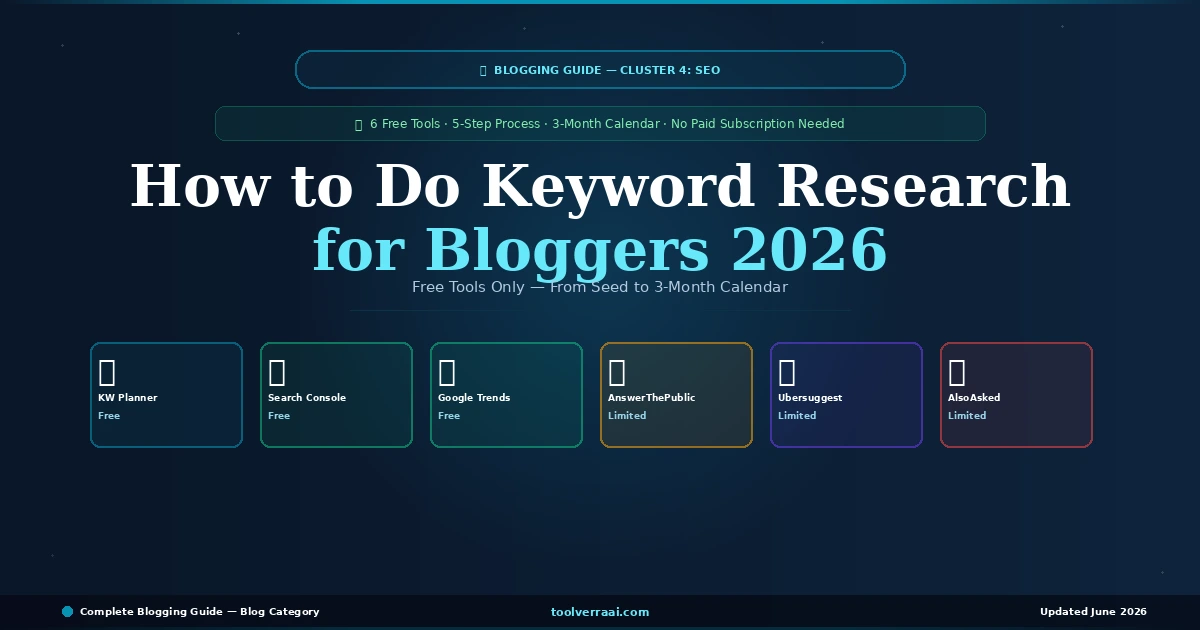
Learning how to do keyword research for bloggers in 2026 does not require expensive tools. The complete process — from blank page to a 3-month editorial calendar full of rankable topics — can be done using only free tools. This guide on how to do keyword research for bloggers 2026 gives you the exact step-by-step system using Google Keyword Planner, Google Search Console, Ubersuggest, AnswerThePublic, and Google Trends. No paid subscriptions required to start.

The honest truth about how to do keyword research for bloggers in 2026 — and why most new bloggers skip this step: without it, even well-written posts sit unread because they never surface in search results. Keyword research is the process of discovering the specific words and phrases your target readers type into Google — and building content that matches exactly what they are searching for. Most new US bloggers see traffic within 3-6 months when they publish consistently and follow on-page SEO best practices after completing proper keyword research.

💡 Direct Answer — How to Do Keyword Research for Bloggers 2026: The complete how to do keyword research for bloggers 2026 process: Start with 5-10 seed topics from your niche. Expand using Google Keyword Planner (free) and AnswerThePublic. Filter for long-tail keywords (3-5 words) with under 500-2,000 monthly searches. Check Google Trends for stability. Verify competition by searching Google — if individual bloggers appear on page one, you can rank. Match to search intent. Build a 3-month content calendar. No paid tools needed to start.
$0Cost to start
6Free tools needed
3-5Word long-tail target
3-6moTo first rankings

🔍 How to Do Keyword Research for Bloggers 2026 — Why It Matters

Keyword research is the process of finding the exact words and phrases people type into Google when looking for information your blog covers. When you know how to do keyword research for bloggers in 2026, every article you write has a proven audience searching for it before you write a single word. Without it, you are guessing — and most guesses result in articles that rank nowhere.

🌱 Seed Keyword

Broad topic — “blogging”, “SEO”, “hosting”. Starting point only — too competitive to target directly.

🎯 Long-tail Keyword

“How to start a blog for free in 2026” — 3-5 words, specific, lower competition, higher conversion.

🔗 LSI / Related Terms

Semantic terms Google expects in your article — “WordPress”, “domain name”, “web hosting”.

💡 How to do keyword research for bloggers 2026 — the new blogger rule: Target long-tail keywords (3-5 words) exclusively for your first 20-30 articles. Long-tail keywords have lower competition, more specific search intent, and higher conversion rates. A new blog cannot compete for “blogging tips” — but it can rank for “how to start a food blog on WordPress in 2026.”

🛠️ How to Do Keyword Research for Bloggers 2026 — Best Free Tools

🔍
Google Keyword Planner
Search volume data, keyword suggestions, CPC estimates. Direct from Google. Free with Google account.
✅ Free
📊
Google Search Console
Shows exact queries your site already ranks for. Best tool for improving existing content. Free always.
✅ Free
📈
Google Trends
Confirms if a keyword is growing, stable, or declining. Essential validation step before writing.
✅ Free
❓
AnswerThePublic
Generates question-based keywords (“how”, “what”, “why”) from a seed term. 3 free searches/day.
⚡ Free Limited
🔎
Ubersuggest
Keyword ideas + difficulty scores + competitor analysis. 3 free searches/day, no account needed.
⚡ Free Limited
🙋
AlsoAsked
Shows “People Also Ask” question clusters. Perfect for FAQ sections and content gap identification.
⚡ Free Limited
⚠️ Google Keyword Planner data warning 2026: Google has been progressively restricting free Keyword Planner data for non-advertisers. Accounts without active ad spend see broader volume ranges (“1K-10K”) rather than precise numbers. Cross-reference Keyword Planner data with Google Trends and Ubersuggest for more accurate volume estimates. Do not rely on any single tool.
1
How to Do Keyword Research for Bloggers 2026 — Find Seed Keywords
⏱ 15 min

A seed keyword is a broad topic word that describes your niche. You do not target seed keywords directly — they are starting points for discovering long-tail variations. Start by listing 5-10 seed topics related to your blog niche.

How to Find Seed Keywords

Think about your niche from your reader’s perspective. A personal finance blogger might have seeds like: “budgeting”, “saving money”, “investing for beginners”, “credit cards”, “side hustles”. A tech blogger: “WordPress”, “web hosting”, “AI tools”, “SEO”. These are starting points — broad terms you will expand in Step 2. You should have 5-10 seeds before moving on.

💡 Seed keyword sources: Your niche’s main topics · The categories you planned for your blog · Questions your target reader asks in Facebook groups and Reddit threads · The “Related searches” shown at the bottom of any Google results page.
2
How to Do Keyword Research for Bloggers 2026 — Expand with Free Tools
⏱ 30 min

Take each seed keyword and run it through three free tools to generate a list of specific long-tail variations. The goal is to end up with 50-100 potential keyword ideas that you will filter in Step 3.

Tool 1: Google Keyword Planner

Go to Google Keyword Planner → “Discover new keywords” → enter your seed keyword. Review the suggestions list. Filter by “Relevance” and look for keywords with at least some search volume that relate directly to your niche. Export to a spreadsheet. Focus on 3-5 word phrases, not 1-2 word broad terms.

Tool 2: AnswerThePublic

Go to AnswerThePublic → enter your seed keyword → select country (US) → generate. The tool shows you hundreds of question-based keywords organized by “how”, “what”, “why”, “when”, “which”, and “are”. These question-format keywords are perfect for blog articles and FAQ sections. Screenshot or export the most relevant ones.

Tool 3: Google Autocomplete

Type your seed keyword into Google’s search bar but do not press Enter. Note the autocomplete suggestions — these are real searches people are making right now. Then add a letter after your keyword (“budgeting a…”, “budgeting b…”) to uncover even more variations. Free, instant, and directly reflects current search behavior.

3
How to Do Keyword Research for Bloggers 2026 — Filter for Low Competition
⏱ 30 min

You now have 50-100 keyword ideas. Step 3 filters these down to the 15-20 best targets for your current domain authority level. New blogs need low-competition keywords — high-volume keywords are dominated by established sites with years of authority.

Filter CriteriaNew Blog (0-6 months)Growing Blog (6-24 months)
Monthly search volume100-2,000 ✅1,000-10,000
Keyword word count3-5 words (long-tail) ✅2-4 words
Page-one competitionIndividual bloggers ranking ✅Mix of blogs + media
Domain authority of top 5DR under 50 ✅DR under 70
Google Trends score50+ and stable/rising ✅30+ stable

The Manual Competition Check

For every keyword that passes the volume filter, open Google in a private browser window and search the exact keyword. Look at the first 10 results. Ask: are any of these individual blogs (not Forbes, WebMD, Wikipedia)? If yes — you have a realistic target. If every result is a major media site or official government page — skip this keyword and find a more specific variation.

💡 The quick win filter: Search your keyword and look specifically for results that are 2-3 years old, have thin content (under 800 words), or do not specifically answer the question in their title. These are weak pages you can replace with a more thorough, up-to-date article.
4
How to Do Keyword Research for Bloggers 2026 — Match Search Intent
⏱ 15 min

Search intent is what a person actually wants when they type a keyword. Google rewards content that perfectly matches intent — and rejects content that technically contains the keyword but serves a different purpose. For each filtered keyword, identify its intent before writing.

Keyword ExampleIntent TypeContent Format
“how to start a blog 2026”InformationalStep-by-step guide
“best WordPress hosting 2026”CommercialComparison/review list
“Hostinger review”CommercialDetailed review
“buy Ahrefs”TransactionalNot ideal for blogs
“what is SEO”InformationalEducational explainer
“Ahrefs vs Semrush”CommercialComparison article
💡 Intent check rule: Search your keyword in Google. If the top 5 results are all listicles — write a listicle. All guides — write a guide. All reviews — write a review. Going against the dominant content format on page one is fighting Google’s own judgment about what searchers want for that query.
5
How to Do Keyword Research for Bloggers 2026 — Build Your 3-Month Calendar
⏱ 20 min

You now have 15-20 validated, low-competition, intent-matched keywords. The final step is organizing them into a publishing schedule. A 3-month content calendar with 2-3 articles per week gives you 24-36 articles — enough to build topical authority in your niche and start seeing consistent organic traffic.

📅 How to Do Keyword Research for Bloggers 2026 — 3-Month Calendar

Month 1 Foundation articles: “how to create a budget 2026” · “best budgeting apps free” · “50/30/20 rule explained” · “how to save money on groceries” · “emergency fund how much” · “checking vs savings account difference” · “how to track expenses spreadsheet” · “money saving tips beginners” · “how to open a bank account online” · “what is compound interest explained”
Month 2 Deeper subtopics: “how to pay off credit card debt fast” · “best high yield savings accounts 2026” · “how to invest $500 beginners” · “Roth IRA vs 401k explained” · “how to negotiate salary first job” · “side hustles from home 2026” · “how to save for house down payment” · “free ways to improve credit score”
Month 3 Commercial intent: “best budgeting apps 2026 reviewed” · “Mint vs YNAB comparison” · “best credit cards no annual fee” · “top index funds beginners” + Update Month 1 articles with new data and internal links

When you have mastered how to do keyword research for bloggers in 2026 with free tools, paid tools like Ahrefs and Semrush add more power — Semrush’s Keyword Magic Tool alone accesses over 25 billion keywords across 142 geographic databases with AI-enhanced difficulty scores that predict 12-month ranking trends. But they are expensive for bloggers who are still finding their footing.

SignalTool to AddWhy
Blog earns $100+/monthSemrush or SE RankingPrecise KD scores + competitor analysis
10,000+ monthly visitsAhrefs Webmaster Tools (free)Backlink analysis + content gap
Need exact volume numbersSemrush $65/moGoogle Planner too vague for scaling
Agency or multiple blogsSE Ranking $65/moBest value at this scale
💡 How to do keyword research for bloggers 2026 — the upgrade rule: Start with free tools. Upgrade to paid only when your blog generates enough revenue to justify the subscription. Semrush at $65/month pays for itself when your blog earns $500+/month. Before that threshold, the free tool stack covered in this guide delivers 80% of the value at 0% of the cost. See our best SEO tools guide for a full paid tool comparison.

🎯 How to Do Keyword Research for Bloggers 2026 — Key Takeaways

  • How to do keyword research for bloggers 2026: 5-step process, all free tools, no paid subscription needed
  • Start with 5-10 seed keywords from your niche → expand → filter → validate → calendar
  • Target long-tail keywords (3-5 words, 100-2,000 searches/month) for your first 20-30 articles
  • Free tool stack: Google Keyword Planner + Google Search Console + Trends + AnswerThePublic + Ubersuggest
  • Competition check: search keyword in Google — if individual bloggers rank on page one, you can too
  • Always match search intent — listicle keywords → write listicles, guide keywords → write guides
  • Build a 3-month calendar with 2-3 articles/week → 24-36 articles builds topical authority
  • Google Keyword Planner data is less precise for free accounts in 2026 — cross-reference with Trends
  • Upgrade to paid tools (Semrush $65/mo) only after blog earns consistent revenue
  • Next step: write your article using the keyword research process from this guide

How to Do Keyword Research for Bloggers 2026 ✅ — Now Write Articles That Rank

Keyword research done · Next: write blog posts that reach page one

How to Write a Blog Post That Ranks → Best SEO Tools 2026 →

How to Do Keyword Research for Bloggers 2026 — FAQ

The best free keyword research tools for bloggers in 2026 are: Google Keyword Planner (search volume + suggestions), Google Search Console (actual queries you already rank for), Google Trends (confirm keyword stability), AnswerThePublic (question-based keywords), and Ubersuggest (difficulty scores, 3 free searches/day). Use three or four of these tools together — each serves a different purpose and cross-referencing gives a more accurate picture than any single tool. None require a paid subscription for beginner blogger needs.
To find low competition keywords for a new blog: (1) Target long-tail keywords — 3-5 word phrases with 100-2,000 monthly searches. (2) Use Google Keyword Planner to find suggestions, then filter by lower search volume — fewer searches often means less competition. (3) Do the manual competition check: search the keyword in Google in a private window. If individual bloggers appear in the top 10 (not just major media sites), the keyword is rankable. (4) Look for existing results that are outdated (2-3 years old) or thin (under 800 words) — these are weak pages you can replace with better content.
Each blog post should target one primary keyword and 3-5 related secondary keywords. The primary keyword is the main search query your article is written to answer — it appears in your H1 title, URL, meta description, and introduction. Secondary keywords are related terms and variations that appear naturally throughout the article. When learning how to do keyword research for bloggers in 2026, avoid targeting multiple competing primary keywords in one article — it dilutes topical focus. Write one article per primary keyword, then link related articles together internally.
Most new US bloggers see their first consistent organic traffic within 3-6 months of publishing regularly, provided they follow on-page SEO best practices and target low-competition keywords. Individual low-competition long-tail keywords can rank within 4-8 weeks. More competitive keywords on a new domain may take 6-12 months. The most important factors: publishing 2-3 times per week consistently, targeting the right keywords (as covered in this how to do keyword research for bloggers 2026 guide), and building internal links between your articles as your library grows.
TV

ToolVerraAI Editorial Team

Bookmark this how to do keyword research for bloggers 2026 guide — updated regularly. This how to do keyword research for bloggers 2026 resource is part of the ToolVerraAI complete blogging series. Free tool recommendations verified June 2026. Last updated: June 2026.

More how to do keyword research for bloggers 2026 resources: Previous: How to Use AI to Write Blog Posts · Related: How to Write a Blog Post That Ranks · Best SEO Tools 2026

Leave a Comment

Top 100 AI Tools
for Bloggers 2026
Your ultimate free guide to the most powerful AI tools for content creators & bloggers.
⭐ Curated by the ToolVerraAI Team
Top 100 AI Tools for Bloggers

Save 100+ hours of research. Get instant access to the best AI tools across 12+ categories — completely free.

✓ 100+ AI tools handpicked for bloggers
✓ Ratings, pricing & honest reviews included
✓ Updated monthly — always current for 2026
⌛ Sending your free guide...
🎉
You're In! Check Your Inbox 💌

Your free Top 100 AI Tools guide is on its way!
Check your email — it arrives within 5 minutes.