
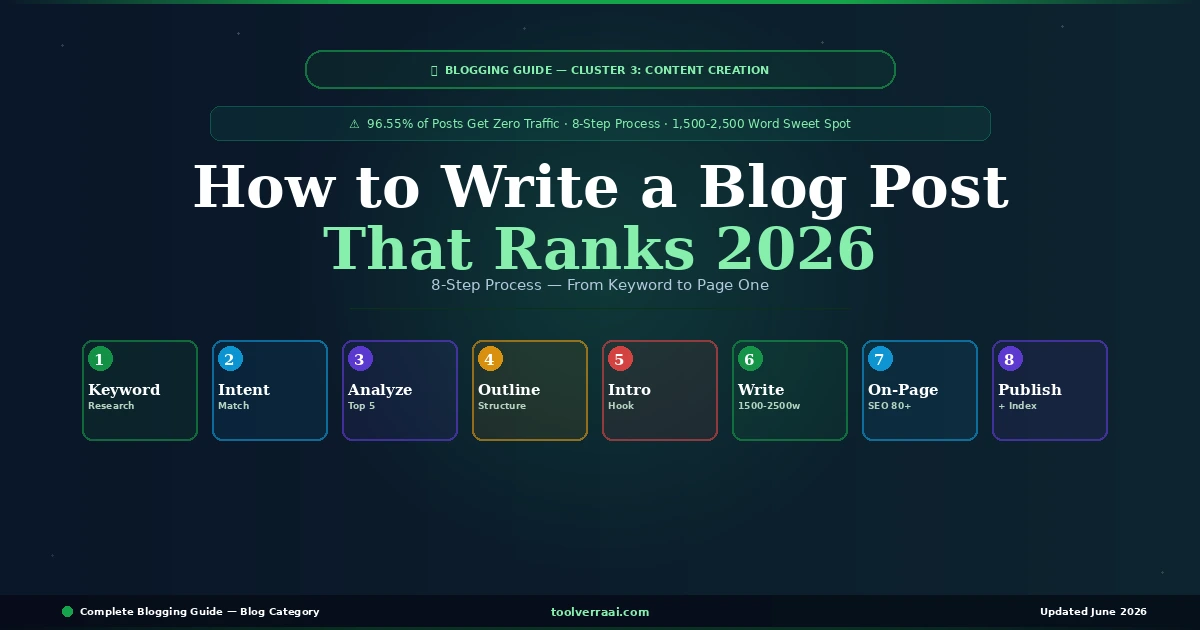
- The Reality: 96.55% of Posts Get Zero Traffic
- Step 1: Choose a Keyword with Real Demand
- Step 2: Understand Search Intent
- Step 3: Analyze the Top 5 Results
- Step 4: Create a Winning Outline
- Step 5: Write a Strong Introduction
- Step 6: Structure Your Article Correctly
- Step 7: On-Page SEO Optimization
- Step 8: Publish, Link, and Wait
- Pre-Publish Checklist
- FAQ
Learning how to write a blog post that ranks in 2026 starts with one uncomfortable fact: 96.55% of all published web pages receive zero organic traffic from Google. Over 7.5 million blog posts go live every single day — and the vast majority rank for nothing. This guide on how to write a blog post that ranks in 2026 gives you the exact 8-step process that separates ranking content from invisible content.
The process for how to write a blog post that ranks in 2026 has not changed at its core — it still requires keyword research, search intent matching, structured writing, and on-page optimization. What has changed is the bar. Google’s Helpful Content system and the rise of AI Overviews mean that surface-level, generic articles that used to rank easily no longer get clicks. Zero-click behavior rose from 56% in May 2024 to 69% in May 2025 after AI Overviews rolled out. The articles that still earn consistent traffic in 2026 are specific, deeply helpful, and genuinely better than competing pages.
📊 The Reality: Why 96.55% of Blog Posts Get Zero Traffic
Before covering how to write a blog post that ranks in 2026, understand why most do not. The problem is almost never the writing quality — it is the process that happens before writing. Most bloggers choose topics based on personal interest rather than proven search demand, write articles that do not match what searchers actually want, and publish without doing basic on-page SEO. The result: technically well-written articles that rank on page 5 or lower, where clicks effectively do not exist.
Every ranking blog post starts with a keyword that real people actually search for. Writing without a target keyword is publishing blind. Your keyword is the search query your target reader types into Google — and your article’s job is to be the best answer to that query.
How to Find the Right Keyword
- Use Google Keyword Planner — enter a topic idea and look for keywords with 500-10,000 monthly searches
- Check Google Trends — confirm the keyword is stable or rising, not declining
- Look at “People Also Ask” in Google — these are real questions real people are asking
- For new blogs: target “long-tail” keywords (3-5 words) with lower competition — easier to rank faster
- Avoid keywords with millions of results where the top 10 are all major media sites — competition you cannot beat yet
Search intent is the single most important shift in SEO content writing since 2023. Google has become extremely good at understanding what a searcher actually wants — meaning articles that contain the right keywords but fail to match the right intent are increasingly impossible to rank, regardless of quality. Before you write a single word, identify which intent your keyword serves.
📚 Informational
“How to install WordPress” — wants a step-by-step guide
🧭 Navigational
“Hostinger login” — wants to reach a specific site
🛒 Transactional
“Buy Astra Pro” — wants to make a purchase
🔍 Commercial
“Best WordPress hosting” — wants to compare before buying
Before writing your outline, read the top 5 results for your keyword. This is not about copying — it is about understanding the minimum bar you need to clear and identifying what those articles are missing. The articles you need to beat have already done the work of proving what Google wants for this query. Your job is to cover everything they cover, plus something they do not.
| What to Note for Each Competitor | Why It Matters |
|---|---|
| H2 headings they use | These are the subtopics Google considers essential for this keyword |
| Questions they answer | Cover the same questions — plus ones they missed |
| Content gaps | Topics mentioned but not explained in depth — your opportunity |
| Approximate word count | Your article should be similar depth — not shorter, not artificially padded |
| Featured snippet format | If a competitor has a snippet, replicate and improve that format |
Your outline is the skeleton of your article. A well-built outline means you always know what comes next when writing, prevents rambling sections, and ensures you cover all the subtopics Google expects for your keyword. Do not skip the outline step — it is the difference between content that feels random and content that feels authoritative.
📐 Winning Blog Post Outline Structure 2026
Your introduction has one job: prove to the reader in under 10 seconds that they clicked the right link. Most blog introductions fail because they start with a story, a generic definition, or motivational language that adds zero value. Your reader clicked for a specific answer — respect their time from the very first sentence.
The 3-Part Introduction Formula
- Part 1 — The Hook: State the problem or opportunity the reader has — make them feel understood
- Part 2 — The Promise: Tell them exactly what they will have after reading this article
- Part 3 — The Credibility: One sentence that establishes why your article is worth their time
Article structure determines whether your content ranks and whether readers stay. Google evaluates heading structure, paragraph length, and content organization as signals of quality. A high-performing blog post in 2026 is scannable — readers can find what they need without reading every word.
Article Length in 2026
Most competitive informational queries rank best with articles between 1,500 and 2,500 words. Focus on covering the topic thoroughly rather than hitting a specific word count. An 800-word article that fully answers a simple question will outrank a padded 3,000-word article that repeats itself. Match length to the depth the topic requires.
Heading Rules That Help You Rank
- One H1 per article — this is your page title, never repeat it below
- H2 for each main section — naturally include keyword variations, not exact matches
- H3 for sub-points under each H2 — use for numbered steps and named features
- Never skip heading levels — go H1 → H2 → H3, never H1 → H3
- Write headings for humans first — they should make sense read alone, out of context
Paragraph Length
Keep paragraphs to 3-4 sentences maximum for online reading. Long, dense paragraphs are the most common reason readers bounce — they look intimidating on mobile. Short paragraphs with clear transitions are a genuine competitive advantage in 2026, where 60%+ of searches happen on mobile devices.
On-page SEO is what tells Google what your article is about and why it should rank for your target keyword. With Rank Math SEO installed, this process takes about 20 minutes per article and covers the major technical signals Google uses for ranking.
| On-Page Element | What to Do | Priority |
|---|---|---|
| SEO Title (H1) | Include primary keyword near the start · Under 60 characters | ⭐ Critical |
| Meta Description | Include keyword · Under 158 characters · Write like ad copy | ⭐ Critical |
| URL Slug | Short, keyword-only · No dates · Hyphens between words | ⭐ Critical |
| Keyword in intro | Natural mention in first 100 words | ⭐ Critical |
| Image Alt Text | Describe the image naturally — include keyword once if relevant | Important |
| Internal Links | 3-5 links per 1,000 words to related articles on your blog | Important |
| External Links | 1-3 dofollow links to authoritative sources (gov, edu, major brands) | Important |
| Schema Markup | Article + FAQPage — Rank Math adds automatically | Good to have |
Publishing is not the end of the process for how to write a blog post that ranks in 2026. After hitting Publish, three steps determine whether your article gets indexed and starts climbing the search results.
- Submit to Google Search Console: In Google Search Console, paste your new article URL into the Inspect URL tool → click “Request Indexing.” This speeds up Google’s discovery of your new content
- Add internal links FROM existing articles: Go to 2-3 published articles on your blog and add a natural internal link pointing to your new article — this passes authority from your established pages to the new one
- Wait 3-6 months for stable rankings: New content typically takes 3-6 months to reach stable ranking positions. Lower-competition keywords can rank faster. Do not judge ranking success in the first 60 days — keep publishing consistently
- Update after 6-12 months: Return to articles that rank on page 2-3 and update them with fresh data, new examples, or expanded sections. Updated content often jumps 5-15 positions after republishing
✅ Pre-Publish Checklist — How to Write a Blog Post That Ranks 2026
Run through every item below before hitting Publish. This takes 10 minutes and catches the most common ranking mistakes.
- Primary keyword in H1 title tag (near the beginning)
- Meta description written — under 158 characters, includes keyword
- URL slug is short, contains keyword, no dates or stop words
- Keyword appears naturally in first 100 words of introduction
- Article has a direct answer/snippet box under the first H2
- All images have descriptive alt text
- 3-5 internal links to related articles on your blog
- At least 1 dofollow external link to an authoritative source
- FAQ section with 3-5 questions (enables FAQPage schema in Rank Math)
- Rank Math SEO score is 80 or above
- Article submitted to Google Search Console after publishing
🎯 Key Takeaways — How to Write a Blog Post That Ranks 2026
- How to write a blog post that ranks in 2026: 8-step process — skip any step and join the 96.55%
- 96.55% of all published pages get zero organic traffic — the problem is process, not writing skill
- Zero-click behavior: 69% in 2025 — means only genuinely helpful, specific content still earns clicks
- Step 1: keyword with real search volume. Step 2: match search intent exactly
- Step 3: analyze top 5 results before writing your outline
- Sweet spot length: 1,500-2,500 words for competitive informational keywords
- On-page: keyword in H1, meta, URL, intro · 3-5 internal links · 1+ dofollow external
- Rank Math target: 80+ score before publishing
- After publish: submit to Google Search Console + add internal links from existing articles
- Rankings take 3-6 months to stabilize — publish consistently, do not judge too early
Article Written ✅ — Now Learn Keyword Research
Writing process mastered · Next: find keywords your blog can actually rank for
Essential Plugins Setup → Best Hosting for Bloggers →How to Write a Blog Post That Ranks 2026 — FAQ
Previous: Essential WordPress Plugins · Related: How to Choose a Blog Niche · Best Hosting for Bloggers