
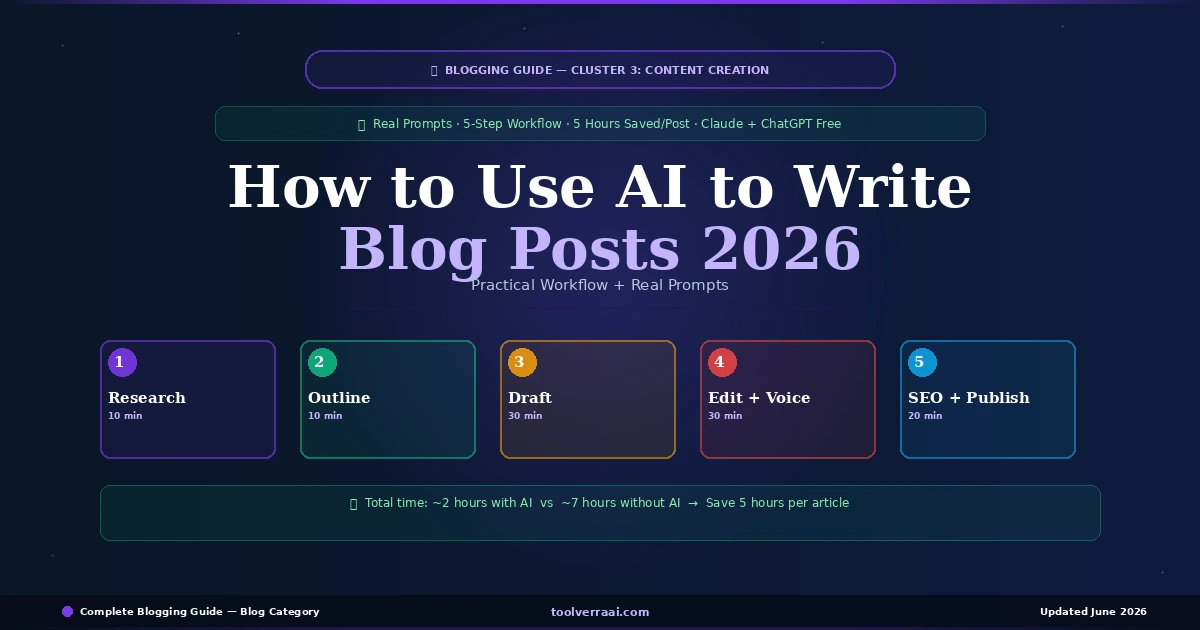
Learning how to use AI to write blog posts in 2026 is not about letting AI write everything and publishing the result. This how to use AI to write blog posts 2026 mistake produces generic, soulless content that sounds like nobody in particular — and Google’s systems are increasingly good at recognizing and filtering it. The practical guide to how to use AI to write blog posts in 2026 — the complete 2026 approach — is about using AI at each stage of your workflow to save time while keeping your expertise and personal voice front and center.
The bloggers winning in 2026 are not choosing between AI and authenticity — they are using both. AI handles research, structure, first drafts, and optimization suggestions. You provide the specific examples, personal stories, real data points, and unique insights that no AI can replicate. This how to use AI to write blog posts 2026 guide gives you the exact workflow, real prompts, and honest assessment of which tools do what best.
How to Use AI to Write Blog Posts 2026 — The #1 Mistake to Avoid
The most common mistake when learning how to use AI to write blog posts in 2026 is treating AI as a ghostwriter. Someone opens Claude or ChatGPT, types “write me a 1,500 word blog post about [topic],” and publishes whatever comes back with minimal editing. The result is technically correct content that sounds like nobody in particular. It is generic, predictable, and increasingly filtered by Google’s Helpful Content system.
🤖 How to Use AI to Write Blog Posts 2026 — Which Tool for Which Task?
🟡 Claude — Best For
- Long-form posts (2,000+ words)
- Retains context across long docs ⭐
- Natural, flowing prose quality
- Complex editing and rewriting
- Brand voice consistency
- Free tier available
🟢 ChatGPT — Best For
- Topic brainstorming (80% of needs)
- Research and fact summaries
- Social media repurposing
- Meta descriptions and titles
- Image generation (DALL-E 3)
- Free tier handles most tasks
🔵 Gemini — Best For
- Google Search integration
- Real-time information queries
- YouTube transcript analysis
- Google Workspace integration
- Free with Google account
- Cross-referencing current data
⚡ How to Use AI to Write Blog Posts 2026 — The 5-Step Workflow
🔄 How to Use AI to Write Blog Posts 2026 — Complete Workflow
When you learn how to use AI to write blog posts 2026 correctly, topic research compresses from 2-3 hours, competitor reading, and keyword checking. With AI, this compresses to 10 minutes. The key is being specific in your prompt — give the AI your niche, your audience, and the format you want.
Give Claude your target keyword, the search intent (informational, commercial, etc.), and the approximate word count. Ask for a detailed H2/H3 outline. Review and edit the outline before starting to write — this is where you add your unique angle, not during the draft. A well-edited outline means the draft almost writes itself.
Do not ask AI to write the entire article in one prompt. Write section by section — one H2 at a time. This gives you more control, produces better output, and makes editing easier. For each section, paste the outline heading and give Claude 2-3 bullet points of what to cover. After each section, read it and add your own specific examples before moving to the next.
This step is where AI-assisted blogging separates from AI-generated blogging. After the draft, read every paragraph aloud. Every sentence that sounds robotic — rewrite it in your own words. Add at least 3-5 specific examples from your own experience or research that the AI could not have included. Verify every statistic and fact the AI mentioned against a primary source. Replace any generic advice with concrete steps your specific reader can take.
Use AI for the technical SEO elements: meta description, title tag variations, and FAQ question generation. These are low-creativity, high-formula tasks that AI handles very well. Then use Rank Math SEO to verify your on-page score reaches 80+ before publishing.
📋 How to Use AI to Write Blog Posts 2026 — Ready-to-Use Prompts
Prompt 1 — Topic Research
Prompt 2 — Outline Generation
Prompt 3 — Section Writing
Prompt 4 — Voice Check & Rewrite
Prompt 5 — Meta Description
🎤 How to Use AI to Write Blog Posts 2026 — Keep Your Voice
✅ Do This
- Add your personal experience in every article
- Include specific real numbers and examples
- Rewrite any sentence that sounds robotic
- Use AI for structure, not for your opinion
- Give AI detailed prompts with your tone guidance
- Read every paragraph aloud before publishing
- Add section transitions in your own words
❌ Don’t Do This
- Publish raw AI output without editing
- Use “Furthermore”, “Delve”, “It’s worth noting”
- Let AI provide statistics you have not verified
- Ask AI to write 2,000 words in one prompt
- Replace all your opinions with AI opinions
- Skip the read-aloud test before publishing
- Ignore AI’s factual errors on recent events
🔍 How to Use AI to Write Blog Posts 2026 — Does Google Penalize It?
No — Google does not penalize AI-generated content in 2026. Google’s guidelines evaluate content quality and helpfulness, not the tool used to create it. A well-edited, AI-assisted post that accurately answers a user’s question thoroughly can rank equally with a fully human-written one. What Google penalizes is low-quality content — regardless of whether it was written by a human or an AI.
| Content Type | Google’s Response | Result |
|---|---|---|
| AI-written + human edited + accurate | Helpful content signal | Can rank normally |
| AI-written + minimal editing + helpful | Evaluated on quality | Depends on quality |
| AI-written + no editing + generic | Unhelpful content signal | Filtered or penalized |
| Human-written + thin + unhelpful | Unhelpful content signal | Filtered or penalized |
⏰ How to Use AI to Write Blog Posts 2026 — Time Saved Per Article
| Task | Without AI | With AI | Time Saved |
|---|---|---|---|
| Topic research + ideas | 2-3 hours | 10 minutes | ~2.5 hours |
| Outline creation | 30-45 min | 10 minutes | ~30 minutes |
| First draft (1,500 words) | 3-4 hours | 30-45 min + editing | ~2 hours |
| Meta description + title | 15-20 min | 5 minutes | ~15 minutes |
| FAQ section (4 questions) | 20-30 min | 5 minutes | ~20 minutes |
| Total per article | ~7 hours | ~2 hours | ~5 hours saved |
🎯 How to Use AI to Write Blog Posts 2026 — Key Takeaways
- How to use AI to write blog posts in 2026: AI accelerates process, you provide unique value
- The ghostwriter mistake: publishing raw AI output = generic content that sounds like nobody
- Claude: best for long-form writing (2,000+ words) and brand voice consistency
- ChatGPT free: handles 80% of blogging needs — brainstorming, research, meta descriptions
- 5-step workflow: Research → Outline → Draft (section by section) → Edit → SEO optimize
- Total time per article with AI: ~2 hours vs ~7 hours without — 5 hours saved per post
- Google does NOT penalize AI content — it penalizes low-quality content regardless of source
- Add your voice: personal examples, verified facts, real opinions, read-aloud test
- Never ask AI to write 2,000 words in one prompt — write section by section
- Next: learn how to write a blog post that ranks to combine AI speed with SEO strategy
How to Use AI to Write Blog Posts 2026 — Start Today
Start with Claude free + ChatGPT free · No cost · First article in under 2 hours
Best AI Tools for Bloggers → Blog Post That Ranks →Best AI Tools for Each Step of Blog Writing
| Step | Best Free Tool | Best Paid Tool | Time Saved |
|---|---|---|---|
| Topic Research | Gemini Free | ChatGPT Plus | 1–2 hours |
| Keyword Validation | Ubersuggest Free | SE Ranking $65/mo | 30 minutes |
| Outline Building | Claude Free | Claude Pro $20/mo | 20 minutes |
| Draft Writing | Claude Free | Claude Pro $20/mo | 2–3 hours |
| Editing | Grammarly Free | Grammarly Premium | 30 minutes |
| SEO Optimization | Rank Math Free | NeuronWriter $19/mo | 30 minutes |
| Repurposing | ChatGPT Free | ChatGPT Plus $20/mo | 1–2 hours |
What to Avoid When Using AI to Write Blog Posts
❌ Publishing Without Editing
Publishing without editing is the biggest mistake beginners make when learning how to use AI to write blog posts. AI generates a starting point, not a finished article. Every paragraph needs a human review. Add your experience, check facts, and make it sound like you — not a machine.
❌ Using the Same Generic Prompts Every Time
“Write a blog post about X” gives you generic content. The more detail you give — audience, tone, specific angle, word count, examples to include — the better your result. Save your best prompts and reuse them.
❌ Ignoring SEO After Writing
A perfectly written article with no SEO optimization is unlikely to rank. Take 15 minutes after writing to optimize with Rank Math. Check keyword placement, meta description, internal links, and image alt text. Those 15 minutes can make the difference between page 1 and page 5.
❌ Skipping the Fact-Check
AI is confident, even when it is wrong. Before publishing any statistic, date, or specific claim from AI output, verify it from the original source. One wrong fact published on your blog hurts your credibility far more than not writing that article at all.
Ready to Try This Workflow?
Start with Claude Free (best writing quality) or ChatGPT Free (most versatile). Use the prompts in this guide on your next article and see the difference.
Try Claude Free → All AI Writing Tools →How to Use AI to Write Blog Posts 2026 — FAQ
More how to use AI to write blog posts 2026 resources: Previous: How to Write a Blog Post That Ranks · Related: Best AI Tools for Bloggers · Claude AI Review