
- The 2026 Traffic Reality — 59% of Sites Declined
- Your Traffic Mix — Why Diversification Matters
- Channel 1: Organic Search (SEO)
- Channel 2: Email Marketing
- Channel 3: Pinterest
- Channel 4: Reddit & Quora
- Channel 5: Google Discover
- Channel 6: AI Search (New 2026)
- Channel 7: YouTube & Video
- Channel 8: Content Repurposing
- Channel Comparison Table
- FAQ
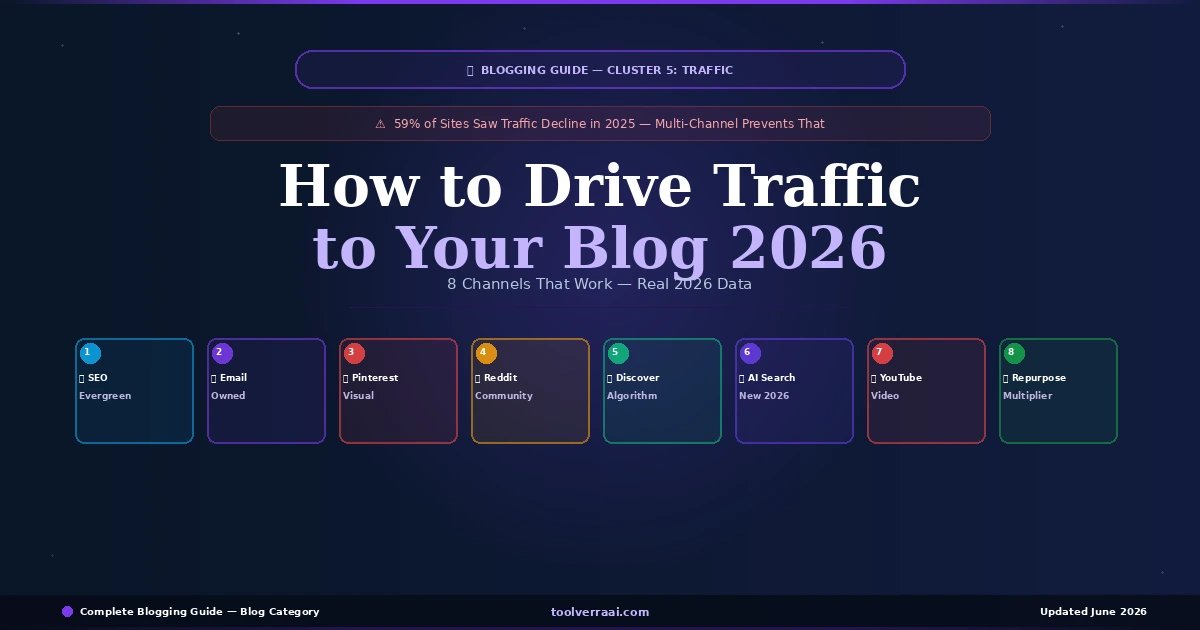
Learning how to drive traffic to your blog in 2026 means building across multiple channels — not betting everything on one source. Contentsquare’s 2026 report found that 59% of websites saw traffic decline in the previous year, primarily because they relied too heavily on a single traffic channel (usually Google search) that then shifted against them. This guide on how to drive traffic to your blog 2026 covers 8 channels that work right now, what each one requires, and how to build a resilient traffic strategy that survives algorithm changes.
The honest reality about how to drive traffic to your blog in 2026: there is no single secret. Sustainable blog traffic is built by consistently publishing quality content optimized for search, growing an owned audience (email list), and distributing that content strategically across the channels where your readers already spend time. Each channel compounds — the more you invest across all 8, the more traffic each individual channel generates over time.
📊 How to Drive Traffic to Your Blog 2026 — The Reality First
Before covering each traffic channel, the most important insight for 2026: over 7.5 million blog posts are published every single day, and the vast majority receive fewer than 10 visitors in their entire lifetime. The blogs that consistently drive traffic in 2026 are not doing something magical — they are doing the fundamentals consistently across multiple channels while their competitors give up after 3 months.
🎯 How to Drive Traffic to Your Blog 2026 — Build Your Traffic Mix
🔍 Organic Search
Long-term. Compounds. Takes 3-6 months. Highest value per visitor.
📧 Email List
Owned audience. No algorithm. Highest conversion. Build from day 1.
🤖 AI Search
New 2026 channel. AI Overviews + Perplexity. Different optimization needed.
Organic search is still the highest-value traffic channel for bloggers in 2026. A well-ranked article drives compounding traffic 24/7 without ongoing effort. The investment is front-loaded (keyword research, quality writing, on-page SEO) and pays returns for months or years. See our full guides on keyword research and on-page SEO for the complete process.
How to Drive Traffic to Your Blog 2026 — SEO Quick Reference
| SEO Action | Impact | Timeline |
|---|---|---|
| Target long-tail keywords | High for new blogs | 4-8 weeks |
| On-page optimization (Rank Math 85+) | High immediate signal | Immediate |
| Publish 2-3x per week | Builds topical authority | 3-6 months |
| Build internal links | Passes authority to new posts | Ongoing |
| Update old content | Ranking boost for stagnant pages | 2-4 weeks |
Email is the only traffic channel you fully own. No algorithm changes can eliminate it. Klaviyo’s 2026 data shows email campaigns average a 1.69% click rate — meaning a list of 10,000 subscribers generates approximately 169 visitors per email send. The top-performing 10% of email campaigns achieve a 3.38% click rate — 338 visitors per send from 10,000 subscribers. Grow your email list from day one. Every month you delay costs you permanently.
How to Drive Traffic to Your Blog 2026 via Email — Key Rules
Offer a lead magnet: Give new subscribers something immediately valuable — a checklist, template, short guide, or email course — in exchange for their email address. A lead magnet that directly solves one specific problem converts 3-5x better than a generic “subscribe for updates” offer.
Send consistently: Weekly or bi-weekly newsletters featuring your newest articles drive repeat visits. Readers who return regularly are your most valuable audience segment — they share content, leave comments, and eventually buy products or click affiliate links.
Segment as you grow: Once past 1,000 subscribers, segment by interest (readers who clicked SEO articles vs. monetization articles) and send targeted content. Segmented emails consistently outperform generic broadcasts on click rate.
Pinterest with 518 million monthly active users operates as a visual search engine, not a social media platform. Pins drive traffic for months or years after posting — unlike Facebook posts that disappear within 24 hours. Pinterest is particularly powerful for bloggers in lifestyle, food, DIY, personal finance, travel, and blogging niches. Images drive 80%+ of Pinterest activity, so well-designed vertical pin graphics are essential.
How to Drive Traffic to Your Blog 2026 via Pinterest
Create 2-3 pins per blog post: Each pin should have a clear headline, your blog URL visible, and a compelling image. Use Canva to design vertical (1000×1500 px) pin graphics. Create different designs for the same article to test which performs best.
Optimize pin descriptions: Pinterest is a search engine. Include your target keyword in the pin description naturally. Add 3-5 relevant hashtags. Link every pin directly to the specific blog post, not your homepage.
Publish consistently: 5-10 fresh pins per day is the recommended frequency for growing a Pinterest presence. Use a scheduling tool like Tailwind to batch-schedule weekly.
Reddit with 97 million daily active users and Quora as a major question-answer platform are high-traffic sources where millions of people ask exactly the questions your blog answers. The key distinction: these platforms punish self-promotion and reward genuine value. Never drop a link without providing a complete, useful answer first.
How to Drive Traffic to Your Blog 2026 via Reddit
Find your subreddits: Search Reddit for your niche topics. r/blogging, r/SEO, r/personalfinance, r/WordPress — identify the 3-5 subreddits where your target readers spend time. Read the rules for each before posting — every subreddit has different self-promotion policies.
Answer first, link second: Write a complete, genuinely useful response to a question. If your blog has an article that goes deeper, add: “I wrote a more detailed guide here if you want to go further” with the link. Never post only a link — it gets downvoted and removed.
Build karma before linking: Spend 2-3 weeks commenting helpfully in your target subreddits before you share any blog links. Community members are highly sensitive to new accounts that immediately start dropping links.
Google Discover is an algorithmically curated content feed that surfaces articles to users before they even search. It appears on Android homescreens and the Google app. A single article appearing in Google Discover can generate thousands of visitors in days — but you cannot directly control whether Google features your content there. You can optimize for it.
How to Drive Traffic to Your Blog 2026 via Google Discover
High-quality featured images: Articles need a large, high-quality image (minimum 1200px wide) to appear in Discover. This is why the featured image for every article in our guides is exactly 1200×630 pixels — it meets Discover’s image requirements.
Engaging titles: Discover favors articles with titles that clearly communicate value or curiosity without being clickbait. “7 Free Strategies That Actually Work” outperforms “Tips for Bloggers.”
Monitor via Google Search Console: The Search Console Performance report has a “Discover” tab once you start receiving Discover traffic. Monitor which article types get featured and publish more of them.
AI-powered search — Google AI Overviews, Perplexity, Bing Copilot, and ChatGPT’s web search — represents a new traffic channel that did not meaningfully exist before 2025. When AI systems cite your blog as a source in their answers, you receive referral traffic and brand visibility even when users do not click through to Google’s traditional results. Optimizing for AI citation is the newest skill in driving traffic to your blog in 2026.
How to Drive Traffic to Your Blog 2026 via AI Search
Write clear, factual, citable content: AI systems prefer articles with direct answers to specific questions, clear statistics, step-by-step processes, and well-structured sections. The same on-page SEO practices that help Google rank your content also make it more likely to be cited by AI.
Include original data and unique angles: AI systems cite sources that add unique value. Generic “5 tips” articles are rarely cited. Original data, honest opinions, and specific examples get cited.
Schema markup matters more than ever: Proper Article and FAQPage schema helps AI systems parse and cite your content accurately. Rank Math adds this automatically.
YouTube is the world’s second largest search engine. Creating videos based on your blog’s top articles adds a powerful companion traffic channel. You do not need high production quality — a clear screen recording with narration converts blog readers to YouTube subscribers and YouTube viewers to blog readers. Each YouTube video description should link directly to the related blog article.
How to Drive Traffic to Your Blog 2026 via YouTube — Starting Simple
Repurpose your best articles: Take your top 5 blog posts and record a 5-10 minute video walkthrough of each one. Use your existing written content as the script. Upload to YouTube with the blog post link in the description and as a pinned comment.
Optimize video titles and descriptions: Apply the same keyword research process you use for blog posts to YouTube video titles. YouTube search works similarly to Google — target specific questions people are searching for.
Content repurposing is the highest-leverage traffic amplifier in this guide. One well-researched blog post contains enough material to create 6+ pieces of content across different platforms — multiplying your traffic from a single piece of research and writing effort.
🔄 How to Drive Traffic to Your Blog 2026 — The 1-to-6 Repurposing System
📊 How to Drive Traffic to Your Blog 2026 — Channel Comparison
| Channel | Time to Traffic | Traffic Type | Effort Level | Best For |
|---|---|---|---|---|
| 🔍 Organic SEO | 3-6 months | Evergreen ⭐ | High setup | All bloggers |
| Immediate (once built) | Owned ⭐ | Medium | All bloggers | |
| 1-3 months | Evergreen | Medium | Visual niches | |
| 🗣️ Reddit/Quora | Days | Referral | Low-Medium | Q&A niches |
| 🔮 Google Discover | Unpredictable | Spike-based | Low (optimize) | All bloggers |
| 🤖 AI Search | 2-6 months | Citation/referral | Medium | All bloggers 2026 |
| 🎬 YouTube | 3-6 months | Evergreen | High | Video-comfortable |
| 🔄 Repurposing | Immediate multiplier | Multiple ⭐ | Low (reuse) | All bloggers ⭐ |
🎯 Key Takeaways — How to Drive Traffic to Your Blog 2026
- How to drive traffic to your blog 2026: build across 8 channels — no single channel should exceed 40% of total traffic
- 59% of sites saw traffic decline in 2025 — most from over-reliance on one channel
- Organic SEO: highest long-term value, 3-6 months to results, compounds permanently
- Email list: only owned audience channel — 10K subscribers = ~169 visitors per send (1.69% avg CTR)
- Pinterest: 518M MAU, search-based, evergreen pins — perfect for visual niches
- Reddit/Quora: answer first, link second — genuine value drives traffic, spam gets banned
- Google Discover: 1200×630 px featured images required — monitor in Search Console
- AI Search (new 2026): write factual, citable, structured content with schema markup
- Content repurposing: 1 blog post → 6 pieces across channels — maximum ROI per hour
- Start with SEO + email + Pinterest — the strongest combination for most new bloggers
Traffic Strategy Ready ✅ — Now Build Your Email List
8 channels mapped · Next: build the email list that owns your audience
Build Backlinks Guide → Best Hosting for Bloggers →How to Drive Traffic to Your Blog 2026 — FAQ
Previous: How to Build Backlinks · Related: On-Page SEO for Bloggers · Keyword Research Guide