
- Why Perplexity Tracking Is Completely Different From Google Tracking
- How Perplexity’s RAG Pipeline Selects Citations (4-Step Architecture)
- 5 Metrics Every Perplexity SEO Tracking Tool Must Measure
- 10 Best Perplexity SEO Tracking Tools in 2026 — Full Reviews
- Full Comparison Table
- Free Manual Perplexity Tracking (No Tool Required)
- Manual vs Paid Tool — Decision Matrix
- Technical Foundation: PerplexityBot Access + Brave Index
- The 60-Day Freshness Loop Strategy
- Why Your Google #1 Doesn’t Guarantee Perplexity Citations
- 7 Perplexity Tracking Mistakes That Waste Your Budget
- Complete Setup Checklist
- FAQ
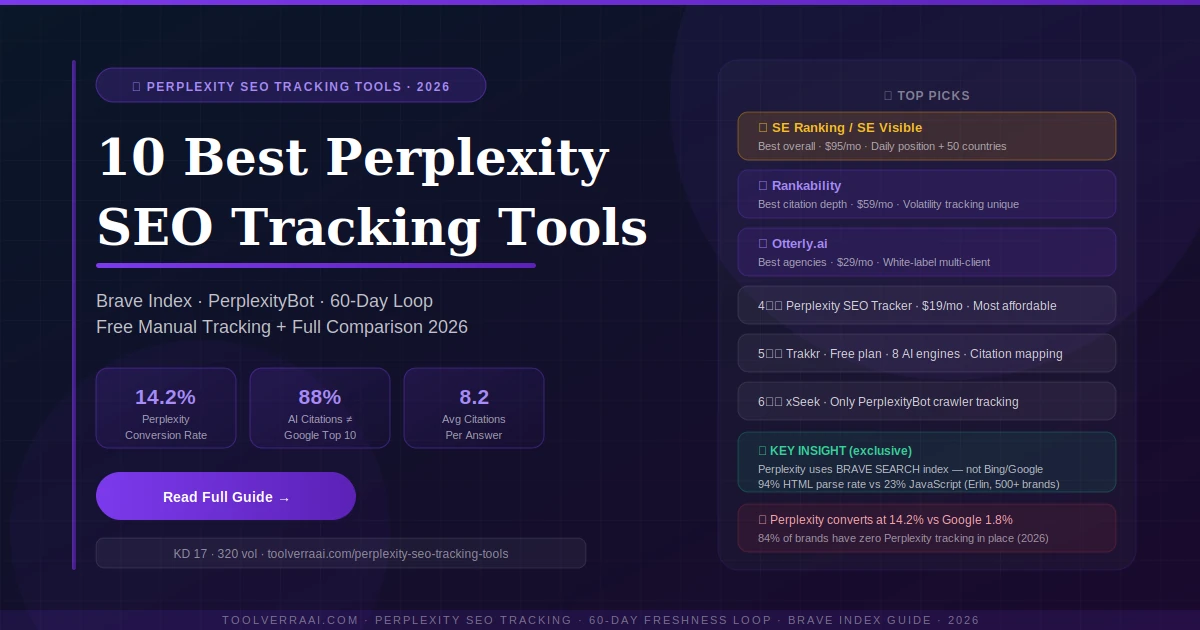
The best perplexity seo tracking tools exist because of a simple problem. When someone asks Perplexity AI “what are the best project management tools for remote teams?” — they don’t see ten blue links. They see a synthesized answer with 6-8 numbered citations, and the brands behind those citations get visibility, trust, and traffic that converts at 14.2% — nearly 8 times Google’s 1.8% organic average (Harbor, 2026). Traditional rank trackers see none of this.
Perplexity’s query volume has grown 239% annually and now processes over 1.2 billion monthly searches (theStacc, March 2026). Its user base is unlike any other search platform: 80% are university graduates, 30% are senior company leaders, and 65% are high-income professionals (WARC, 2025). These are not casual searchers — they are precisely the decision-makers every B2B brand is trying to reach, and they are increasingly bypassing Google entirely.
The problem with not using perplexity seo tracking tools: your Google Search Console shows nothing about Perplexity citations. Your rank tracker doesn’t know which pages Perplexity cites. And 84% of brands have no measurement in place at all. This guide covers the 10 best Perplexity SEO tracking tools in 2026, explains why Perplexity works completely differently from Google (including the Brave Search architecture no other guide covers), and gives you a complete setup — including a free no-tool approach — to start measuring and improving your Perplexity visibility immediately.
📊 Why Perplexity SEO Tracking Tools Measure Something Completely Different From Google
Google rank tracking and perplexity seo tracking tools measure fundamentally different things, and understanding this distinction determines whether you buy the right tool or waste money on the wrong one.
A Google rank tracker watches your URL move between positions 1 and 100 on a results page of ten blue links. A Perplexity SEO tracking tool does something entirely different: it sends real prompts to Perplexity, parses the AI-generated answer, and records whether your domain appears in the numbered citation list, what position that citation holds (citation #1 carries dramatically more weight than citation #6), and whether your brand is mentioned favorably, neutrally, or negatively in the prose itself.
The measurement model has changed completely. The data point you care about is no longer “you rank #3 for [keyword].” It looks like this: “Perplexity cites your domain in 38% of category prompts, lands you at citation position #1 or #2 on 60% of those appearances, and names you favorably in the prose 22% of the time.” These three trackable metrics — citation frequency, citation position, and sentiment — define Perplexity SEO performance, and none of them appear in any traditional SEO tool.
⚙️ How Perplexity’s RAG Pipeline Works — What Every Perplexity SEO Tracking Tool Measures
Understanding how Perplexity chooses sources is the foundation of knowing what your perplexity seo tracking tools are actually measuring — and what you need to optimize to improve those measurements.
Perplexity operates on a Retrieval-Augmented Generation (RAG) pipeline. Critically, and this is what almost no competitor guide mentions: Perplexity’s primary web index is powered by Brave Search, not Bing or Google. Anyone optimizing for Perplexity is, in large part, optimizing for Brave indexation — which has structurally less competitive density than Google and rewards clean entity and passage work disproportionately.
Three critical implications for Perplexity SEO tracking:
Dark queries matter. When Perplexity processes your prompt, it internally generates multiple sub-queries before retrieving content. These sub-queries have zero Google search volume — no traditional keyword tool surfaces them. Only one tool currently tracks them: Profound’s Growth tier, which calls them “dark query data.” Every other Perplexity SEO tracker is measuring what enters the pipeline, not what drives retrieval internally.
PerplexityBot access is a prerequisite, not an afterthought. If PerplexityBot cannot crawl your pages, Perplexity cannot cite them. Step 2 of the pipeline relies on the PerplexityBot-crawled index alongside the Brave Search index. A SeoProfy client who had PerplexityBot blocked at the firewall layer gained 12 new Perplexity citations within 30 days of removing the restriction — with no other content changes.
Freshness is Perplexity’s most aggressive ranking signal. In controlled testing, a content update increased citation frequency by 37% within 48 hours (growthmarshal.io, 2025). Content stamped “updated two hours ago” was cited 38% more often than identical content with last month’s dateline (Kurt Fischman, 2025). Brands updating content monthly see approximately 23% higher AI coverage than brands with stale content (Erlin, 500+ brands, 2026).
📐 5 Key Metrics Every Perplexity SEO Tracking Tool Must Capture in 2026
| Metric | What It Measures | Why Position Matters | Tools That Track It |
|---|---|---|---|
| Citation Frequency | % of target prompts where your domain appears in citations | Baseline — the minimum to know | All tools on this list |
| Citation Position | Whether you’re source #1, #3, or #6 in the numbered list | Critical — #1 citation gets ~40% of clicks | Rankability, SE Ranking, Searchable, Perplexity SEO Tracker |
| Citation Volatility | How stable your citations are day-to-day | Identifies which citations need content refresh | Rankability (unique feature) |
| Source-Level Attribution | Which specific URL Perplexity cited (not just domain) | Shows which content formats earn citations | Rankability, SE Ranking, xSeek |
| Competitor Citation Share | Which competitors appear for the same prompts you target | Identifies the gap to close and whose content to benchmark | Most paid tools |
🛠️ 10 Best Perplexity SEO Tracking Tools in 2026 — Reviewed & Ranked
SE Ranking has built one of the most Perplexity-committed perplexity seo tracking tools in the category. Its dedicated Perplexity Visibility Tracker, part of the SE Visible suite, monitors both brand mentions and URL citations simultaneously with a daily refresh frequency. The platform extracts the full answer text from Perplexity responses and assigns average position scoring — you know not just whether you appeared but where. The “No cited” feature is genuinely useful: it flags every prompt where competitors are cited but your brand is not, transforming a visibility gap into a specific content action.
SE Ranking runs the Perplexity tracker across 50+ countries, distinguishes linked citations from text mentions (a detail that matters enormously for traffic attribution), and covers six AI engines: Perplexity, ChatGPT, Gemini, Claude, AI Overviews, and Copilot. Teams already using SE Ranking for traditional SEO tracking get Perplexity visibility without adding a second vendor or learning a new platform.
✅ Pros
- Daily refresh with average position scoring
- “No cited” gap feature — turns gap into action
- 50+ country tracking
- Distinguishes linked vs unlinked citations
- Traditional SEO + AI tracking in one platform
- Perplexity tracking included in Pro plan — no add-on
❌ Cons
- Most expensive option on this list ($95-$495/mo)
- Overkill if you only need Perplexity tracking
- Copilot tracking requires separate add-on
ToolVerraAI verdict: SE Ranking is our top pick among perplexity seo tracking tools in 2026. The Perplexity-specific features (position scoring, gap flagging, linked vs unlinked distinction) are the most operationally complete we evaluated. Start with the 14-day free trial before committing to a plan.
Rankability answers a question most Perplexity SEO tracking tools ignore: not just “are you cited?” but “which specific page was cited, for which specific query, and is that citation stable or fluctuating?” This source-level, volatility-aware tracking connects content work directly to Perplexity performance — if you published a new guide last week and it is now being cited by Perplexity for three target queries, Rankability shows you that. That feedback loop, unavailable in most platforms, is what separates Rankability from simpler mention counters.
Beyond Perplexity, Rankability tracks ChatGPT, Gemini, Google AI Overviews, and traditional Google and Bing search — making it a hybrid AI + SEO analytics tool. Notably, they rank first on Google for several competitive keywords in this space, demonstrating that they practice what they sell.
✅ Pros
- Deepest citation data: page-level, query-level, and stability tracking
- Citation volatility metric — unique in category
- Links content work directly to citation outcomes
- Multi-engine: Perplexity + ChatGPT + Google AI
- White-label reporting for agencies
❌ Cons
- No mention tracking — if Perplexity names you without citing, you miss it
- No crawler-level tracking (see xSeek for that)
- Steeper learning curve than simpler dashboards
ToolVerraAI verdict: If understanding WHY Perplexity cites specific pages — and whether those citations are stable — is your priority, Rankability is the strongest choice. The volatility tracking alone justifies the subscription for teams running systematic GEO programs.
Otterly.ai is designed specifically for agencies managing multiple client brands across AI platforms. It tracks citations, brand mentions, and prompt-level ranking across Perplexity, ChatGPT, Gemini, and AI Overviews with white-label client reporting built in from day one. At $29/month for the Lite plan, it is the most accessible paid option on this list — and one of the two cheapest (tied with Keyword.com). The multi-engine view is particularly useful for diagnosing platform-specific problems: if your brand is visible in ChatGPT but absent in Perplexity, Otterly surfaces that pattern quickly, pointing to a Perplexity-specific content or crawl issue.
✅ Pros
- Starts at $29/month — most accessible paid option
- White-label reports built in from day one
- Multi-client management for agencies
- Multi-engine: Perplexity, ChatGPT, Gemini, AI Overviews
- Cross-engine comparison surfaces platform-specific gaps
❌ Cons
- Better for monitoring than deep analysis
- No content optimization workflow
- 100 monitored prompts at $189/mo Standard — limited for large agencies
ToolVerraAI verdict: For agencies entering Perplexity SEO tracking for the first time, Otterly’s $29 entry point is the lowest-risk way to get started with proper monitoring. Upgrade to higher tiers as client scale demands it.
Perplexity SEO Tracker (perplexityseotracker.com) is a dedicated, credit-based platform with a citation-first dashboard, starting at $19/month. Unlike subscription tools that lock you into a prompt volume tier, it operates on a credit wallet — top up a balance, pay only for what you use, carry unused credits forward. The platform focuses exclusively on Perplexity (no multi-engine), which keeps the interface clean and the data directly actionable. Unlimited competitor tracking at this price point is unusual and valuable: you can benchmark against as many rival brands as relevant without hitting extra fees.
✅ Pros
- $19/month — cheapest dedicated Perplexity tracker
- Credit-based pay-as-you-go flexibility
- Unlimited competitor tracking
- Clean citation-first dashboard
- Citation position tracking included
❌ Cons
- Perplexity-only — no multi-engine coverage
- Less depth than SE Ranking or Rankability
- Limited reporting for client-facing agencies
ToolVerraAI verdict: The best entry point for any small business or solo operator who wants proper Perplexity citation tracking. The credit-based model is ideal for teams that check in weekly rather than daily.
Trakkr covers eight AI models — ChatGPT, Claude, Gemini, Perplexity, Grok, Meta AI, DeepSeek, and AI Overviews — with daily visibility tracking and a free plan that makes it the best starting point for teams not yet ready to invest in paid Perplexity SEO tracking tools. The citation source intelligence is particularly useful: it maps which external domains Perplexity references when answering queries in your category, broken down by source type (reviews, news, social). The “Improve” workflow synthesizes data weekly into prioritized actions with projected impact scores.
✅ Pros
- Free plan available — start with zero cost
- 8 AI engines including niche ones (Grok, Meta AI)
- Citation domain mapping by source type (reviews/news/social)
- Weekly prioritized action recommendations
- 7, 14, and 30-day trend windows
❌ Cons
- Free plan has significant prompt volume limits
- Less citation depth than Rankability or SE Ranking
- Limited white-label for agency reporting
xSeek occupies a unique position among Perplexity SEO tracking tools: it is the only platform that shows you when PerplexityBot actually visits and indexes your pages. Most tools track what appears in Perplexity’s answers. xSeek tracks the layer below that — “can Perplexity even find my content?” — and shows both sides: PerplexityBot crawl activity and citation performance. The analogy is exact: it’s like optimizing for Google while blocking Googlebot. This crawler visibility is critical for diagnosing why content that should be cited isn’t appearing — almost always a crawl access or indexation issue, not a content quality issue.
✅ Pros
- Unique: shows PerplexityBot crawl visits in real time
- Diagnoses crawl-level issues before content optimization
- Citation tracking alongside crawler data
- Essential for sites with technical complexity
❌ Cons
- Perplexity-only — no multi-engine coverage
- Niche tool — most teams won’t need crawler tracking
- Less brand visibility tracking than generalist tools
ToolVerraAI verdict: If your pages should be cited but aren’t — and you’ve eliminated content quality as the cause — xSeek is the diagnostic tool that reveals whether PerplexityBot is even reaching your content.
Keyword.com extends traditional SEO analytics into AI search with sentiment analysis that most Perplexity trackers lack. Beyond Perplexity, it tracks ChatGPT, Gemini, Google AI Mode, Mistral Large, and DeepSeek alongside traditional SEO — the widest AI engine coverage on this list. The sentiment scoring tells you not just whether Perplexity mentions your brand, but whether that mention is positive, neutral, or negative — the foundation of understanding whether you’re earning Level 3 “recommended” status.
✅ Pros
- Sentiment analysis — unique capability at this tier
- Widest AI engine coverage including Mistral + DeepSeek
- Traditional SEO + AI in one platform
- Competitive ranking insights
❌ Cons
- Less Perplexity-specific depth than SE Ranking
- Sentiment accuracy can vary by query type
AIclicks.io takes a different strategic angle from every other Perplexity SEO tracking tool on this list: instead of showing where you currently appear, it focuses on identifying which third-party pages Perplexity already trusts in your category, then hands you a plan to get featured on those pages. The logic is sound: Perplexity’s citations heavily favor content from sources it already considers authoritative. Getting mentioned on those sources — through digital PR, guest contributions, and review placements — is often faster than waiting for your own content to earn citation authority organically.
✅ Pros
- Identifies which off-site sources Perplexity trusts
- Auto-suggests prompts based on content and industry
- Covers ChatGPT, Perplexity, Gemini, Claude, and 5 more
- CSV import for custom prompt lists
❌ Cons
- Strategy-focused — less raw tracking data than SE Ranking
- Requires active outreach follow-through to benefit
WorkDuo uses real-time browser-based tracking for Perplexity visibility — querying Perplexity through actual browser sessions rather than API calls, which produces more accurate results for platforms where API responses differ from real user experience. It tracks how Perplexity, Gemini, ChatGPT, Copilot, Claude, and other AI engines display brand data, with competitive benchmarking, sentiment scoring, and visibility change monitoring. The structured data insights reveal how AI engines interpret your content’s schema markup — a useful addition for technical teams implementing structured data for GEO.
✅ Pros
- Real-time browser tracking for higher accuracy
- Competitive benchmarking with share of voice
- Structured data insight — schema interpretation by AI
- Sentiment scoring across platforms
❌ Cons
- Agency features limited on lower tiers
- Less established than SE Ranking in Perplexity tracking specifically
Peec AI was built from the ground up for AI search visibility, not retrofitted from a traditional SEO tool. Its most distinctive capability: distinguishing between explicit brand mentions (Perplexity names your brand in the prose) and silent source citations (Perplexity synthesizes content from your URL without naming your brand in the text). That second category is a significant source of invisible traffic — Perplexity pulls your content but doesn’t surface your name, generating referral clicks without brand attribution. Peec AI is one of the few tools that makes this distinction trackable.
✅ Pros
- Distinguishes explicit mentions vs silent source citations
- Built natively for AI search — not a retrofit
- Daily competitive intelligence across AI platforms
- Shares structure-of-voice across AI + traditional search
❌ Cons
- Starter plan restricts to 3 AI models — confirm Perplexity is included
- Growth plan ($399/mo) required for full Perplexity coverage
📊 Full Comparison Table: Best Perplexity SEO Tracking Tools 2026
| Tool | Price From | Citation Position | Volatility | Crawler Track | Free Plan | Multi-Engine | White-Label |
|---|---|---|---|---|---|---|---|
| SE Ranking | $95/mo | ✅ Daily | Partial | ❌ | 14-day trial | ✅ 6 engines | ✅ |
| Rankability | $59/mo | ✅ + Stability | ✅ Unique | ❌ | ❌ | ✅ 4 engines | ✅ |
| Otterly.ai | $29/mo | Partial | ❌ | ❌ | ❌ | ✅ 4 engines | ✅ |
| Perplexity SEO Tracker | $19/mo | ✅ | ❌ | ❌ | ❌ | Perplexity only | ❌ |
| Trakkr | Free | Partial | ❌ | ❌ | ✅ Free | ✅ 8 engines | Partial |
| xSeek | Contact | ✅ | ❌ | ✅ Unique | ❌ | Perplexity only | ❌ |
| Keyword.com | ~$29/mo | ✅ | ❌ | ❌ | ❌ | ✅ 7+ engines | Partial |
| AIclicks.io | Contact | Partial | ❌ | ❌ | ❌ | ✅ 8 engines | ❌ |
| WorkDuo | Contact | ✅ | ❌ | ❌ | ❌ | ✅ 6 engines | Limited |
| Peec AI | $99-399/mo | ✅ | ❌ | ❌ | ❌ | ✅ 10+ engines | ❌ |
🆓 Free Manual Perplexity SEO Tracking (Before Buying Any Perplexity SEO Tracking Tool)
Before spending money on any perplexity seo tracking tools, understand what you can measure for free — and whether your current scale justifies paid tooling at all. Many teams with under 20 target prompts can run an effective Perplexity tracking program manually with zero additional software cost.
Free Manual Tracking Setup — 5 Steps
- Build your prompt library. Identify 15-25 queries that represent how your target audience researches your category in Perplexity. Format them as natural questions: “what are the best [your category] tools for [use case]?”, “which [your service] companies do agencies use?”, “compare [your product] vs [competitor].” These become your weekly tracking prompts.
- Run weekly prompt audits. Open Perplexity.ai in an incognito browser window. Run each prompt and record: (1) Is your brand cited? (2) What citation position? (3) Which specific URL was used? (4) Are competitors cited instead? Store in a spreadsheet with weekly columns — the trend line matters more than any single data point.
- Set up GA4 Perplexity channel grouping. In Google Analytics 4, go to Admin → Data Settings → Channel Groups and create a custom channel for Perplexity referral traffic. Filter for source/medium containing “perplexity.” This shows you how much traffic Perplexity is already sending — and whether that traffic converts differently from Google organic.
- Check server logs for PerplexityBot activity. Filter your server logs for the PerplexityBot user-agent string:
Mozilla/5.0 (compatible; PerplexityBot/1.0). Increasing crawl frequency is a leading indicator — if PerplexityBot visits your pages more often, your content is entering Perplexity’s retrieval pipeline. Zero PerplexityBot visits despite allowing access in robots.txt means a CDN or firewall is blocking it at a lower layer. - Monitor Google Search Console for indirect signals. While GSC doesn’t show Perplexity-specific data, an increase in impressions for informational queries often correlates with improved AI search visibility. Use it as a sanity check alongside your manual prompt audit.
⚖️ Manual vs Paid Perplexity SEO Tracking Tools — Decision Matrix
🟡 Use Manual Tracking If…
- You have fewer than 25 target prompts
- You are just starting to explore Perplexity SEO
- You run one brand with limited competition
- Budget is under $100/month for all tools
- You check quarterly, not weekly
- You are pre-revenue or very early stage
🟣 Upgrade to Paid Tool When…
- You have 25+ prompts to track consistently
- You compete against 3+ brands for citations
- You need daily data, not weekly snapshots
- You report AI visibility to clients or stakeholders
- You want citation position data, not just presence
- Perplexity referral traffic is measurable in GA4
⚙️ Technical Foundation: PerplexityBot Access + Brave Search
No perplexity seo tracking tools can improve your citations if the technical foundation is broken. Before evaluating any platform’s tracking data, verify these three technical prerequisites.
1. PerplexityBot robots.txt Configuration
Verify your robots.txt explicitly allows PerplexityBot. The most common failure: a User-agent: * Disallow rule from a 2023-era bot-blocking strategy that catches PerplexityBot as collateral damage. The correct configuration:
User-agent: PerplexityBot
Allow: /
# Allow Perplexity user-triggered fetches
User-agent: Perplexity-User
Allow: /
# Allow OAI-SearchBot (ChatGPT Search)
User-agent: OAI-SearchBot
Allow: /
# Allow Claude search crawler
User-agent: Claude-SearchBot
Allow: /
# Sitemap (critical for Brave discovery)
Sitemap: https://yourdomain.com/sitemap.xml
2. Static HTML vs JavaScript — Critical for PerplexityBot
This is the data point no other guide covers: static HTML content has a 94% parse success rate with PerplexityBot, while JavaScript-rendered content has a 23% parse success rate (Erlin, 500+ brands, 2026). If your content is rendered client-side via React, Next.js, or Vue without server-side rendering, PerplexityBot is likely seeing an empty shell — not your content.
3. IndexNow — Speed Up PerplexityBot Discovery via Brave
Since Perplexity’s primary index uses Brave Search, and Brave Search supports IndexNow — pushing your new and updated URLs through IndexNow automatically notifies Brave when content changes. This is one of the fastest ways to get fresh content picked up and served in Perplexity citations. Most modern WordPress installations can add IndexNow support through Rank Math or a dedicated plugin in minutes.
Additionally: Perplexity uses Bing’s signals alongside Brave for some content discovery. A clean, current XML sitemap submitted to Bing Webmaster Tools provides a secondary discovery channel that many sites overlook.
4. TTFB Under 200ms
Achieving a Time to First Byte (TTFB) under 200ms reduces crawl friction for PerplexityBot. Slow pages get lower crawl priority, and pages that require heavy JavaScript rendering time may not be fully readable in the crawl window Perplexity allocates. Check your TTFB via Google Search Console‘s Core Web Vitals report — the same TTFB improvements that help Google also help PerplexityBot.
🔄 The 60-Day Freshness Loop — Strategy Every Perplexity SEO Tracking Tool User Needs
Freshness is the most aggressive ranking signal in Perplexity’s system — and the most underused lever available to brands who have already done the content work. The 60-Day Freshness Loop is a systematic content refresh cycle designed to maintain citation eligibility for competitive evergreen content.
🚫 Why Google #1 Doesn’t Guarantee Perplexity Citations — Every Perplexity SEO Tracking Tool Proves This
This is the assumption that leads most brands to underinvest in dedicated Perplexity SEO tracking tools: “If we rank well on Google, Perplexity will cite us automatically.” The data says otherwise — conclusively.
88% of AI-cited links do NOT rank in Google’s top 10. A 2026 Ahrefs study of 863,000 keywords found only 38% of Google AI Overview citations come from pages ranking in the top 10, down from 76% in July 2025 — a dramatic decline in the overlap between traditional ranking and AI citation (Sam Shev, 2026). For Perplexity specifically, 60% of citations overlap with Google top 10, meaning 40% come from a content layer entirely outside what Google ranks highly.
Domain authority explains less than 4% of the variance in AI citation outcomes. The signals that drive Perplexity citations are fundamentally different from the signals that drive Google rankings: factual density (cited content has 32% more explicit semantic concepts than uncited content — ZipTie research), freshness, structural extractability, and entity clarity. High domain authority with stale, poorly structured content will consistently lose to lower-authority sites with fresh, structured, fact-dense content in Perplexity’s citation algorithm.
The 73% proof: 73% of B2B websites that experienced organic Google traffic loss in 2024-2025 had stable Google rankings — suggesting AI search systems were pulling traffic from content layers Google’s algorithm evaluated differently (Onely, 2026). This is direct evidence that tracking Google rankings tells you nothing about AI search citation performance.
⚠️ 7 Common Perplexity SEO Tracking Tool Mistakes That Waste Your Budget
A tool that reports “you were mentioned 47 times this month” without telling you whether you were citation #1 or citation #6 is giving you half the story. Citation #1 gets approximately 40% of source panel clicks. Being consistently in positions 5-8 generates traffic but suggests your content is being used as supplementary context rather than primary authority — different content optimization implications entirely.
The single most common sequence: invest $200/month in a tracking tool, observe poor citation rates, optimize content for months with minimal improvement, then discover PerplexityBot was blocked by a CDN rule the entire time. Always audit PerplexityBot access — check robots.txt, server logs for PerplexityBot visits, and CDN bot management settings — before spending money on any tracking tool.
Some tools allow you to input any prompt you want for tracking. The temptation is to track brand-name queries (“tell me about [company name]”) because they show high citation rates. But buyers don’t ask about your brand until they already know it. Track category-level queries (“best [your category] tools for [use case]”) — these are the prompts where you’re winning or losing new customers who have never heard of you.
If your site renders content client-side via JavaScript, PerplexityBot may be seeing only the initial HTML shell. Static HTML has a 94% parse success rate; JavaScript-rendered content has 23% (Erlin, 2026). Verify your critical pages serve readable content in their initial HTML — use “View Source” (not Inspect Element, which shows rendered output) to see what PerplexityBot actually receives.
The freshness loop requires content updates every 60 days for competitive topics. If you track 200 prompts mapped to 200 pages, you need a system to update 60-70 pages every two months. Most teams start too broad and end up with stale tracking data because the content maintenance can’t keep pace. Start with 20-30 highest-value prompts, nail the freshness loop for those pages, then expand.
Not every query triggers Perplexity to cite external sources. Some queries are answered from training data alone, with no numbered source panel. Before optimizing for a query, run it in Perplexity and verify the response includes numbered citations. If it doesn’t, that’s not a Perplexity SEO opportunity regardless of how well you optimize for it.
The 82% overlap between Perplexity and Google AI Overview citations (Onely, 2026) means that content optimized for Perplexity citation — direct answers, FAQPage schema, fresh data, clear entity signals — also performs better in Google AI Overviews. Good GEO practice compounds across platforms. Don’t run a separate Perplexity content program; integrate citation-optimized content structure into your standard SEO content workflow.
✅ Complete Perplexity SEO Tracking Tools Setup Checklist
- Audit robots.txt: Confirm PerplexityBot is not blocked. Check for User-agent: * Disallow rules, firewall blocks, and CDN bot management settings.
- Check server logs: Verify PerplexityBot (Mozilla/5.0 compatible; PerplexityBot/1.0) is generating access log entries. Zero visits = blocked at infrastructure level.
- Test HTML parse-ability: View Source (Ctrl+U) on your key pages. If your primary content doesn’t appear in the raw HTML, PerplexityBot sees an empty shell.
- Set TTFB target: Confirm Time to First Byte is under 200ms for pages you want cited. Use Google Search Console Core Web Vitals report.
- Submit sitemap to Bing Webmaster: Perplexity uses Bing signals alongside Brave Search. Ensure your sitemap is submitted and indexed.
- Implement IndexNow: Install an IndexNow-compatible plugin. New and updated content will notify Brave Search for faster pickup.
- Build your prompt library: 20-30 category-level buyer prompts (not brand-name queries). Store in spreadsheet. These are your tracking baseline.
- Run baseline manual audit: Before any tool purchase, manually run your prompts in Perplexity incognito. Record citation presence, position, and competitor names.
- Set up GA4 Perplexity channel: Create custom channel group for source/medium containing “perplexity.” Measure current referral traffic before spending on optimization.
- Implement Article schema: Every page you want Perplexity to cite needs Article schema with datePublished and dateModified — freshness signals AI systems read directly.
- Implement FAQPage schema: On key pages, add FAQPage schema with structured Q&A pairs. Perplexity’s extraction algorithm reads structured Q&A with high reliability.
- Add direct-answer blocks: Under each H2, place a 40-60 word direct answer to the heading’s implied question. This is Perplexity’s primary extraction zone — it reads the first 200 words of each section most heavily.
- Choose and configure a tracking tool: Use the comparison table above to select the right tool for your scale and budget. Set your 20-30 baseline prompts and establish weekly monitoring.
- Schedule 60-day freshness loop: Calendar refresh cycles for competitive pages. Update data points, refresh examples, update dateModified schema, ping IndexNow.
🎯 Key Takeaways — Perplexity SEO Tracking Tools 2026
- Perplexity converts at 14.2% — nearly 8× Google organic’s 1.8% average. 84% of brands have no tracking in place to measure this channel.
- Perplexity’s primary index is Brave Search — not Bing or Google. Optimizing for Perplexity means optimizing for Brave indexation and PerplexityBot crawl access.
- The 4-step RAG pipeline: query interpretation → Brave retrieval → re-ranking → synthesis. “Dark queries” (internal sub-queries with zero Google volume) drive Step 1 — only Profound tracks them.
- Static HTML has 94% PerplexityBot parse success vs 23% for JavaScript-rendered content (Erlin, 500+ brands, 2026). Check your pages with View Source before any optimization.
- Best tools: SE Ranking ($95/mo, best overall), Rankability ($59/mo, best citation depth), Otterly ($29/mo, best for agencies), Perplexity SEO Tracker ($19/mo, most affordable), Trakkr (free plan).
- The 60-Day Freshness Loop: update statistics and examples every 60 days for competitive pages. A content update produces 37% more citations within 48 hours (growthmarshal).
- 88% of AI-cited links don’t rank in Google top 10. Domain authority explains less than 4% of AI citation variance. Your Google rankings tell you almost nothing about Perplexity performance.
- IndexNow integration speeds PerplexityBot discovery via Bing/Brave signals — implement via Rank Math or dedicated plugin in minutes.
- Always audit PerplexityBot access BEFORE buying any tracking tool — a blocked crawler makes every optimization irrelevant.
FAQ — Perplexity SEO Tracking Tools
Related: Best AI Mode SEO Tracking Tools 2026 · AI SEO Tools for Brand Visibility in ChatGPT · All SEO Tools Reviews · Free SEO Audit