
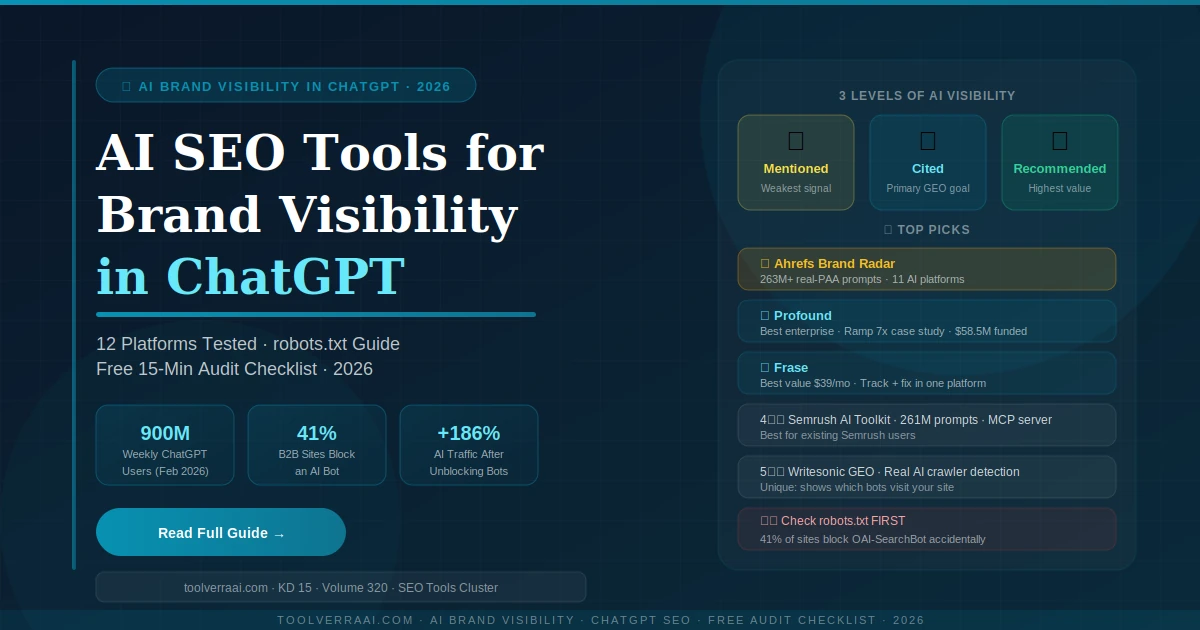
- Mentioned vs Cited vs Recommended — The 3 Levels of AI Visibility
- Why ChatGPT Specifically Matters in 2026
- The 6 Metrics That Actually Matter
- 12 Best AI SEO Tools for ChatGPT Brand Visibility
- Full Feature & Pricing Comparison Table
- Which Tool for Which Situation
- Beyond Tools: The Technical Fixes That Unlock AI Visibility
- Free 15-Minute AI Visibility Audit Checklist
- 5 Myths About AI Brand Visibility
- FAQ
Most brands discover they need AI SEO tools for brand visibility in ChatGPT the wrong way: a competitor’s name comes up in a sales call because a prospect “asked ChatGPT” and got a recommendation that didn’t include them. By that point, the gap has existed for months.
AI SEO tools for brand visibility in ChatGPT close that gap by doing what human monitoring cannot: running hundreds of real prompts across ChatGPT, Perplexity, Gemini, and Google AI Mode every day, tracking which brands get mentioned and cited, and identifying exactly what’s causing the gap. That is the core value proposition of every AI SEO tool for brand visibility in ChatGPT on this list. ChatGPT had approximately 900 million weekly active users by February 2026 (OpenAI via TechCrunch). Gemini AI Overviews reaches an estimated 2 billion people monthly. These platforms are shaping purchasing decisions at a scale no marketing team can manually monitor.
This guide to the best AI SEO tools for brand visibility in ChatGPT is different from most roundups: we also cover what the tools cannot do for you — the technical configuration of your own site that determines whether AI engines can access your content in the first place. No AI SEO tool for brand visibility in ChatGPT will work if your robots.txt is accidentally blocking the crawlers that power ChatGPT search.
📊 Mentioned vs Cited vs Recommended — How AI SEO Tools for Brand Visibility in ChatGPT Measure Success
Before selecting any of the AI SEO tools for brand visibility in ChatGPT, you need to know what you are actually measuring. Most platforms in this category track all three levels, but they report them differently. Understanding the distinction helps you set the right KPIs.
💬 Why ChatGPT Specifically Matters for Brand Visibility in 2026
ChatGPT is not just another search engine — which is why AI SEO tools for brand visibility in ChatGPT require a dedicated approach. It operates as a trust aggregator — it synthesizes what the broader web says about your brand and delivers a confident recommendation to the user. Unlike Google, which shows 10 options and lets the user decide, ChatGPT typically cites 3-5 sources and expresses a preference. Being excluded is therefore more damaging than ranking position 8 on Google.
The commercial stakes for AI SEO tools for brand visibility in ChatGPT are measurable. Ramp — a company that deployed a systematic stack of AI SEO tools for brand visibility in ChatGPT — documented a 7x AI visibility increase after implementing a systematic GEO strategy — becoming the 5th most visible fintech brand globally across AI platforms (Profound case study, 2026). The Aggarwal et al. 2024 GEO research paper (Princeton/Georgia Tech) found that citation-rich content structures produced a 40% lift in generative engine visibility compared to standard SEO content. Traditional rank tracking tells you nothing about whether any of this is happening for your brand.
📐 The 6 Metrics That Matter Most in AI SEO Tools for Brand Visibility in ChatGPT
| Metric | What It Measures | Why It Matters | Tools That Track It Well |
|---|---|---|---|
| Mention Frequency | How often your brand appears in AI answers for target prompts | Baseline visibility — the minimum to track | All tools on this list |
| Citation / Source Tracking | Which exact URLs the AI references when discussing your brand | Critical — reveals what content earns AI trust | Ahrefs Brand Radar, Profound, Frase, Writesonic |
| Share of Voice | Your mention rate vs. competitors for the same prompts | The competitive benchmark — not just your own stats | Semrush AI Toolkit, Profound, SE Ranking, Frase |
| Prompt Gap Analysis | Prompts where competitors are cited but you are absent | Actionable: shows where to create or improve content | Profound, CapstonAI, Gracker AI, AIclicks |
| Sentiment Analysis | Whether AI describes your brand positively, neutrally, or negatively | Level 3 visibility driver — affects recommendations | Profound, Writesonic, Otterly.ai |
| Technical Crawlability | Whether AI search bots can actually access your content | Foundation — nothing else works if bots are blocked | Writesonic GEO, Screaming Frog + AI integration |
🛠️ 12 Best AI SEO Tools for Brand Visibility in ChatGPT in 2026 — Tested & Compared
Ahrefs Brand Radar monitors your brand’s visibility across 263 million monthly prompts — and crucially, these prompts are derived from real “People Also Ask” data, not synthetic queries someone guessed. That distinction matters: you are tracking how AI responds to questions people actually ask, not hypothetical scenarios. It covers ChatGPT, Perplexity, Gemini, Copilot, Google AI Overviews, Google AI Mode, YouTube, TikTok, and Reddit — 11 indices total. The Competitor Gap Analysis identifies AI responses that mention rivals while omitting your brand, with co-mention tracking showing how AI models perceive your topic authority. Brand Radar integrates directly with Ahrefs Web Analytics to categorize AI referral traffic as a distinct channel, connecting visibility metrics to actual clicks from ChatGPT and Perplexity.
As Aleyda Solis (International SEO Consultant, Orainti) describes it: Brand Radar provides “one of the easiest and most comprehensive ways to understand what plays a role in AI answers: from brand and topic inclusions and gap analysis at scale, to easy citation identification for any topic, vertical in any model.”
✅ Pros
- 263M+ monthly prompts — largest real-query database
- Prompts from actual PAA data, not synthetic
- 11 platforms including YouTube, TikTok, Reddit
- Native integration with Ahrefs Web Analytics
- Competitor gap analysis with co-mention tracking
❌ Cons
- Requires an Ahrefs subscription (not standalone)
- No built-in content optimization workflow
- Pricier for teams not already on Ahrefs
ToolVerraAI verdict: If you are choosing between AI SEO tools for brand visibility in ChatGPT and data completeness is the priority, Brand Radar is unmatched in 2026. The PAA-sourced prompt database is a meaningful structural advantage over competitors using synthetic queries.
Profound is the most-funded platform in the AEO category — $58.5M total across Kleiner Perkins, NVIDIA, and Sequoia — and its feature depth reflects that investment. It tracks 10+ AI models including ChatGPT Shopping, DeepSeek, and Grok, runs thousands of daily browser-level queries across all major LLMs, and includes prompt volume data showing how many people ask related questions across AI platforms. Ramp’s documented case study — 7x AI visibility increase leading to #5 most visible fintech brand globally — is the strongest evidence of enterprise-grade results in this category. For teams needing AI search data combined with content production and deep competitive intelligence, Profound is the most comprehensive single platform.
✅ Pros
- 10+ AI engines including ChatGPT Shopping + DeepSeek
- Browser-level query execution for maximum accuracy
- Prompt volume data — shows actual query frequency
- Ramp case study: 7x visibility increase documented
- G2 Winter 2026 AEO Leader status
❌ Cons
- Pricing starts ~$399/month for growth tiers
- Enterprise-focused — overkill for solo users
- Setup complexity for smaller teams
ToolVerraAI verdict: If you are a mid-market or enterprise brand for whom AI search visibility is a board-level priority, Profound is the most complete platform. The Ramp case study alone justifies evaluation.
Frase solves a problem every other tool on this list ignores: knowing you have an AI visibility gap is useless if you then have to open three other tools to fix it. Frase tracks your prompts across ChatGPT, Perplexity, Claude, Gemini, and Google AI with daily updates and same-day alerts, then connects that signal directly to research, writing, optimization, and publishing in the same workspace. The Content Guard feature monitors published pages for Google ranking decay and proposes fixes before they become problems. Frase is also agent-native in 2026 — it ships with an MCP server, a CLI, and agent skills, so it integrates into modern AI-assisted workflows. At $39/month with a 7-day free trial, it is the most accessible serious platform on this list.
✅ Pros
- Tracking + research + writing + publishing in one tool
- $39/month — most affordable serious option
- 7-day free trial, no credit card required
- MCP server + CLI for agent-native workflows
- Daily monitoring with same-day alerts
❌ Cons
- Less breadth on AI platform coverage than Ahrefs/Profound
- No dedicated enterprise compliance features
ToolVerraAI verdict: For most in-house content and SEO teams, Frase is the best AI SEO tool for brand visibility in ChatGPT at this price point. The monitor-then-fix loop in one platform eliminates the tool-switching that kills execution speed.
Semrush AI Visibility Toolkit tracks 261M+ prompts across 32 countries, covering ChatGPT, Google AI Mode, Perplexity, AI Overviews, and Gemini. The key advantage is context: when ChatGPT mentions a competitor more often, the Semrush platform lets you trace the web signals behind that answer — backlink gaps, content structure differences, entity clarity issues — and connects AI visibility data to the traditional SEO picture. Semrush One bundles this with keyword research, backlink intelligence, competitive analysis, and technical audits. The Semrush MCP server allows direct data access inside Claude, ChatGPT, or Cursor. One independent agency reports attributing 40% of new leads to AI visibility improvements tracked through Semrush.
✅ Pros
- 261M+ prompts, 32 countries
- MCP server for Claude/ChatGPT integration
- AI + traditional SEO in one familiar platform
- Trace AI visibility back to underlying web signals
❌ Cons
- Third-party testing flagged accuracy issues on ChatGPT counts (3 reported vs 123 actual in one test)
- Expensive at $199-$549/month for AI features
- No standalone purchase — requires base Semrush plan
ToolVerraAI verdict: If your team is already in Semrush daily, the AI Visibility Toolkit is the most natural addition. For new users evaluating standalone AI visibility tools, start with Frase or Ahrefs instead.
Writesonic GEO is the only platform on this list that combines real AI crawler detection — tracking which GPTBot, Claude, Perplexity, and Gemini crawlers actually visit your website — with prompt-level performance monitoring and integrated content creation. This crawler-detection capability is unique and valuable: it shows whether the AI engines you want to rank in are actually indexing your content, not just whether your brand appears in their answers. It covers ChatGPT, Perplexity, Google AI Overviews, Gemini, Claude, and Microsoft Copilot with brand sentiment analysis, AI visibility scores, and average position compared to competitors.
✅ Pros
- Real AI crawler detection — unique capability
- Combines tracking + content creation in one tool
- Sentiment analysis included
- Covers 6+ major AI platforms including Copilot
❌ Cons
- Content creation quality varies — human editing still required
- Less established brand history than Ahrefs/Semrush
SE Visible is SE Ranking’s purpose-built AI visibility platform: multi-brand management, unlimited seats, multi-country support, and weekly automated reports. It tracks AI Overviews, AI Mode, Perplexity, ChatGPT, and Gemini with an Organic-AI Overlap metric that shows what percentage of your top organic pages also appear in AI responses. For agencies managing 10, 20, or 50 client accounts simultaneously, the operational maturity here — inherited from SE Ranking’s decade of SEO tool development — is a meaningful advantage over newer, single-focus tools.
✅ Pros
- Multi-brand, unlimited seats — built for agencies
- Organic-AI Overlap metric is uniquely useful
- From $129/month — accessible agency pricing
- 10+ years of operational SEO tool reliability
❌ Cons
- AI tracking is an extension of the core tool, not the primary focus
- Less depth per-platform than dedicated tools like Profound
Tools 7–12: The Rest of the Field
| # | Tool | Best For | Price From | Standout Feature |
|---|---|---|---|---|
| 7 | AIclicks | Off-site AI visibility strategy | Contact | Identifies third-party pages AI already trusts — shows where to get mentioned |
| 8 | Gracker AI | Automated GEO content production | Contact | Programmatic SEO features — generates comparison pages, glossaries, use case libraries |
| 9 | Otterly.ai | AI reputation monitoring (PR angle) | Lower price point | Scans for AI hallucinations and brand sentiment — treats GEO as a PR discipline |
| 10 | Conductor | Enterprise end-to-end AEO | Enterprise custom | 3.3 billion session benchmark study (13,000+ domains) — most credible industry research |
| 11 | Limy | Full-funnel AI search revenue attribution | Contact | Only platform connecting AI brand mentions to revenue conversions end-to-end |
| 12 | Scrunch AI | JavaScript-heavy / image-heavy brands | Enterprise | Agent Experience Platform (AXP) — creates AI-readable version of JS-heavy sites without redesign |
📊 Full Feature & Pricing Comparison Table
| Tool | ChatGPT | Perplexity | Gemini | AI Mode | Citation Track | Sentiment | Content Fix | Price From |
|---|---|---|---|---|---|---|---|---|
| Ahrefs Brand Radar | ✅ | ✅ | ✅ | ✅ | ✅ | Partial | ❌ | $129/mo |
| Profound | ✅ | ✅ | ✅ | ✅ | ✅ | ✅ | ✅ | ~$399/mo |
| Frase | ✅ | ✅ | ✅ | ✅ | ✅ | Partial | ✅ | $39/mo |
| Semrush AI Toolkit | ✅ | ✅ | ✅ | ✅ | ✅ | Partial | Partial | $99+/mo add-on |
| Writesonic GEO | ✅ | ✅ | ✅ | Partial | ✅ | ✅ | ✅ | Contact |
| SE Visible | ✅ | ✅ | ✅ | ✅ | Partial | ❌ | ❌ | $129/mo |
| Conductor | ✅ | ✅ | ✅ | ✅ | ✅ | ✅ | ✅ | Enterprise only |
| Limy | ✅ | ✅ | ✅ | ✅ | ✅ | ✅ | Partial | Contact |
🎯 Which Tool for Which Situation
🧑💻 Solo Creator / Blogger
Budget is the constraint. You need to know if ChatGPT mentions you, not a full enterprise dashboard.
📈 Growing SMB
You rank on Google but aren’t sure if ChatGPT recommends you. You want tracking + content help.
🏢 SEO Agency
Managing 10-50 client brands. Need white-label reports and multi-brand management.
🛒 E-commerce
ChatGPT Shopping is now active. You need product-level AI visibility, not just brand mentions.
🔧 B2B SaaS
Buyers research via ChatGPT. You need to appear in category queries (“best [tool type] for [use case]”).
🏦 Enterprise / Finance
SOC 2, compliance, multi-region, multi-language. Deep competitive intelligence required.
⚙️ Beyond AI SEO Tools for Brand Visibility in ChatGPT: Technical Fixes That Unlock Visibility
No AI SEO tool for brand visibility in ChatGPT can improve your citations if the technical foundation is broken. This section covers what none of the five competitor articles explain — and what most brands get wrong before they even open a tracking dashboard.
1. The Training vs. Search Crawler Distinction (Most Expensive Mistake in 2026)
Every major AI provider now runs two separate crawlers with different jobs:
| Provider | Training Crawler | Search Crawler | If You Block Search Crawler |
|---|---|---|---|
| OpenAI (ChatGPT) | GPTBot | OAI-SearchBot | ❌ Invisible in ChatGPT Search |
| Anthropic (Claude) | ClaudeBot | Claude-SearchBot | ❌ Not cited in Claude answers |
| Perplexity | — | PerplexityBot | ❌ Not cited in Perplexity |
| Google (Gemini) | Google-Extended | Googlebot | ⚠️ Googlebot must remain allowed |
A CapstonAI Q1 2026 cohort audit of 86 customers (24,800 LLM responses analyzed) found that 41% of B2B sites blocked at least one major AI search bot — mostly leftover configurations from the 2023-2024 “block everything” panic. Sites that unblocked GPTBot, PerplexityBot, and ClaudeBot in Q4 2025 saw a +186% increase in AI-attributed referral traffic within 90 days.
2. The Correct robots.txt Configuration for Maximum AI Visibility
Copy this starter configuration and adapt it to your policy. The key decision: allow search/citation bots regardless, and make a separate choice on training bots based on your content policy.
User-agent: OAI-SearchBot
Allow: /
User-agent: Claude-SearchBot
Allow: /
User-agent: PerplexityBot
Allow: /
# TRAINING crawlers — your choice
# Allow for maximum model knowledge + future citations:
User-agent: GPTBot
Allow: /
User-agent: ClaudeBot
Allow: /
# Opt out of Google/Apple AI training (doesn’t affect Google Search)
User-agent: Google-Extended
Disallow: /
User-agent: Applebot-Extended
Disallow: /
# Block non-compliant scrapers (WAF required for Bytespider)
User-agent: CCBot
Disallow: /
3. llms.txt — What It Is and What It Actually Does (Honest Assessment)
llms.txt is a structured Markdown file at your domain root (/llms.txt) that lists your most important pages with descriptions, intended to guide AI systems to your best content. Over 844,000 sites have published one. However, Limy’s analysis of 515 million LLM bot traffic events found that search-relevant AI crawlers (GPTBot, ClaudeBot, PerplexityBot, OAI-SearchBot) accessed /llms.txt in only 408 visits during a 90-day monitoring window. Search Engine Journal has covered this skepticism, and Google’s Gary Illyes confirmed in July 2025 that Google does not support llms.txt. Publish it — the cost is zero and some agents use it — but do not rely on it as your primary AI visibility strategy.
4. Schema Markup That Directly Supports AI Citation
The following schema types are directly correlated with AI citation patterns. None of the five competitor articles mention this:
| Schema Type | Implementation | AI Citation Benefit |
|---|---|---|
| Organization | Site-wide in JSON-LD with name, url, logo, sameAs (Wikidata, LinkedIn) | Establishes entity identity — AI uses this to correctly attribute brand mentions |
| FAQPage | On pages with Q&A content — structured question/answer pairs | AI systems extract exact Q&A pairs for direct citation in answers |
| Product | On product pages with Offer, AggregateRating, Review | ChatGPT Shopping and Perplexity use structured product data for recommendations |
| Article / NewsArticle | On blog posts and guides with author, datePublished, dateModified | Freshness and authorship signals — AI prefers recently updated, attributed content |
✅ Free 15-Minute Audit Checklist for AI SEO Tools for Brand Visibility in ChatGPT
Run through this checklist before investing in any AI SEO tools for brand visibility in ChatGPT. It costs nothing and reveals fast wins every time. It costs nothing and often reveals the fastest wins available.
- Check robots.txt: Open
yourdomain.com/robots.txt— search for OAI-SearchBot, Claude-SearchBot, PerplexityBot. Any “Disallow: /” entry = invisible to that engine. Fix immediately. - Test manual ChatGPT visibility: Open ChatGPT and ask “what are the best [your product category] for [your audience]?” — does your brand appear? Note competitors who do.
- Test Perplexity visibility: Same query in Perplexity. Check which URLs it cites in the sources panel — are any of your pages there?
- Run a free AI Visibility Score: Rocketito.com and Rankscale.ai both offer free baseline checks — takes 5 minutes, no login required.
- Check Organization schema: Run your homepage through Google’s Rich Results Test — verify Organization schema with sameAs links is present and error-free.
- Audit FAQPage schema: Confirm FAQPage schema is enabled on your key service/product pages and FAQ articles (Rank Math handles this automatically for WordPress).
- Check content structure: Do your key pages have a 40-60 word direct answer under the first H2? This is the primary Featured Snippet and AI Overview citation trigger.
- Verify CDN settings: If you use Cloudflare, check that your WAF rules aren’t blocking AI bots at the CDN level even if robots.txt allows them — these two layers must agree.
- Check noindex tags: Any page with a noindex meta tag is invisible to ALL crawlers including AI search bots. Pages you want AI-cited must be indexable.
- Review redirect chains: AI search crawlers (OAI-SearchBot, PerplexityBot) tolerate only 3-5 redirect hops. Long chains mean pages don’t get indexed. Test with a redirect checker that simulates AI user-agents.
- Identify your top competitor prompts: Ask ChatGPT to recommend tools/services in your category across 5-10 relevant prompts. List every competitor mentioned. These become your target prompt set for tracking.
- Choose a tracking tool and set baseline: Using the comparison table of AI SEO tools for brand visibility in ChatGPT above, select one platform matching your budget and team size. Run your 10-20 target prompts and record baseline scores. You cannot improve what you don’t measure.
🚫 5 Myths About AI SEO Tools for Brand Visibility in ChatGPT
Only 14% of URLs cited by Google AI Mode rank in the traditional top 10 (CapstonAI research). Google rankings and AI citations are different signals, driven by different algorithms. You need to optimize for both independently.
Overlapping but distinct disciplines. Traditional SEO optimizes for ranked pages in SERPs. GEO/AEO optimizes for being cited as a source in AI-generated answers — which requires direct-answer content structures, FAQPage schema, entity clarity, and off-site authority on sources AI already trusts (Reddit, Quora, industry publications). The techniques overlap but the optimization targets are fundamentally different.
Blocking GPTBot (the training crawler) opts you out of future model training — it has no effect on ChatGPT Search answers today, which are powered by OAI-SearchBot. And the protection is partial at best: AI models are trained on data from many sources, not just direct crawls. The main effect of blocking GPTBot is hurting your future discoverability as models are updated.
llms.txt is a useful signal but not a significant driver of AI citations in 2026. Limy’s analysis of 515M+ LLM bot visits found only 408 visits to /llms.txt files. Google explicitly does not support it. Publish it (the cost is zero), but your robots.txt configuration, content quality, and off-site authority signals matter orders of magnitude more.
AI SEO tools for brand visibility in ChatGPT show you the gap — they don’t close it. Improving ChatGPT brand visibility requires actual work: creating direct-answer content, earning citations on sources AI trusts, fixing technical crawler access, implementing schema markup, and building entity clarity through structured data and Wikidata presence. Tools accelerate and measure this work; they don’t replace it.
🎯 Key Takeaways — Best AI SEO Tools for Brand Visibility in ChatGPT 2026
- There are 3 levels of AI visibility: Mentioned (weakest) → Cited (primary goal) → Recommended (highest value). Choose tools that track all three.
- ChatGPT has two separate crawlers: GPTBot (training) and OAI-SearchBot (search). Blocking OAI-SearchBot removes you from ChatGPT search answers entirely — check your robots.txt now.
- 41% of B2B sites block at least one major AI search bot. Fixing this one configuration produced +186% AI-attributed traffic in 90 days across a cohort study.
- Best all-in-one data: Ahrefs Brand Radar (263M real-PAA prompts, 11 platforms). Best value: Frase ($39/mo, tracking + content in one). Best enterprise: Profound. Best for agencies: SE Visible.
- No tool improves your AI citations if your content lacks direct-answer structure, FAQPage schema, or entity clarity in your Organization schema.
- llms.txt has negligible impact on AI citation rates in 2026 — robots.txt is orders of magnitude more important.
- Run the 15-minute free checklist above before paying for any platform — it often reveals the fastest wins.
- The Aggarwal et al. 2024 GEO research paper established a 40% visibility lift from citation-rich content structures — the academic foundation for everything in this guide.
FAQ — AI SEO Tools for Brand Visibility in ChatGPT
Related: Best AI Mode SEO Tracking Tools · Perplexity SEO Tracking Tools · Best SEO Tools 2026 · Free SEO Audit