
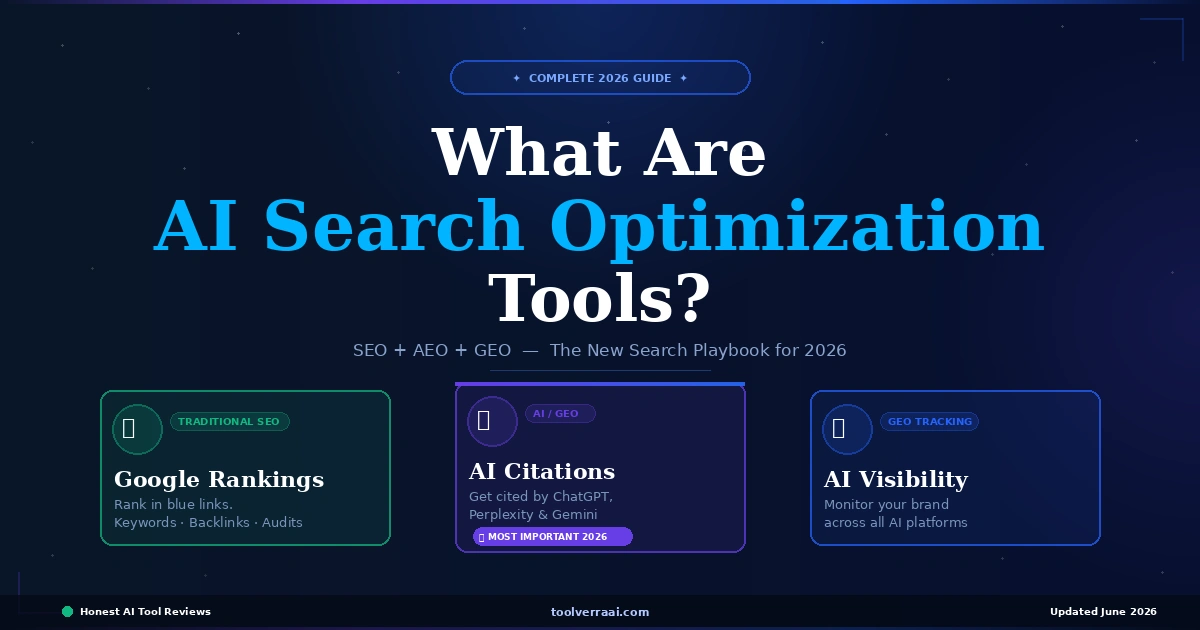
What are AI search optimization tools? They are software platforms that help your content rank on traditional search engines like Google and get cited by AI systems like ChatGPT, Perplexity, Google AI Overviews, and Gemini. In 2026, having one without the other is no longer enough.
Search behavior has shifted dramatically. Understanding what are AI search optimization tools — and which ones to use — has become one of the most important decisions for any blogger or marketer in 2026. According to EMARKETER, 31.3% of the US population now uses generative AI search — and AI-referred sessions jumped 527% year-over-year in 2025. That means a massive and growing portion of your audience is getting answers from AI, not from the traditional blue links. If your content isn’t optimized for both, you’re invisible to half the market.
This guide explains exactly what these tools are, how they work, and which ones are worth using in 2026 — with real pricing and honest assessments.
What Are AI Search Optimization Tools?
AI search optimization tools are platforms that go beyond traditional keyword ranking to help your content get discovered in the new AI-first search landscape. They serve two interconnected jobs:
Traditional SEO
Rank in Google’s blue links. Keyword research, backlinks, technical audits, on-page optimization.
AI Answer Optimization
Get cited by ChatGPT, Perplexity, Gemini, and Google AI Overviews when users ask questions.
AI Visibility Tracking
Monitor how often AI engines mention your brand and which sources they trust and cite.
The term “AI search optimization” covers three disciplines that are now used interchangeably across the industry: Answer Engine Optimization (AEO), Generative Engine Optimization (GEO), and AI Visibility Optimization. They all describe the same goal: making your content the source that AI systems trust enough to quote.
Why You Need AI Search Optimization Tools in 2026
The search funnel has split into two distinct pathways. This is exactly why knowing what are AI search optimization tools — and how they differ from traditional SEO software — matters more than ever. Users either Google something and click a result — or they ask ChatGPT, Perplexity, or Google’s AI Mode and get a synthesized answer without clicking anything. Both pathways matter. Ignoring one cuts your visibility roughly in half.
Here is what changed: Ahrefs found that Google’s AI Overviews reduced click-through rates for top-ranking content by 58%. That means even if you rank #1 on Google, you might be losing more than half your clicks to an AI-generated answer above your result — an answer that cites someone else. The only solution is to be the source that AI cites. That requires a different set of tools, strategies, and content structures than traditional SEO.
3 Types of AI Search Optimization Tools: SEO vs AEO vs GEO
Most bloggers and marketers confuse these three terms. To fully understand what are AI search optimization tools, you need to understand the three disciplines they cover. Here is a clear breakdown:
| Discipline | Goal | Optimizes For | Key Platforms |
|---|---|---|---|
| SEO | Rank in blue links | Google, Bing SERPs | Semrush, Ahrefs, Moz |
| AEO | Own direct answers | Featured snippets, AI Overviews, voice search | SurferSEO, Frase, NeuronWriter |
| GEO | Get cited by AI | ChatGPT, Perplexity, Gemini, Claude | Semrush AI Toolkit, Ahrefs Brand Radar, SE Ranking |
SEO Tools — Still the Foundation
Traditional SEO tools remain essential in 2026. They handle keyword research, backlink analysis, technical site audits, rank tracking, and competitor analysis. Without strong traditional SEO, your content cannot get the authority and visibility that AI engines need to trust and cite you. Nearly 70% of content cited in Google’s AI Overviews ranks in the top 100 organic results — which means SEO is still the bedrock.
AEO Tools — Optimizing for Direct Answers
Answer Engine Optimization focuses on structuring content so it gets selected as the direct answer when users ask a question. This covers featured snippets, People Also Ask boxes, voice search responses, and Google’s AI Overviews. AEO tools analyze your content for answer-readiness: clear definitions, FAQ schema, direct opening statements, and question-answer formatting.
GEO Tools — Getting Cited by AI Engines
Generative Engine Optimization (GEO) is the newest discipline. It focuses on making your content the source that AI systems like ChatGPT, Perplexity, and Google AI Mode cite when generating their responses. GEO tools track your brand’s citation rate across AI platforms, benchmark you against competitors, identify which content is being cited and why, and provide recommendations to increase your AI visibility.
How AI Search Optimization Tools Work
What are AI search optimization tools capable of? They work across several interconnected functions. Here is what the best platforms actually do:
AI Visibility Monitoring
Track how often and how positively your brand appears in AI-generated answers across ChatGPT, Perplexity, Gemini, and Google AI Mode.
Content Optimization
Score and optimize content for both traditional SEO signals and AI-extractable structures like clear definitions, Q&A formats, and semantic depth.
Competitor Benchmarking
Compare your AI citation rate against competitors. Identify which sources AI engines trust in your niche and model your content accordingly.
Citation Source Analysis
Identify which specific pages get cited by AI and what structural elements make them trustworthy to language models.
Keyword + Prompt Research
Discover not just what keywords users type into Google but what questions they ask AI engines — a critical difference in 2026.
AI Content Generation
Some tools integrate AI writing that produces content pre-structured for both SEO and AI citation — saving hours of manual optimization.
The 8 Best AI Search Optimization Tools in 2026
Based on hands-on testing, pricing research, and real-world performance data, here are the best AI search optimization tools that actually deliver results for bloggers, content teams, and marketers in 2026:
🔍 Semrush One
Semrush is the most complete AI search optimization platform for 2026. It handles traditional SEO (keyword research, competitor analysis, backlinks, site audits) and AI visibility in one unified dashboard. Its AI Visibility Toolkit tracks your brand mentions and citations across ChatGPT, Perplexity, Google AI Mode, and AI Overviews — giving you a complete picture of your AI search presence.
The platform’s real advantage is breadth. You can go from keyword research to competitor analysis to AI citation monitoring to content brief creation without switching tools. For agencies managing multiple clients or content teams publishing regularly, this saves significant time and money compared to running three separate platforms.
✅ Pros
- Best all-in-one SEO + AI visibility platform
- AI Visibility Toolkit tracks citations across 5 AI platforms
- Most comprehensive keyword and competitor database
- ContentShake AI integrates SEO + writing in one workflow
- 14-day free trial available
❌ Cons
- Expensive — $119.95/mo is steep for solo bloggers
- AI Visibility Toolkit is an add-on, not included by default
- No real-time content editor like SurferSEO
- Backlink database smaller than Ahrefs
📈 Ahrefs
Ahrefs has the strongest backlink database in the industry and has now expanded into AI search with Brand Radar — a module that tracks your brand appearances across Google AI Overviews, ChatGPT, Perplexity, Microsoft Copilot, and Gemini. It identifies cited pages, analyzes what makes them trustworthy to AI systems, and benchmarks you against competitors.
For teams that already use Ahrefs for traditional SEO and want to layer in AI visibility without adding a new platform, Brand Radar is a natural extension. The combination of the best backlink data in the industry plus AI citation discovery makes it particularly powerful for authority-building strategies. Read our full Semrush vs Ahrefs comparison to see how they differ.
✅ Pros
- Best backlink database — essential for authority building
- Brand Radar monitors AI citations across 5 major platforms
- Cited-page analysis reveals what AI engines trust
- Ahrefs Webmaster Tools free tier available
- Cleaner, more intuitive interface than Semrush
❌ Cons
- No free trial — paid plans only
- Brand Radar is relatively new and still maturing
- Weaker content optimization features vs SurferSEO
- AI writing tools less integrated than Semrush
🏄 SurferSEO
SurferSEO is the gold standard for on-page content optimization. It analyzes the top 20 ranking pages for any keyword and gives you a real-time content score as you write — telling you exact word counts, which semantic terms to include, how to structure headings, and what data points will strengthen your authority in AI engines.
The Content Editor acts as a live SEO coach. Every change updates your score in real time. For bloggers writing more than 2–3 articles per month, SurferSEO consistently improves rankings. Its AI visibility tracking is newer and less mature than Semrush’s, but its content optimization is unmatched for producing AI-extractable, well-structured articles.
✅ Pros
- Best real-time content editor — live SEO score as you write
- Analyzes top 20 ranking pages per keyword
- Auto-Optimize inserts missing terms in one click
- Internal linking suggestions built in
- Integrates with Google Docs and WordPress
❌ Cons
- No keyword research or backlink tools
- AI visibility tracking less mature than Semrush/Ahrefs
- $99/mo is steep — need Semrush or Ahrefs for full picture
- Article quotas per plan — can run out on high-volume teams
📖 Frase.io
Frase covers the full content pipeline — research, briefing, writing, optimization, and now GEO scoring — at a price that bloggers and small teams can actually afford. At $49/month, it handles all six stages of the content production workflow: keyword research, content brief creation, AI writing, content optimization, AI visibility monitoring, and automated content recovery.
The combination of SEO briefing + GEO scoring at this price point is genuinely unusual in 2026. Most tools either focus on traditional optimization or AI visibility — not both. Frase connects AI visibility data directly into the writing workflow, so when your AI visibility drops, it tells you why and what to fix.
✅ Pros
- Most affordable full-pipeline tool — $49/mo covers everything
- Content briefs + GEO scoring in one platform
- AI visibility monitoring connected to content editing
- Automated content recovery suggestions
- 7-day free trial available
❌ Cons
- Smaller keyword database than Semrush or Ahrefs
- No backlink analysis
- Less powerful AI writing than Jasper or ChatGPT
- GEO features still maturing vs dedicated tools
📊 SE Ranking
SE Ranking offers the best balance of traditional SEO tools and AI visibility features at a mid-range price. It includes keyword research, competitor analysis, rank tracking, backlink monitoring, site auditing, and — critically — AI Overview tracking that monitors when your content appears inside Google’s AI Overviews.
For bloggers and small business owners who want a serious platform without the Semrush price tag, SE Ranking hits the sweet spot. It also includes an AI content writer built into the platform, making it a genuinely integrated solution for content creation and optimization in one dashboard.
✅ Pros
- Best price-to-features ratio among all-in-one tools
- AI Overview tracking included
- Built-in AI content writer
- Clean, beginner-friendly interface
- Full SEO suite at less than half the Semrush price
❌ Cons
- Smaller keyword and backlink database than Semrush/Ahrefs
- AI visibility tracking limited to Google AI Overviews
- Less comprehensive than Semrush for large agencies
⚙️ NeuronWriter
NeuronWriter is the most affordable dedicated content optimization tool in 2026 — and it works. Starting at $19/month, it provides NLP-based content scoring that analyzes what terms and concepts top-ranking pages use, and guides you to include them in your content for both search and AI extractability.
It is not a full SEO suite like Semrush, but for bloggers who already have keyword research covered and want a tool specifically for optimizing content quality and AI-readiness, NeuronWriter provides real value at a genuinely accessible price. Read our full NeuronWriter review for detailed testing results.
✅ Pros
- Most affordable content optimizer — $19/mo
- Strong NLP scoring for semantic optimization
- SERP-based recommendations from real competitors
- Built-in AI writing with content guidance
- Lifetime deal available on AppSumo
❌ Cons
- No keyword research, backlinks, or rank tracking
- No AI visibility tracking for ChatGPT/Perplexity
- Must pair with Semrush or Ahrefs for full strategy
📌 Rank Math SEO
Rank Math is the most powerful free tool in this entire list — and it is essential for every WordPress blogger. It handles on-page SEO analysis, schema markup (critical for AI engines to understand your content), XML sitemaps, title/meta optimization, and a built-in content AI that scores your writing for SEO and AEO signals as you edit.
The free version alone outperforms the paid tier of many competing plugins. The schema markup features are particularly valuable for AI optimization — structured data helps both Google and AI engines correctly interpret and extract your content. Every blogger using WordPress should have Rank Math installed before doing anything else.
✅ Pros
- Most powerful free WordPress SEO plugin available
- Schema markup for AI content structuring
- Real-time content scoring in WordPress editor
- AI-powered content suggestions on paid plan
- Free plan is genuinely sufficient for most bloggers
❌ Cons
- WordPress-only — not useful outside WordPress
- No AI visibility tracking
- Must combine with Semrush/Ahrefs for keyword research
🔎 Google Search Console
Google Search Console is the only tool that gives you real performance data directly from Google — and it is completely free. In 2026, it also shows AI Overview impressions for your content, helping you see which pages appear inside Google’s AI-generated answers and how often they get clicked.
No serious content strategy can function without it. The data you get from GSC — real click-through rates, actual impressions, indexing status, Core Web Vitals, and now AI Overview presence — cannot be replicated by any paid tool. Use it as the foundation of everything else.
Set Up Google Search Console →Side-by-Side Comparison: All 8 Tools
| Tool | Starting Price | SEO | AEO / GEO | AI Writing | Best For |
|---|---|---|---|---|---|
| Semrush | $119.95/mo | ✅ Full | ✅ Advanced | ✅ Yes | Agencies & teams |
| Ahrefs | $129/mo | ✅ Full | ✅ Brand Radar | Limited | Backlink strategy |
| SurferSEO | $99/mo | Partial | Partial | ✅ Yes | Content optimization |
| Frase | $49/mo | Partial | ✅ GEO scoring | ✅ Yes | Small teams on budget |
| SE Ranking | $65/mo | ✅ Full | Partial | ✅ Yes | Best value all-in-one |
| NeuronWriter | $19/mo | ❌ None | Content only | ✅ Yes | Budget content optimizer |
| Rank Math | Free | On-page only | Schema / AEO | Limited | WordPress bloggers |
| Google Search Console | Free | Monitoring only | AI Overviews data | ❌ None | Everyone — essential |
How to Choose the Right AI Search Optimization Tool
Choosing among AI search optimization tools depends on three things: your budget, your publishing volume, and your primary goal. Here is a simple decision framework:
| If You Are… | Start With | Add Later |
|---|---|---|
| A new blogger (under $50/mo budget) | Rank Math (free) + Google Search Console (free) | NeuronWriter at $19/mo |
| A growing blogger (publishing 4–8x/month) | SE Ranking ($65/mo) or Frase ($49/mo) | SurferSEO for content optimization |
| An affiliate marketer (SEO-focused) | Ahrefs ($129/mo) for backlinks and keywords | SurferSEO for content scoring |
| A content team (5+ people) | Semrush ($119.95/mo) for full pipeline | SurferSEO for editors |
| A brand tracking AI mentions | Semrush AI Toolkit or Ahrefs Brand Radar | Frase for content recovery |
Budget Overview: AI Search Optimization Tools
Quick-Start Checklist: AI Search Optimization in 2026
Here is the step-by-step process for setting up AI search optimization tools for your blog or website — from free setup on day one to a full professional stack:
Set Up Google Search Console (Free — Day 1)
Verify your site, submit your sitemap, and enable AI Overview impression tracking. This gives you real baseline data on where you stand before adding any paid tools.
Install Rank Math on WordPress (Free — Day 1)
Configure schema markup for all content types (articles, reviews, FAQs). This is the single most important technical step for making your content extractable by AI engines.
Optimize Content for Direct Answers (AEO)
Add clear definitions at the top of every article, include FAQ sections with schema markup, use question-based H2 and H3 headings, and write in plain conversational language. AI engines prioritize content that answers questions clearly and directly.
Add a Keyword Research Tool (Week 2)
Sign up for SE Ranking, Semrush, or Ahrefs — these are the most established AI search optimization tools for keyword research. Start tracking your target keywords and competitors. Identify what questions your audience asks both in Google and in AI chat tools — the phrasing is often different and both matter.
Optimize Content with a Scoring Tool (Week 3)
Use SurferSEO, Frase, or NeuronWriter to score your existing content. Start with your top 10 most-visited pages. Optimize semantic depth, add missing terms, improve structure, and ensure each page answers one core question completely.
Monitor AI Visibility (Month 2+)
Enable AI citation tracking in Semrush or Ahrefs Brand Radar. Track how often your brand appears in AI-generated answers. Identify which pages get cited and why — then replicate those structural patterns across your content library.
🎯 Key Takeaways — What Are AI Search Optimization Tools?
- AI search optimization tools help content rank on Google AND get cited by ChatGPT, Perplexity, Gemini, and Google AI Overviews
- Three disciplines: SEO (blue links) + AEO (direct answers) + GEO (AI citations) — all three are needed in 2026
- 31.3% of the US population uses generative AI search — that audience requires a different optimization approach
- AI Overviews reduced CTR for top-ranking content by 58% — being cited is now as important as ranking
- Best all-in-one: Semrush · Best for backlinks: Ahrefs · Best content editor: SurferSEO · Best budget: Frase
- Start free: Google Search Console + Rank Math cover the basics at zero cost
- Schema markup (structured data) is the single most important technical element for AI extractability
Find the Right AI Search Optimization Tool for You
Browse our detailed reviews of every major SEO and AI tool — with real testing data, honest pricing, and clear use-case breakdowns.
Semrush vs Ahrefs 2026 → SurferSEO Review →FAQ — AI Search Optimization Tools
Now that you know what are AI search optimization tools and how they work, the next step is choosing the right one. Read our full Semrush vs Ahrefs 2026 comparison to see which platform delivers better results for AI visibility tracking and traditional SEO.