
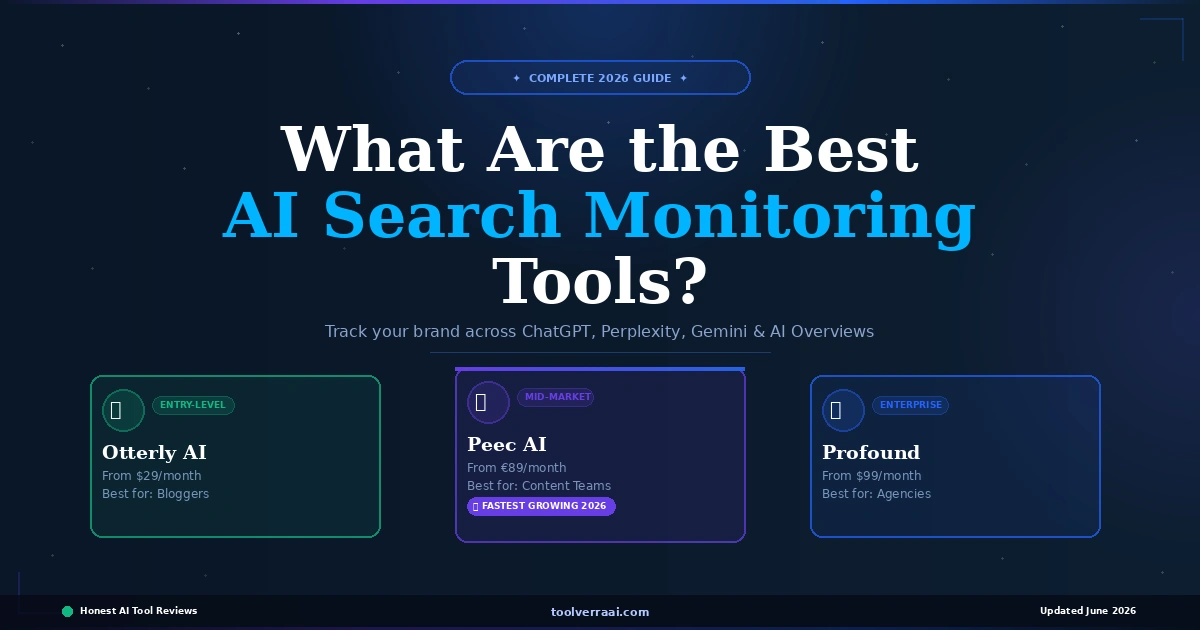
What are the best AI search monitoring tools? This is the question every blogger and marketer needs to answer in 2026. These platforms track how your brand, blog, or content appears inside AI-generated answers from ChatGPT, Perplexity, Google AI Overviews, Gemini, Claude, and Microsoft Copilot. In 2026, these tools have moved from “nice to have” to essential — because AI engines now answer millions of questions daily that used to send traffic directly to your website.
What are the best AI search monitoring tools capable of that traditional platforms cannot do? The best AI search monitoring tools do something traditional SEO platforms like Google Search Console and Ahrefs cannot: they tell you whether ChatGPT mentions your brand when someone asks “what is the best hosting for bloggers?” — a question your customer is asking right now, without ever clicking a Google result. This guide gives you the honest comparison no other article does — including which tools are actually worth paying for, and where you can start for free.
What Are AI Search Monitoring Tools? (2026 Definition)
The Fastest-Growing Category in Marketing Technology
AI search monitoring barely existed before 2024. By mid-2026, the category has raised over $300M in funding — Profound alone reached a $1B valuation. Traditional rank trackers measure SERP positions. AI search monitoring tools measure something completely different: whether AI engines mention you when your potential customers ask questions. These are not competing categories — they measure different surfaces entirely.
To understand what are the best AI search monitoring tools, start with the definition. An AI search monitoring tool is software that tracks how your brand, content, and competitors appear in AI-generated responses. These tools run predefined prompts and topic queries daily — or weekly — to measure brand mentions, citation frequency, sentiment, and competitive positioning across the major AI platforms. They record every result over time so you can spot trends, detect drops, and understand why a competitor suddenly gets cited more than you.
📡 Traditional SEO Tracks
Keyword positions in Google. Click-through rates. Impressions in blue-link results. Backlinks. All measurable via Search Console and Ahrefs.
🤖 AI Monitoring Tracks
Whether ChatGPT mentions your brand. Which URLs Perplexity cites. How Gemini describes you versus a competitor. Sentiment of AI-generated answers about you.
⚠️ The Gap
Google Search Console shows AI Overview impressions but not citation depth. Traditional trackers cannot parse LLM outputs at all. You need a dedicated tool.
Why Every Blogger and Marketer Needs AI Search Monitoring in 2026
Gartner projects traditional search traffic will decline 25% by 2026 as AI engines capture a growing share of information queries. AI search optimization tools help you appear in those answers — but without monitoring, you have no idea whether your optimization efforts are working.
This is why what are the best AI search monitoring tools has become such a searched question. Here is the real problem: a brand that ranks #1 on Google can be completely invisible in AI answers. These are different algorithms, different trust signals, and different content requirements. The only way to know your AI visibility status is to measure it — which is exactly what the best AI search monitoring tools do.
The best AI search monitoring tools solve four specific problems that no traditional SEO tool addresses: they tell you whether you are mentioned, how often versus competitors, what sentiment AI engines assign to you, and which content and URLs are being cited as sources.
How AI Search Monitoring Tools Work — The 4 Core Features
🔍 Prompt Monitoring
The tool sends pre-configured questions to AI engines on a schedule — daily, weekly, or on-demand. It records which brands get mentioned, in what context, and with what sentiment. Good tools run each prompt multiple times because AI answers vary between runs.
🔗 Citation Tracking
Beyond mentions, citation tracking shows which specific URLs AI engines are linking to as sources. Citations are stronger authority signals than mentions — they mean the AI is treating your content as a trusted reference, not just a name.
📊 Competitive Benchmarking
AI share of voice — how often your brand appears in AI answers versus competitors — is the primary metric. The best tools show this over time so you can see whether an optimization move improved or hurt your position.
⚡ Actionable Recommendations
The most advanced tools go beyond dashboards to tell you why a competitor is being cited more, which content gaps to fill, and what structural changes to your content would improve citation rates. This is where tools differ most dramatically.
The 8 Best AI Search Monitoring Tools in 2026
We reviewed 14 platforms to answer the question: what are the best AI search monitoring tools in 2026? Here are the best AI search monitoring tools for different budgets and goals — with real, verified pricing from June 2026:
🔍 Otterly AI
Otterly AI is the most accessible of all the best AI search monitoring tools — and the platform that put this category on the map. If you are asking what are the best AI search monitoring tools for entry-level use, Otterly is the answer. It tracks brand mentions, link citations, and rankings across multiple AI platforms with a clean dashboard, daily data refresh, and a Looker Studio connector for custom reporting. When it launched, most teams tracking AI visibility were doing it manually — running ChatGPT prompts and pasting results into spreadsheets. Otterly automated that entirely.
The core workflow is straightforward: you configure a set of prompts (questions your customers might ask AI engines about your category), Otterly runs them on a schedule, and delivers trend data on how often and how positively your brand appears. The Lite plan at $29/month covers 15 prompts — enough to get a baseline read on your AI visibility without significant investment.
✅ Pros
- Most affordable entry point — $29/mo covers the basics
- Automated daily monitoring — no manual prompt running
- Looker Studio connector for custom agency reports
- Clean interface — fastest to set up in the category
- Free trial available
- Citation-level tracking included
❌ Cons
- Prompt limits get restrictive fast — 15 prompts on Lite
- Gemini and Claude require paid add-ons
- Recommendations less actionable than Peec AI or Profound
- No search engine tracking for AI-triggered web lookups
- Prompt-based pricing gets expensive for agencies with many clients
📊 Peec AI
Peec AI is the fastest-growing challenger in the AI search monitoring category — raising $29M and reaching $4M+ ARR in under ten months. Based in Berlin, it tracks brand visibility and sentiment across ChatGPT, Perplexity, and Google AI Overviews, with a focus on giving content strategists actionable insights rather than just monitoring dashboards. The key differentiator: Peec AI tells you not just whether you were mentioned, but exactly what content to create and which third-party sources to target to close citation gaps.
Unlike Otterly’s monitoring-first approach, Peec AI is designed for teams that want to act on the data — it connects AI visibility monitoring directly to a content action plan. For growing blogs and mid-size content teams, this makes it the most practical tool at this price point. The platform recently moved to a per-brand pricing model with separate agency tiers, so cost comparison with Otterly depends on how many brands you track.
✅ Pros
- Actionable recommendations — tells you exactly what to fix
- Daily brand visibility tracking with sentiment analysis
- Prioritized action items — not just a monitoring dashboard
- Source and citation insights built in
- Strong competitive benchmarking features
- $29M funding — well-resourced development roadmap
❌ Cons
- Per-brand pricing model can get expensive for agencies
- No Microsoft Copilot or Grok tracking
- More complex to set up than Otterly
- Priced in EUR — cost varies with exchange rate for US users
🏆 Profound
Profound is the category leader by funding — having raised $155M and reaching a $1B valuation with Fortune 500 clients. It delivers the most comprehensive AI visibility analytics available: visibility tracking, share of voice, sentiment analysis, citation mapping, prompt volume data (showing which questions your audience actually asks AI engines), and Agent Analytics that tracks how AI crawls your site. The professional tier at $499/month is expensive, but the $99/month Starter plan has emerged as a credible mid-market option in 2026.
Profound’s real advantage is depth. It does not just show you whether you were mentioned — it shows you the full context: which prompts triggered mentions, what sources were cited alongside you, how your sentiment compares to competitors, and what volume of questions your category receives in AI engines. For brands running serious GEO strategies, this level of intelligence is difficult to replicate elsewhere.
✅ Pros
- Most complete feature set in the category
- Prompt volume data — shows what AI users actually ask
- Agent Analytics tracks AI web crawls of your site
- Full 6-platform coverage including Claude and Copilot
- Sentiment + citations + share of voice in one dashboard
- $99/mo Starter plan accessible for smaller teams
❌ Cons
- Professional tier at $499/mo is steep for solo bloggers
- Setup and interpretation require more time than Otterly
- Enterprise sales process for larger plans — no instant signup
- Feature depth can feel overwhelming for simple use cases
🔍 Semrush AI Toolkit
If you already use Semrush for traditional SEO, the AI Toolkit is the most logical way to add AI search monitoring without adding another platform. It tracks brand citations across ChatGPT, Perplexity, Google AI Mode, Google AI Overviews, and Microsoft Copilot — and uniquely integrates this data with your existing keyword research, competitor analysis, and content workflows. No other tool connects AI visibility data to the full SEO picture the way Semrush does.
The key advantage for bloggers and content teams: when your AI visibility drops, Semrush can immediately cross-reference which keywords and pages are affected, suggest content improvements via ContentShake AI, and track the SEO + AI recovery in one dashboard. This integration makes it more powerful than standalone AI monitoring tools for users who already have a content strategy.
✅ Pros
- Integrates AI monitoring with full SEO workflow
- No extra platform to manage if you use Semrush already
- Connects AI visibility drops to keyword and content data
- ContentShake AI suggests content fixes alongside monitoring data
- 14-day free trial on Semrush plans
❌ Cons
- AI Toolkit is an add-on — not included in base plans by default
- Less depth in AI-specific features than Profound or Peec AI
- No Claude or Grok tracking currently
- High base cost if you only want AI monitoring
🧹 Scrunch AI
Scrunch AI focuses on something the other tools underserve: narrative control and misinformation detection. It not only tracks whether AI mentions your brand, but analyzes what AI engines say about you — flagging factual inaccuracies, outdated information, and negative framing that could be harming how customers perceive you through AI channels. For B2B and SaaS brands where AI is frequently asked about product comparisons, pricing, and capabilities, accuracy matters as much as frequency.
Scrunch also includes journey mapping — understanding what questions prospects ask AI engines at each stage of the buying journey — which makes it particularly useful for content strategy teams planning long-form buying-stage content.
✅ Pros
- Best misinformation and accuracy detection
- AI journey mapping for buying-stage content strategy
- Narrative control — tracks what AI says, not just whether
- Strong B2B and SaaS fit
- 5-platform coverage including Claude
❌ Cons
- Custom pricing — no transparent self-serve tiers
- Less suitable for individual bloggers
- Sales process required to get started
📈 Ahrefs Brand Radar
Ahrefs Brand Radar monitors your brand appearances across Google AI Overviews, ChatGPT, Perplexity, Microsoft Copilot, and Gemini. Its unique value is citation analysis — because Ahrefs has the best backlink database in the industry, it can cross-reference which pages AI engines cite with the authority signals those pages carry. This tells you not just that a page was cited, but why it was trusted enough to cite — which is critical intelligence for replicating that authority on your own content.
✅ Pros
- Best backlink + AI citation cross-reference
- No extra tool needed if you use Ahrefs already
- Cited-page analysis reveals why AI trusts certain sources
- Ahrefs Webmaster Tools has a free tier
❌ Cons
- Brand Radar is newer — still maturing vs dedicated tools
- No Claude or Grok tracking yet
- Less actionable recommendations than Peec AI or Profound
📊 SE Ranking AI Overview Tracker
SE Ranking offers the best value for bloggers who want AI Overview monitoring as part of a full SEO package. At $65/month, it tracks when and how your content appears inside Google’s AI Overviews, identifies which of your pages trigger AI-generated answers, and provides recommendations to improve AI Overview presence. While it does not track ChatGPT or Perplexity like the dedicated tools above, its Google AI Overview coverage is solid and its price point makes it the most accessible complete-package option for growing content sites. For AI search optimization, SE Ranking + Otterly together at ~$95/month covers both bases effectively.
✅ Pros
- Full SEO suite + AI Overview tracking in one $65/mo platform
- Built-in AI content writer for optimization
- Best price-to-features ratio for growing blogs
- Free trial available
❌ Cons
- Only tracks Google AI Overviews — not ChatGPT or Perplexity
- Limited AI visibility depth vs dedicated monitoring tools
🔎 Google Search Console
Google Search Console is not a dedicated AI search monitoring tool, but it is the only free platform that shows you real Google AI Overview performance data. In 2026, GSC reports impressions and clicks specifically from AI Overviews — separate from traditional blue-link results — giving you a baseline of which pages trigger AI-generated answers and how often users click through. No other free tool provides this data.
Start here before spending anything on paid tools. GSC gives you the baseline data to justify a paid monitoring tool investment — and it tells you immediately which pages are already appearing in AI Overviews so you can prioritize optimization efforts.
Full Comparison: What Are the Best AI Search Monitoring Tools in 2026?
| Tool | Starting Price | ChatGPT | Perplexity | AI Overviews | Gemini | Recommendations | Best For |
|---|---|---|---|---|---|---|---|
| Otterly AI | $29/mo | ✅ | ✅ | ✅ | Add-on | Basic | Entry-level, bloggers |
| Peec AI | €89/mo | ✅ | ✅ | ✅ | ✅ | Advanced | Mid-market, content teams |
| Profound | $99/mo | ✅ | ✅ | ✅ | ✅ | Full stack | Enterprise, agencies |
| Semrush AI | $119.95/mo | ✅ | ✅ | ✅ | ✅ | Integrated SEO | Existing SEO teams |
| Scrunch AI | Custom | ✅ | ✅ | ✅ | ✅ | Narrative | B2B, SaaS accuracy |
| Ahrefs Brand Radar | $129/mo | ✅ | ✅ | ✅ | ✅ | Basic | Backlink + AI combo |
| SE Ranking | $65/mo | ❌ | ❌ | ✅ | ❌ | Basic | Budget blogs, Google focus |
| Google Search Console | Free | ❌ | ❌ | ✅ | ❌ | None | Everyone — essential |
How to Choose the Right AI Search Monitoring Tool
When deciding what are the best AI search monitoring tools for your specific situation, the right answer depends entirely on your budget, team size, and which AI platforms your audience uses. Here is the clearest decision framework we have found:
| Your Situation | Best Tool | Monthly Cost |
|---|---|---|
| Starting out, limited budget | Google Search Console + Otterly Lite | $29/mo |
| Growing blog, 4+ articles/month | SE Ranking + Otterly Standard | $164/mo |
| Content team, need full-platform coverage | Peec AI or Profound Starter | ~$100/mo |
| Already using Semrush for SEO | Add Semrush AI Toolkit | Semrush plan |
| B2B / SaaS, accuracy matters | Profound + Scrunch AI | Custom |
| Enterprise, Fortune 500 | Profound Professional | $499+/mo |
Free AI Search Monitoring Options in 2026
Several of the best AI search monitoring tools offer free tiers or trials. Here is what are the best AI search monitoring tools you can access at zero cost: Here is what you actually get at zero cost:
Quick-Start Checklist: Set Up AI Search Monitoring Today
Set Up Google Search Console (Free — 10 Minutes)
Verify your site and enable AI Overview tracking. This gives you real Google data on which pages appear in AI-generated answers — the essential free baseline before adding any paid tool.
Define Your Monitoring Prompts (15 Minutes)
Write 10–15 questions your customers actually ask AI engines about your niche. Example: “what is the best hosting for bloggers,” “how to start a blog,” “best SEO tool for beginners.” These become your monitoring prompt library — the queries the tool tracks for you automatically.
Run a Manual Baseline Test (Free)
Before paying for any tool, run your 10–15 prompts manually in ChatGPT and Perplexity. Screenshot the results. This tells you immediately whether you currently appear in AI answers — and gives you a starting benchmark to compare paid monitoring data against.
Sign Up for Otterly AI Lite ($29/mo)
Enter your monitoring prompts, add your brand and 2–3 competitors, and activate daily tracking. After 2 weeks you will have your first real AI visibility trend data — showing whether you appear more or less often than competitors across ChatGPT, Perplexity, and Google AI Overviews.
Act on the Data — Optimize Content
When your monitoring shows a competitor getting cited more, analyze their cited page: what is its structure, what questions does it answer directly, what schema markup does it use? Use content optimization tools to close the gap. AI monitoring without content action is just data collection.
Upgrade When the Data Justifies It
When Otterly’s prompt limits become restrictive — or you need sentiment analysis, full competitor benchmarking, and actionable recommendations — upgrade to Peec AI (€89/mo) or Profound Starter ($99/mo). Make this decision based on data, not marketing.
🎯 Key Takeaways — Best AI Search Monitoring Tools 2026
- What are the best AI search monitoring tools in 2026? Otterly ($29/mo), Peec AI (€89/mo), Profound ($99/mo), Semrush AI Toolkit, and Google Search Console (free)
- The category barely existed before 2024 — by mid-2026 it has raised $300M+ in funding
- AI Overviews now appear in 48% of Google searches — monitoring this surface is no longer optional
- Traditional SEO tools cannot track ChatGPT or Perplexity mentions — you need a dedicated tool
- Start free: Google Search Console + manual prompt testing before committing to paid plans
- Citation tracking is more valuable than mention tracking — citations mean AI trusts you as a source
- Otterly is the best entry-level pick; Profound is the deepest enterprise tool; Peec AI is the best mid-market option
- Monitoring without acting on the data is pointless — pair every tool with a content optimization workflow
Start Monitoring Your AI Search Visibility Today
Find out if ChatGPT and Perplexity are mentioning your brand — or your competitors instead.
Try Otterly AI Free → AI Search Optimization Guide →FAQ — Best AI Search Monitoring Tools
Now that you know what are the best AI search monitoring tools and how to choose one, the next step is improving your AI visibility. Related: What are AI search optimization tools? — the complete guide to improving your AI visibility, not just measuring it. Also see our Semrush vs Ahrefs 2026 comparison for traditional SEO platforms that are adding AI monitoring features.