
- AEO vs GEO vs AIO — Complete Glossary
- Why AI Visibility Is Now a Real Revenue Channel
- Free DIY AI Visibility Audit (Do This First)
- 12 Best AI Visibility Tools — Full Reviews
- Full Comparison Table
- Budget & Team-Size Decision Matrix
- Engine-Specific Optimization Playbooks
- Technical GEO Foundation: Robots.txt, Schema & llms.txt
- Troubleshooting: Why Your Brand Isn’t Showing Up
- AI Visibility Setup Checklist
- FAQ
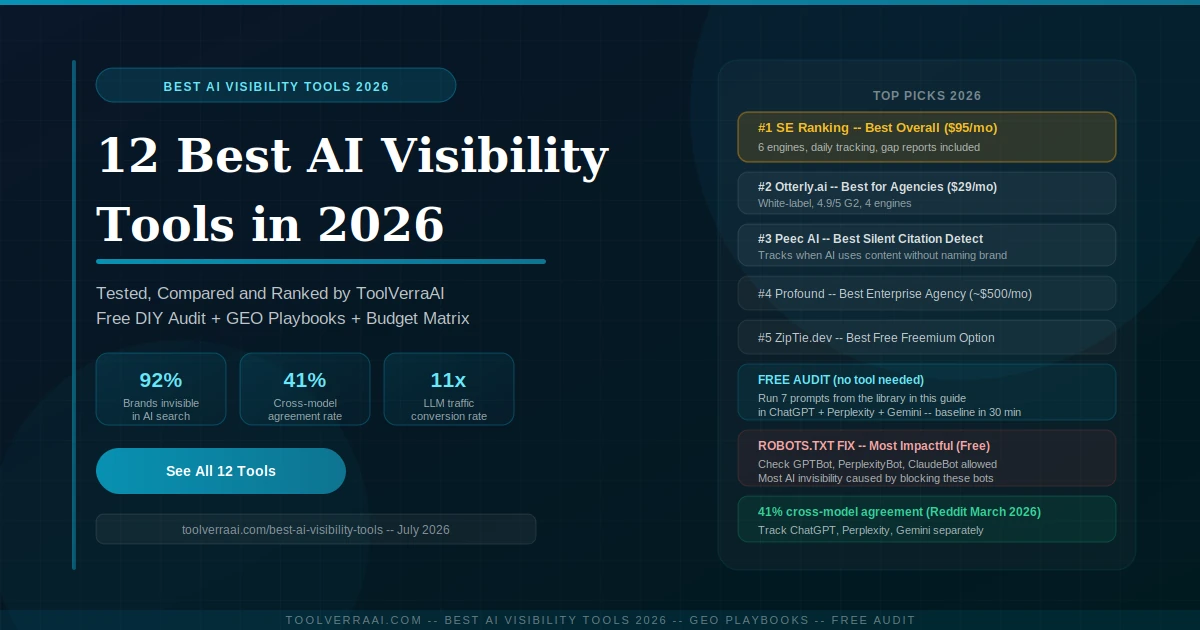
Something counterintuitive is happening in search. A study tracking 1,000+ brand recommendation queries across ChatGPT, Gemini, and Perplexity found only a 41% agreement rate between the three platforms on which brands to recommend — meaning if your competitor appears in ChatGPT answers, you cannot assume you appear in Gemini or Perplexity answers for the same queries (r/DigitalMarketing, March 2026). These three platforms are drawing from different index architectures, different training data freshness cycles, and different citation logic. The implication: winning AI visibility requires tracking each engine separately, not assuming a single strategy covers all.
The market for the best AI visibility tools grew from near-zero in 2024 to a category with 30+ competing platforms in 2026. ChatGPT has 700 million weekly active users. Google AI Mode surpassed 1 billion monthly users at Google I/O in May 2026. AI Overviews now appear in nearly 50% of all Google searches. Yet only 8% of companies have a formal GEO strategy in place (WorkDuo, 2026). This gap between AI search adoption and brand measurement creates both the problem — 92% of brands invisible in AI answers — and the opportunity: the brands that track and act on AI visibility data now will dominate recommendations before the category gets crowded.
This guide covers the 12 best AI visibility tools in 2026 with honest testing data, a free DIY audit method, engine-specific optimization playbooks, and the technical GEO implementation that no other guide covers in one place.
📖 AEO vs GEO vs AIO — Glossary for Best AI Visibility Tools Users
The terminology around the best AI visibility tools is fragmented. Different vendors use different terms for overlapping concepts, which creates genuine confusion when evaluating tools. Here is the definitive glossary in one place:
📈 Why AI Visibility Is Now a Real Revenue Channel
The skepticism is understandable: is AI visibility just another SEO vendor category selling FOMO? Here is the honest answer. The revenue case is real but unevenly distributed — it matters more for some businesses than others.
Who needs AI visibility tools urgently: B2B SaaS companies, professional services (consultants, agencies, law firms), e-commerce in considered-purchase categories (software, health, finance), and any brand in a category where buyers research via conversational queries. When someone asks ChatGPT “what are the best project management tools for a 10-person remote team?” — and your SaaS product doesn’t appear — you are losing a buyer who was already primed to buy.
Who can wait 6-12 months: Local service businesses (plumbers, restaurants, salons), physical retail, and businesses with sub-$5K annual digital marketing budgets. These categories see lower AI-search traffic currently, though AI-sourced local recommendations are growing (Google’s Ask Maps launched March 2026).
🆓 Free DIY Audit Before Buying the Best AI Visibility Tools
Every guide to the best AI visibility tools skips this section. You don’t need a $500/month dashboard to discover your current AI visibility status. The following free method takes 30 minutes and tells you exactly where you stand before spending money on measurement tools.
🔍 Free AI Visibility Audit — Before Buying Best AI Visibility Tools
- Check your robots.txt first. Open yourdomain.com/robots.txt. Search for GPTBot, PerplexityBot, ClaudeBot, Google-Extended, OAI-SearchBot. Any Disallow entry for these bots = you are actively blocking AI engines from crawling your content. This single issue causes most AI invisibility and costs $0 to fix. Add explicit Allow entries for each bot.
- Run the prompt library below. Open ChatGPT, Perplexity, and Google AI Mode in separate browser tabs (incognito). Run each prompt. Record whether your brand appears, what position, and what competitors appear instead. This is your baseline data.
- Score your AI visibility. For each prompt: 2 points for being cited, 1 point for being mentioned without citation, 0 points for absence. Total across all prompts = your raw AI visibility score. Benchmark: under 30% appearance rate = urgent action needed; 30-60% = optimization opportunity; 60%+ = maintenance mode.
- Set up GA4 channel grouping. In GA4, create custom channel groups for each AI engine referral source (perplexity.ai, chatgpt.com, bing.com/chat, etc.). This measures actual traffic you’re already receiving from AI engines — often surprisingly significant even before any optimization.
- Document competitors. Note every competitor that appeared in place of your brand. Their content, structure, or citation profile is outperforming yours in these specific AI engines. You now have a shortlist of content to reverse-engineer.
📋 Best AI Visibility Tools Prompt Library — Copy & Run These — Copy & Run These
- “What are the best [your category] tools for [your target audience]?”
- “Which [your service] companies do [your customer type] typically use?”
- “Compare [your brand] vs [top competitor] — which is better for [use case]?”
- “What do people say about [your brand name]?”
- “Recommend a [your service] provider for a [company size/type] company”
- “What are the top-rated [your category] options in [your location/market]?”
- “Is [your brand] a reputable [service/product] provider?”
🛠️ 12 Best AI Visibility Tools in 2026 — Reviewed & Ranked
SE Ranking’s AI Visibility Toolkit is the best overall choice among all best AI visibility tools because it covers the widest engine set — ChatGPT, Perplexity, Gemini, Google AI Mode, Google AI Overviews, and Copilot — at a price that doesn’t require enterprise justification, and because it is included in the core SE Ranking platform rather than sold as a separate add-on. For teams already using SE Ranking for traditional keyword rank tracking, AI visibility data sits in the same dashboard alongside organic performance — eliminating the context-switching that undermines consistent monitoring.
The “No Cited” gap feature is uniquely actionable: it automatically flags every tracked prompt where competitors are cited but your brand is not, transforming a passive monitoring dashboard into a prioritized content action list. Daily refresh cadence with average position scoring means you know not just whether you appeared, but whether you were the primary source or a supplementary citation. The linked versus unlinked citation distinction matters for traffic attribution — Perplexity citations without a hyperlink generate no referral traffic regardless of brand mention.
✅ Pros
- 6 AI engines tracked — widest coverage at this price point
- “No Cited” gap feature turns monitoring into action
- Daily refresh with average position scoring
- Distinguishes linked vs unlinked citations
- Included in core plan — no expensive add-on
- Traditional SEO + AI tracking in one platform
- 14-day free trial, no credit card
❌ Cons
- Less enterprise depth than Profound for agency workflows
- No dark query tracking (sub-queries AI generates internally)
- No white-label client workspaces on lower tiers
ToolVerraAI verdict: SE Ranking is the right starting point for any team evaluating the best AI visibility tools in 2026. The combination of 6-engine coverage, daily tracking, actionable gap reports, and inclusion in an existing SEO platform makes it the highest-value tool in the category per dollar spent.
Otterly.ai earns second position among the best AI visibility tools for a straightforward reason: it was designed specifically for agencies managing multiple client brands, and it executes that use case better than any other platform at this price point. The white-label reporting is built in from day one (not locked behind an expensive tier), making it the most accessible client-facing AI visibility reporting tool available. The 4.9/5 rating across 40+ G2 reviews reflects consistent praise for its intuitive interface and daily insight delivery — important for agencies that need to brief clients on AI visibility performance without requiring clients to understand the underlying technology.
✅ Pros
- $29/mo — lowest price for a dedicated AI visibility tracker
- 4.9/5 on G2 (40+ verified reviews)
- White-label reports built in — no extra tier required
- Multi-client management for agencies
- Daily insights without overwhelming complexity
- Covers Perplexity, ChatGPT, Gemini, AI Overviews
❌ Cons
- No traditional SEO features — AI visibility tracking only
- 100 prompts at $189/mo Standard — limited for large-volume agencies
- Less deep analysis than SE Ranking for competitive gap work
Peec AI solves a problem most of the best AI visibility tools ignore: the difference between explicit brand mentions (an AI names your brand in the prose) and silent source citations (an AI synthesizes content from your URL without naming you in the response text). This second category is a significant source of invisible influence — Perplexity may pull your content to generate an answer while giving credit to a competitor’s URL that also appears in the source panel. Peec AI is built natively for AI search measurement rather than retrofitted from a traditional SEO tool, and it shows in the specificity of its citation intelligence.
✅ Pros
- Distinguishes explicit mentions vs silent source citations
- Built natively for AI search — not a retrofit
- Daily competitive intelligence across AI platforms
- Share of voice across AI + traditional search
- Structured data insights (schema interpretation by AI)
❌ Cons
- Starter plan restricts to 3 AI models — verify Perplexity included
- $399/mo Growth plan required for full platform coverage
- Higher learning curve than Otterly for new AI visibility practitioners
Profound is the most agency-native enterprise platform among the best AI visibility tools for 2026. Its defining differentiator is the pitch workspace — an environment where agencies can create AI visibility analysis presentations for prospective clients before those clients sign a contract, demonstrating the client’s current AI invisibility as a compelling reason to engage. The Conversation Explorer shows which specific AI questions trigger brand citations, while Agent Analytics reveals how AI agents make purchase decisions rather than just tracking static answer citations. The funding and product depth suggest serious long-term product investment.
The caveat: Profound’s pricing starts significantly higher than most alternatives and scales steeply with agency client count. It is genuinely best suited for agencies managing 10+ AI-active brand accounts who need structured client workspaces, multi-model tracking at scale, and presentation-ready reporting. For smaller agencies or single brands, SE Ranking or Otterly deliver 70-80% of the visibility data at a fraction of the cost.
✅ Pros
- Pitch workspace — present AI visibility gaps to prospective clients
- Agent Analytics — tracks AI agent purchase behavior
- Conversation Explorer — maps which prompts trigger citations
- Most complete agency workflow tool in the category
- Multi-model tracking at enterprise scale
❌ Cons
- Expensive — entry pricing ~$500+/mo, agency tiers much higher
- Publisher is also vendor — undisclosed conflict of interest in its own “best tools” list
- Overkill for single brands or agencies with under 10 active clients
ZipTie.dev is the best free starting point for teams evaluating best AI visibility tools on zero budget before committing to a paid subscription. Its freemium model provides citation tracking, source intelligence (which domains AI engines trust in your category), and competitive share-of-voice data at no cost for limited prompt volumes. The €5.2M seed round (2025-2026) signals product investment that will continue growing the feature set. ZipTie also published original research finding that cited content contains 32% more explicit semantic concepts than uncited content — insight that directly informs content optimization strategy rather than just measurement.
✅ Pros
- Freemium model — start tracking at no cost
- Citation source intelligence: which domains AI trusts in your niche
- Original research outputs — data-driven product team
- €5.2M seed funded — sustained development ahead
- Competitive share-of-voice on free tier
❌ Cons
- Free tier has prompt volume limits
- Less depth than SE Ranking or Peec AI for enterprise use
- Relatively newer platform — some features still maturing
Semrush’s AI Visibility Toolkit adds AI search tracking to the platform that many SEO teams already open every morning. The value proposition is operational rather than technical: eliminating the context-switch between traditional rank tracking in Semrush and AI visibility tracking in a separate tool. The toolkit tracks brand citations and mentions across ChatGPT, Gemini, Perplexity, and Google AI Overviews alongside conventional SERP positions — connecting AI visibility to the full keyword and competitive landscape Semrush already tracks.
The limitation is cost structure: the AI Visibility Toolkit is an add-on costing $99+/month on top of the base Semrush plan ($139.95/month minimum), making the combined commitment $240+/month before you’ve run a single optimization. For teams with that budget already committed to Semrush, the integration value is genuine. For teams starting fresh, SE Ranking provides equivalent or better AI coverage at less than half the combined cost.
Ahrefs Brand Radar tracks your brand across 263 million real monthly user prompts across 11 AI platforms — the largest prompt dataset available in any AI visibility tool. The data comes from actual user queries rather than synthetic prompt testing, which means visibility scores reflect genuine consumer behavior rather than curated test scenarios. For brands in categories where AI recommendations drive significant purchase consideration, Brand Radar’s dataset gives the most statistically representative picture of real AI visibility performance.
✅ Pros
- 263M+ real monthly prompts — largest dataset in category
- 11 AI platforms covered
- Real user queries vs synthetic test prompts
- Integrates with existing Ahrefs SEO workflow
❌ Cons
- Expensive: requires Ahrefs from $199/mo + Brand Radar is higher-tier feature
- Overkill data depth for most SMBs and early-stage GEO programs
AIclicks.io takes a strategically distinct approach from other best AI visibility tools in 2026: instead of just showing where you currently appear, it identifies which third-party pages and domains AI engines already trust in your category, then helps you build a plan to earn mentions on those sources. The logic is sound — AI citation patterns favor sources that AI engines have established as authoritative, meaning getting featured in those sources (via digital PR, guest content, expert commentary) is often faster than waiting for your own content to build citation authority independently.
AthenaHQ raised $20 million to build what it positions as a comprehensive AI brand measurement platform — combining AI visibility tracking with brand sentiment analysis and competitive benchmarking at enterprise scale. The funding implies sustained product development and enterprise support infrastructure, making it a credible long-term vendor choice for large organizations with complex multi-brand measurement needs. Pricing is enterprise-tier and requires direct sales engagement.
Scrunch AI specializes in tracking competitive displacement — the specific scenario where AI engines switch their recommendation from your brand to a competitor (or vice versa) in response to content changes. Where most tools show static citation frequency, Scrunch surfaces the temporal dimension: when did citations change, what changed in the competitive content landscape at the same time, and which competitor gained or lost citations? For brands in categories where AI recommendation position flips significantly based on content freshness or entity changes, Scrunch provides the diagnostic layer other tools lack.
Rankscale AI positions itself in the gap between SMB-priced tools (Otterly, ZipTie) and enterprise platforms (Profound, AthenaHQ) — offering share-of-voice tracking across AI and traditional search alongside content workflow recommendations at pricing accessible to growing teams without enterprise budgets. The platform’s workflow layer is its differentiator: unlike pure monitoring tools, Rankscale generates content briefs and optimization recommendations based on the gaps it identifies in your AI visibility data.
Gumshoe.AI is the most distinctive tool in this review — and the only one not mentioned by any other guide except Traffic Think Tank. Where every other AI visibility tool generates standard category queries to test brand citation, Gumshoe creates realistic buyer personas (demographic profile, purchase context, decision stage) and generates prompts that a person fitting that persona would realistically ask. The result is visibility data that reflects actual buyer journeys rather than idealized keyword-focused test scenarios. For brands with complex, persona-differentiated customer bases, this produces more actionable insights than generic share-of-voice tracking.
📊 Full Comparison Table — Best AI Visibility Tools 2026
| Tool | Price From | Engines | Free Option | Agency | Silent Citations | Content Actions | Best For |
|---|---|---|---|---|---|---|---|
| SE Ranking ⭐ | $95/mo | 6 engines | 14-day trial | ✅ | Partial | ✅ Gap reports | Most teams |
| Otterly.ai | $29/mo | 4 engines | ❌ | ✅ WL | ❌ | Partial | Agencies |
| Peec AI | $99/mo | 10+ engines | ❌ | ✅ | ✅ Unique | ✅ | Silent tracking |
| Profound | ~$500/mo | 5+ engines | Demo | ✅ Deep | ❌ | ✅ | Enterprise agencies |
| ZipTie | Free | 5+ engines | ✅ Free | Partial | ❌ | Partial | Budget start |
| Semrush AI | $99+ add-on | 4 engines | 14-day trial | ✅ | ❌ | ✅ | Semrush users |
| Ahrefs Brand Radar | $199+/mo | 11 engines | AWT free | ❌ | ❌ | ❌ | Data volume |
| AIclicks | Contact | 8 engines | Trial | ❌ | ❌ | ✅ Off-site | Digital PR |
| AthenaHQ | Enterprise | Multi | Demo | ✅ | ❌ | ✅ | Enterprise |
| Scrunch AI | Contact | 4+ engines | ❌ | ✅ | ❌ | Partial | Displacement |
| Rankscale AI | Contact | 5+ engines | ❌ | ✅ | ❌ | ✅ Briefs | Mid-market |
| Gumshoe.AI | Contact | 3+ engines | ❌ | ❌ | ❌ | Partial | Persona testing |
🎯 Budget & Team-Size Decision Matrix
The biggest waste of money when buying the best AI visibility tools comes from buying enterprise-scale platforms before you’ve established a baseline or proven the revenue case internally. Use this decision matrix to find the right entry point:
📝 Solo Creator / Blogger
- Run the free DIY audit from Section 3 first
- Fix robots.txt (free) — most impactful single action
- ZipTie free tier for basic citation tracking
- SE Ranking free trial (14 days) for gap analysis
🏪 Small Business / SMB
- SE Ranking Starter ($95/mo) — best single investment
- Includes 6-engine tracking + traditional SEO in one platform
- Use AI Search Toolkit gap reports to prioritize content
- Otterly ($29/mo) if reporting is primary need
📈 Digital Marketing Agency
- Otterly ($29-189/mo) for white-label client reporting
- SE Ranking Pro ($245/mo) for deeper competitive gap analysis
- Peec AI ($99/mo) if clients need silent citation tracking
- Consider Profound if 10+ active AI-visibility client accounts
🏢 Enterprise / Large Brand
- Profound (agency-native, pitch workspaces, agent analytics)
- AthenaHQ ($20M funded, enterprise brand measurement)
- Ahrefs Brand Radar (263M+ real prompts, 11 engines)
- Semrush AI Toolkit (if already on Semrush)
⚙️ Engine-Specific Playbooks for Best AI Visibility Tools Users
The 41% cross-model agreement rate — the most important stat for choosing best AI visibility tools — between ChatGPT, Gemini, and Perplexity (r/DigitalMarketing, March 2026) is not a bug — it reflects genuinely different retrieval architectures. What gets you cited in Perplexity does not automatically work in ChatGPT. Here is what differs by engine and how to optimize for each:
🤖 ChatGPT / ChatGPT Search
- Prioritizes content from domains with editorial authority and named expert authorship
- OpenAI crawls via GPTBot — verify it is allowed in robots.txt
- Structured Q&A content and FAQ schema improve extraction probability
- Fresh publication dates matter — content updated within 30 days is cited more often
- Organization schema with sameAs links to LinkedIn/Wikidata helps entity recognition
🔍 Perplexity AI
- Uses Brave Search index primarily (not Google or Bing) — optimize for Brave indexation
- Freshness is most aggressive ranking signal — content updated in 48 hours cited 38% more
- PerplexityBot must be allowed in robots.txt
- Static HTML content: 94% parse rate vs 23% for JavaScript-rendered content
- IndexNow submission notifies Brave Search for faster pickup
♊ Google Gemini / AI Overviews
- Google-Extended user-agent for AI training — ensure not blocked in robots.txt
- FAQPage schema is the primary AEO lever for AI Overview inclusion
- Content from sites with strong E-E-A-T signals cited disproportionately
- Core Web Vitals (LCP <2.5s, CLS <0.1) indirectly affect citation eligibility
- HowTo schema and Article schema with dateModified support freshness signals
🔷 Claude (Anthropic)
- ClaudeBot user-agent in robots.txt — verify allowed
- Prioritizes content from authoritative, long-form sources with clear provenance
- Named, credentialed authorship on content is a stronger signal for Claude than for other engines
- Factual density: content with verifiable, specific data points cited more than general assertions
- llms.txt file helps Claude understand your site structure and content purpose
🔧 Technical GEO Foundation for Best AI Visibility Tools Results
The most impactful AI visibility improvements are often free technical fixes, not paid tool subscriptions. Here is the complete technical implementation list that no other competitor article covers in one place:
1. Robots.txt AI Crawler Configuration
The most commonly missed fix. Add these explicit Allow entries to your robots.txt:
Allow: /
User-agent: OAI-SearchBot
Allow: /
User-agent: PerplexityBot
Allow: /
User-agent: Perplexity-User
Allow: /
User-agent: ClaudeBot
Allow: /
User-agent: Claude-SearchBot
Allow: /
User-agent: Google-Extended
Allow: /
User-agent: Applebot-Extended
Allow: /
Sitemap: https://yourdomain.com/sitemap.xml
2. Schema Markup Priority Order
Implement in this order for maximum AI citation impact:
| Schema Type | AI Citation Impact | Priority | Pages to Add |
|---|---|---|---|
| Organization | High | 1st | Homepage, About |
| FAQPage | High | 2nd | All key service pages |
| Article + dateModified | High | 3rd | All blog content |
| HowTo | Medium | 4th | Tutorial and guide pages |
| Product | Medium | 5th | Product/service pages |
| LocalBusiness | Medium (local) | 5th | Location pages |
3. llms.txt File
The llms.txt file (analogous to robots.txt but for LLMs) helps AI systems understand your site’s content structure and intended use. Create a file at yourdomain.com/llms.txt with your site description, key pages, author information, and content classification. Supported by Claude, some ChatGPT configurations, and Rank Math (auto-generates for WordPress sites). This is a 2026 addition with growing adoption — implementing it now positions you ahead of the majority of sites that haven’t.
🚨 Troubleshooting With Your Best AI Visibility Tools — Why Isn’t Your Brand Showing?
Check yourdomain.com/robots.txt for Disallow entries covering GPTBot, PerplexityBot, ClaudeBot, Google-Extended. A broad “User-agent: * Disallow: /” blocks everything. An AI-specific Disallow blocks that engine specifically. Fix: add explicit Allow entries from the template above. This is the most common cause of near-zero AI citations despite quality content. Track impact within 30 days in your chosen AI visibility tool.
PerplexityBot parses static HTML at 94% success rate, JavaScript-rendered content at 23% (Erlin, 500+ brands, 2026). If your key pages load content client-side, AI crawlers may see only an empty shell. Fix: implement server-side rendering (Next.js, Nuxt.js) or static site generation for pages you want AI engines to cite. Check what AI crawlers see by using “View Source” (not Inspect Element) on your key pages — if your content isn’t visible in the raw source, AI crawlers likely can’t read it either.
AI engines extract from content that directly answers questions. If your pages use narrative prose without clear question headings, definition blocks, or structured Q&A sections, AI extraction probability drops significantly. Fix: under each major H2, add a 40-60 word direct answer to the section’s implied question. Add a FAQ section with FAQPage schema on every key service and comparison page. Cited content has 32% more explicit semantic concepts than uncited content (ZipTie research, 2026).
This reflects the 41% cross-model agreement problem. The three engines use different index architectures (Perplexity primarily Brave Search; ChatGPT its own index + Bing; Gemini its own crawler + Google index). Appearing in one does not guarantee appearing in others. Fix: run engine-specific optimizations from the playbook above. Check that each engine’s specific crawler bot is allowed in your robots.txt. Track each engine separately in your AI visibility tool — a combined “AI visibility score” masks important per-engine gaps.
Check three possible causes: (1) Competitor content is more recently updated — freshness is the most aggressive citation signal in Perplexity and an important one in ChatGPT. (2) Competitor brand is more prominently featured in sources AI engines already trust (reviews, press coverage, “best of” lists) — off-site mentions create citation authority. (3) Competitor has explicitly optimized for AI extraction (Organization schema with sameAs links, FAQPage schema, direct-answer blocks) while your content has not. Use the AI brand visibility diagnostic for a specific action plan.
- Check robots.txt: Verify GPTBot, OAI-SearchBot, PerplexityBot, ClaudeBot, Google-Extended all have Allow: / entries.
- Run the free prompt audit: Test 7 prompts from the library above in ChatGPT, Perplexity, and Gemini. Record your baseline before spending on tools.
- Add Organization schema: Include sameAs links to LinkedIn, Wikidata, and major directory profiles. This is the #1 entity recognition signal.
- Add FAQPage schema to all key pages: This is the primary AEO lever for Google AI Overview inclusion.
- Set up GA4 AI channel grouping: Add custom channel for perplexity.ai, chatgpt.com, and other AI referral sources to measure current traffic.
- Choose a tracking tool based on your budget tier: Free (ZipTie) → SMB (SE Ranking $95/mo) → Agency (Otterly $29 + SE Ranking Pro) →