
- What Are Technical SEO Services?
- Technical vs On-Page vs Off-Page SEO
- The 2-Tier Technical SEO Framework
- The 7 Core Technical SEO Service Components
- Core Web Vitals in 2026 — LCP, INP, CLS Explained Simply
- Technical SEO & AI Crawlers — The 2026 Blind Spot
- Real Results — What Technical SEO Delivers
- One-Time Audit vs Ongoing Technical SEO
- Real Pricing in 2026
- Questions to Ask Before Hiring
- Free Technical SEO Audit
- FAQ
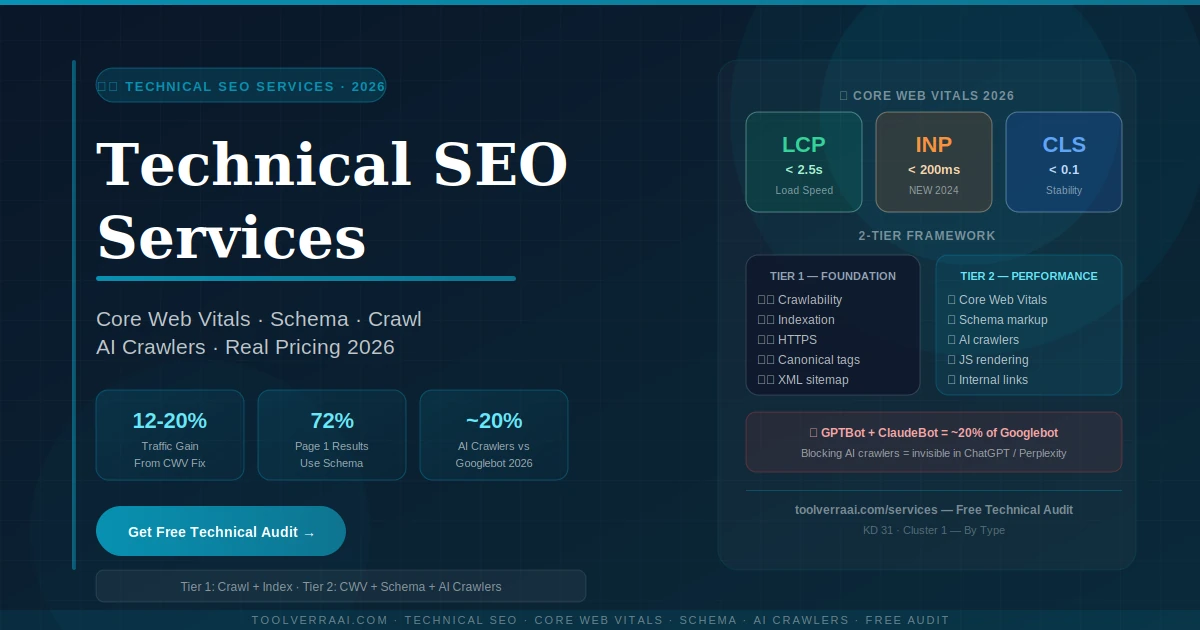
Technical SEO services optimize the infrastructure of your website — not the content itself — so that Google and AI search platforms can efficiently crawl, render, index, and rank your pages. In 2026, technical SEO services address a wider surface area than ever before: Core Web Vitals now include INP (Interaction to Next Paint, which replaced FID in 2024), schema markup has become critical for AI citation, and AI crawlers like GPTBot and ClaudeBot now collectively represent approximately 20% of Googlebot’s crawl volume — yet most websites have never checked whether they’re blocking these bots by accident.
The fundamental principle of technical SEO services has not changed, even as the landscape shifts: Google cannot rank what it cannot crawl, index, and trust. Technical SEO removes the barriers that prevent your content and links from performing to their full potential. A site with excellent content but severe crawl errors won’t rank. A site with strong backlinks but slow load times will lose positions to faster competitors. This guide explains exactly what professional technical SEO services cover in 2026, what they cost, and what questions to ask before hiring.
⚙️ What Are Technical SEO Services?
Technical SEO services are professional optimization services that address the infrastructure layer of your website — the elements search engines interact with before they ever evaluate your content or authority. While on-page SEO optimizes what users see (content, titles, headings), and off-page SEO builds authority through external signals (backlinks), technical SEO optimizes what search engines experience when they crawl your site: can they access every page? Can they render JavaScript? Does the page load fast enough? Are there duplicate content issues from canonical tag errors? Is structured data implemented correctly?
In 2026, technical SEO services have expanded beyond the traditional checklist to include two new critical areas: AI search readiness (ensuring AI crawlers can access and parse your content) and structured data for AI citation (schema markup is now a primary signal for which sources AI Overviews, ChatGPT, and Perplexity choose to cite in their answers).
⚡ Technical vs On-Page vs Off-Page SEO — The Exact Difference
| SEO Type | What It Optimizes | Primary Goal | Who Does It | First Priority? |
|---|---|---|---|---|
| Technical SEO | Site infrastructure — crawlability, speed, schema, indexation | Google can find & understand your pages | Technical SEO specialist / developer | ✅ Fix first if blockers exist |
| On-Page SEO | Page content — title tags, meta, headings, keywords, images | Google understands what each page is about | SEO copywriter / content strategist | ⚠️ Second — after tech foundation |
| Off-Page SEO | External signals — backlinks, brand mentions, digital PR | Google trusts and ranks your pages highly | Link builder / PR specialist | ❌ Third — after on-page is solid |
🏛️ The 2-Tier Technical SEO Framework for 2026
The most practical way to understand technical SEO services in 2026 is through a two-tier framework. Tier 1 issues are foundation-level — they actively prevent Google from accessing and indexing your content. Tier 2 issues are performance-level — they disadvantage your rankings against competitors who have solved them. Always fix Tier 1 before investing in Tier 2.
- Clean robots.txt — no accidental AI crawler blocks
- XML sitemap — submitted to Google Search Console
- Correct canonical tags — no duplicate content signals
- HTTPS throughout — no mixed content warnings
- No critical crawl errors (404s, redirect loops)
- Mobile-first content parity (no hidden content)
- No accidental noindex on production pages
- LCP under 2.5s · INP under 200ms · CLS under 0.1
- Schema markup — Article, FAQPage, Organization, Service
- JavaScript rendering — content accessible without JS
- Internal link depth — priority pages within 3 clicks
- AI crawler access — GPTBot, ClaudeBot, PerplexityBot
- Log file analysis — actual Googlebot crawl patterns
- Structured data for AI citation eligibility
📋 The 7 Core Technical SEO Service Components
Systematic review of robots.txt, canonical tags, noindex directives, XML sitemaps, and redirect chains. Google Search Console Coverage report analyzed for pages in “Excluded” or “Error” status. Common finding: staging environment noindex tags never removed before launch — blocking key pages from ever being ranked.
LCP, INP, and CLS measured via real user data (CrUX/Google Search Console), not just lab tests. Primary fixes: image preloading, WebP conversion, JavaScript deferral, caching (WP Rocket), CDN (Cloudflare), and server response time (TTFB under 800ms). Comprehensive CWV fixes produce 12-20% organic traffic increases (ALM Corp 2026).
72% of first-page results now use schema markup (Involve Digital 2026) — making it table stakes for competitive rankings. Sites with proper structured data see 20-40% higher CTR. In 2026, schema also determines which sources AI Overviews, ChatGPT, and Perplexity cite in AI-generated answers. Minimum: Organization, Article, FAQPage, Service.
Google uses the mobile version of your site as the primary index. Technical SEO services ensure full content parity between mobile and desktop — no “tap to read more” buttons that hide body content from mobile Googlebot. Mobile usability errors in Search Console are addressed systematically across all page templates.
Mapping the depth of your site’s internal architecture — ensuring priority pages are reachable within 2-3 clicks from the homepage. Identifying orphaned pages (pages with no internal links pointing to them) that Googlebot may never discover. Internal link depth analysis ensures crawl budget is spent efficiently on your most important pages.
Auditing redirect chains (A → B → C instead of A → C), identifying 301 vs 302 misuse, and managing URL parameter handling. Every unnecessary redirect hop wastes PageRank and slows page load. For ecommerce sites, faceted navigation parameter management is a critical component of crawl budget optimization.
New in 2026: auditing robots.txt to ensure GPTBot, ClaudeBot, PerplexityBot, and OAI-SearchBot are not inadvertently blocked. Verifying main content is accessible as plain HTML (not dependent on JavaScript rendering for AI crawlers). Configuring llms.txt via Rank Math. AI crawlers collectively represent ~20% of Googlebot volume — blocking them means losing AI citation traffic.
⚡ Core Web Vitals in 2026 — Explained Simply
Core Web Vitals are Google’s three primary page experience metrics — and they are confirmed ranking factors. Pages at position 1 are 10% more likely to pass Core Web Vitals thresholds than pages at position 9 (Involve Digital 2026). In 2026, the metric set is: LCP, INP, and CLS. INP replaced FID (First Input Delay) in March 2024 — and it’s the metric most sites currently fail.
🤖 Technical SEO & AI Crawlers — The 2026 Blind Spot
This is the most underaddressed technical SEO issue in 2026 — and it’s entirely fixable once you know about it. In late 2024, GPTBot (ChatGPT’s crawler) and ClaudeBot (Anthropic’s crawler) combined made requests equivalent to approximately 20% of Googlebot’s volume. By 2026, AI crawlers collectively represent a meaningful share of server traffic for most websites.
The problem: most websites have never audited whether their robots.txt allows or blocks these AI crawlers. Many sites that implemented AI-blocking rules in 2023 (to prevent content scraping) are now inadvertently invisible to AI search platforms — losing a channel that drives 22-30% of informational query traffic (ITD GrowthLabs 2026).
| AI Crawler | Platform | Robots.txt User-Agent | Block or Allow? |
|---|---|---|---|
| GPTBot | ChatGPT Search | GPTBot | ✅ Allow (unless paywalled content) |
| OAI-SearchBot | ChatGPT Search indexing | OAI-SearchBot | ✅ Allow |
| ClaudeBot | Anthropic / Claude | ClaudeBot | ✅ Allow |
| PerplexityBot | Perplexity AI | PerplexityBot | ✅ Allow |
| Google-Extended | Gemini AI training | Google-Extended | ⚠️ Strategic choice (not required to allow) |
📊 Real Results — What Technical SEO Services Deliver
🔄 One-Time Technical Audit vs Ongoing Technical SEO Services
| Model | What You Get | Cost Range | Best For | Limitation |
|---|---|---|---|---|
| One-Time Technical Audit | Comprehensive issue list, prioritized by impact, action roadmap | $2,000-$10,000 | Site launches, migrations, major redesigns | Point-in-time only — new issues appear after audit |
| Ongoing Technical SEO | Continuous monitoring, proactive issue detection, monthly fixes | $1,000-$5,000/mo | Growing sites, ecommerce, active publishing | Ongoing cost — needed indefinitely |
| Audit + Implementation | Audit + fixing all identified issues in defined scope | $5,000-$30,000 | Sites with known technical debt | Implementation cost varies with site complexity |
| Free Audit First | High-level technical health check, priority issues identified | $0 — ToolVerraAI | Any site — right starting point | Identifies whether full audit is needed |
💰 Technical SEO Services Pricing in 2026
- Crawl + indexation audit
- Core Web Vitals baseline
- Schema review
- Prioritized action list
- No implementation included
- Full audit + all fixes applied
- CWV optimization
- Schema implementation
- AI crawler access setup
- Best for: site launches
- Monthly crawl + monitoring
- Proactive issue detection
- CWV regression monitoring
- Schema maintenance
- Included in most full-SEO retainers
- Large/complex sites (10K+ pages)
- Log file analysis
- JavaScript rendering
- Crawl budget optimization
- Weekly monitoring
❓ Questions to Ask a Technical SEO Service Provider Before Hiring
- “Do you measure Core Web Vitals using field data (CrUX) or only lab tools?” — Field data is what affects rankings. A provider relying only on PageSpeed Insights scores may miss real-user experience failures.
- “Do you audit our robots.txt for AI crawler access?” — If they’ve never heard of GPTBot or ClaudeBot, they are not operating to 2026 technical SEO standards.
- “What schema types do you implement and how do you validate them?” — Correct answer: Google’s Rich Results Test + Schema.org validator. Both must return zero errors.
- “Do you use log file analysis or only crawl tool data?” — Log file analysis shows how Googlebot actually interacts with your site — far more revealing than what crawl tools report from their own simulation.
- “What’s your process when new technical issues appear after the initial audit?” — One-time audits age quickly. Understanding ongoing monitoring processes separates serious providers from report-and-walk services.
- “Can you show us the before-and-after on a previous technical SEO engagement — specifically traffic impact?” — A legitimate technical SEO provider has measurable case studies. Traffic improvements of 12-20% after CWV fixes are documented and verifiable.
- “What do you include vs. charge separately — especially for implementation?” — Technical recommendations without implementation are worthless. Confirm who makes the changes on your site and whether that’s included in the scope.
🎯 Key Takeaways — Technical SEO Services 2026
- Technical SEO removes barriers so content and links can perform — it’s the prerequisite for everything else working
- 2-Tier Framework: Tier 1 (Foundation) — crawlability, indexation, HTTPS, canonical; Tier 2 (Performance) — Core Web Vitals, schema, AI crawler access
- Core Web Vitals 2026: LCP < 2.5s · INP < 200ms (new — replaced FID) · CLS < 0.1. Comprehensive CWV fixes = 12-20% traffic increase
- Schema markup: 72% of first-page results use it · 20-40% CTR lift · Now also critical for AI search citation
- AI crawlers blind spot: GPTBot + ClaudeBot = ~20% of Googlebot volume. Most sites have never audited their robots.txt for accidental AI blocking
- One-time audit: $2,000-$10,000. Ongoing technical SEO: $1,000-$3,000/month. Always included in full-service SEO retainers
- Measure CWV with field data (CrUX/GSC) — not just lab tools (PageSpeed Insights). Field data is what feeds the ranking signal
- Right starting point: free technical SEO audit to identify Tier 1 issues before committing to paid services
🔍 Free Technical SEO Audit — ToolVerraAI
Find out exactly which technical issues are limiting your rankings. Our free audit covers crawlability, Core Web Vitals baseline, schema validation, mobile usability, and AI crawler access — delivered as a prioritized action roadmap.
Technical SEO Services — FAQ
Related: On-Page SEO Services · SEO Audit Services · Complete SEO Services Guide · Get Your Free Technical SEO Audit