
- What Are On Page SEO Services?
- On-Page vs Off-Page vs Technical SEO — The Difference
- The 8 Critical Elements On Page SEO Services Must Cover
- On-Page SEO & AI Search in 2026 — The New Layer
- Real Results — What On-Page SEO Delivers
- How Fast Does On-Page SEO Work?
- Real Pricing in 2026
- The 17-Point On-Page SEO Checklist
- 10 On-Page SEO Mistakes That Kill Rankings
- How to Choose On Page SEO Services
- Free On-Page SEO Audit
- FAQ
On page SEO services optimize everything directly on your web pages — title tags, meta descriptions, heading structure, content, internal links, and schema markup — to improve Google rankings without relying on external factors like backlinks. In 2026, on page SEO services are the single fastest route to ranking improvements: while link building takes months to show impact, on-page optimizations can move rankings in 4 to 8 weeks on pages Google has already indexed. For businesses that already have a website with content but aren’t ranking where they should, on-page SEO is almost always the highest-leverage first investment.
This guide covers exactly what professional on page SEO services include in 2026, what separates them from technical and off-page SEO, real pricing, a complete 17-point checklist you can use yourself, the most common on-page mistakes that silently destroy rankings, and how to find a provider who delivers measurable results.
🔍 What Are On Page SEO Services?
On page SEO services are professional optimization services that improve the elements living directly on your web pages — the content, HTML tags, URL structure, internal architecture, and structured data that signal to Google what each page is about, why it is authoritative, and why searchers will benefit from clicking it. The “on-page” distinction is specific and important: unlike off-page SEO (which focuses on earning backlinks from other websites) or technical SEO (which addresses server, crawling, and infrastructure issues), on-page SEO works entirely within your own pages.
Professional on page SEO services go far beyond keyword insertion. In 2026, they require understanding search intent (what the searcher actually wants to find), semantic search (how Google understands meaning, not just matching text), entity optimization (people, places, tools, and concepts that establish topic relevance), and E-E-A-T signals (demonstrating genuine Experience, Expertise, Authoritativeness, and Trustworthiness through the content itself). Google’s “information gain” principle — rewarding content that provides unique value competitors don’t — makes on-page SEO in 2026 as much about content strategy as it is about HTML tags.
⚡ On-Page vs Off-Page vs Technical SEO — The Exact Difference
Most businesses confuse these three disciplines. Here is the clearest breakdown — and why each one matters at a different stage:
| SEO Type | What It Covers | Where It Lives | Timeline to Impact | First Priority? |
|---|---|---|---|---|
| On-Page SEO | Title tags, meta, content, headings, internal links, schema, images | Your pages directly | 4-8 weeks | ✅ Yes — always first |
| Technical SEO | Crawlability, indexation, speed, Core Web Vitals, mobile, HTTPS | Site infrastructure | 2-6 weeks (fixes) | ⚠️ Fix blockers first |
| Off-Page SEO | Backlinks, brand mentions, digital PR, citations | Other websites | 3-6 months minimum | ❌ After on-page is solid |
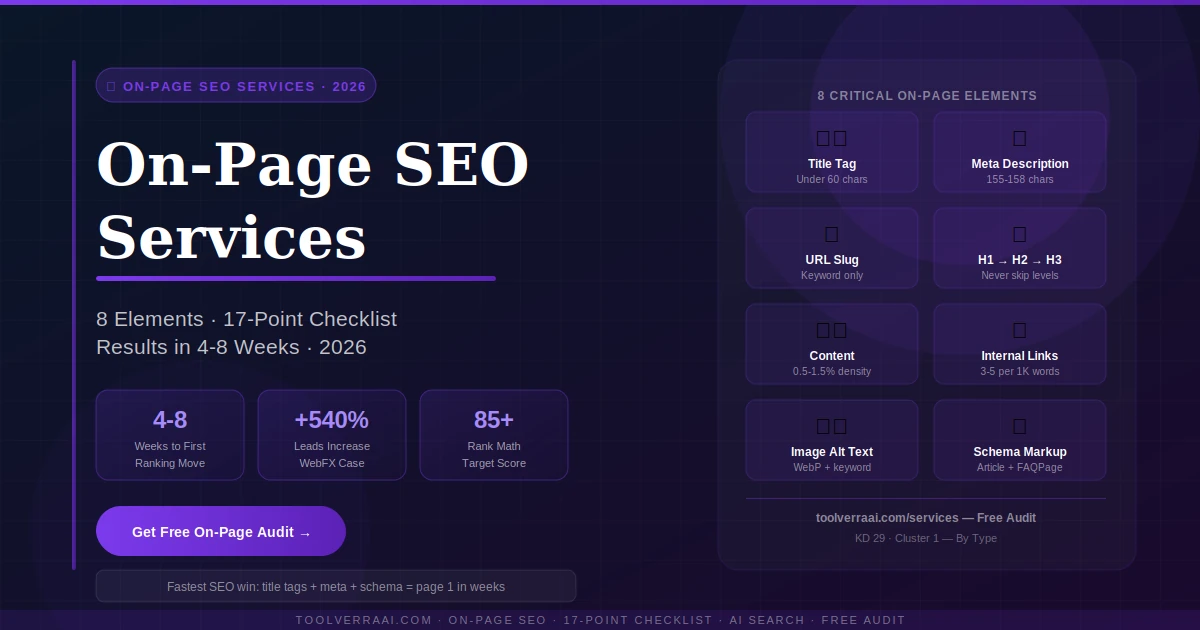
📋 The 8 Critical Elements Every On-Page SEO Service Must Cover
Your title tag is the clickable headline in Google search results — the first signal Google reads to understand your page’s topic and the first thing searchers see before clicking.
- Primary keyword at the beginning (not the end)
- Under 60 characters (Google truncates beyond this)
- One power word — “Complete”, “2026”, “Free”
- Never repeat the keyword twice
- Never stuff multiple keywords
The meta description appears under your title in search results. It doesn’t directly affect rankings — but it directly affects CTR, which influences rankings indirectly as a behavioral signal.
- 155-158 characters exactly
- Include primary keyword — Google bolds it
- State one specific benefit clearly
- Never copy your introduction paragraph
- Never start with “This page is about…”
Your URL slug sends a direct keyword signal to Google. Clean, keyword-focused URLs also earn more clicks — searchers trust URLs that clearly describe the page they’re about to visit.
- Keyword only — remove all stop words
- Under 5 words · Hyphens between words
- All lowercase · No dates
- Never change a published URL without a 301 redirect
Heading tags define your content’s hierarchy for both Google and readers. H1 is your page title (one per page, contains primary keyword). H2s are your main sections. H3s are sub-points. Never skip levels — going H1 → H3 confuses Google’s structural understanding.
- H1: Exactly 1 · Primary keyword · Set by WordPress automatically
- H2: 6-10 per article · Keyword variations naturally
- H3: Sub-points under each H2 · Related terms
- Never add a second H1 in your content body
Content optimization in 2026 is about semantic completeness and information gain — not keyword density. Google evaluates whether your article covers the topic thoroughly, uses related entities naturally, and provides unique value competitors miss.
- Keyword in first 100 words naturally
- Density 0.5-1.5% (Rank Math measures this)
- Use semantic entities throughout — tools, people, concepts
- Never keyword-stuff — triggers spam signals
Alt text describes images for Google’s crawlers and for screen readers. Every image needs descriptive alt text — especially your featured image, which should include the primary keyword. File names set before uploading also pass keyword signals.
- Alt text: describe naturally · Keyword once if relevant
- File name: keyword-based before upload
- Format: WebP (40% smaller than JPEG)
- Never leave alt text blank on any image
Internal links pass authority from established pages to newer content, help Google understand your site’s topical structure, and keep visitors engaged longer. Descriptive anchor text (not “click here”) passes both relevance and context to the linked page.
- 3-5 internal links per 1,000 words
- Descriptive anchor text — topic-relevant words
- Link from high-authority pages to new content
- Never use “click here” or “read more” as anchor text
Schema markup tells Google explicitly what type of content your page contains — enabling rich results (FAQ dropdowns, star ratings, breadcrumbs) that increase CTR by 20-30%. Rank Math adds schema automatically based on post type — free, with 18+ schema types.
- Article — all blog posts
- FAQPage — posts with FAQ section
- Service — service/landing pages
- BreadcrumbList — all pages
🤖 On-Page SEO & AI Search in 2026 — The Layer Everyone Misses
Google AI Overviews now appear in 25.11% of all search queries (Conductor Q1 2026). ChatGPT Search and Perplexity are pulling significant traffic for informational queries. This creates a new on-page optimization layer that most on page SEO services in 2026 still don’t address — and which represents a major opportunity for businesses that get there first.
The key insight: the same on-page signals that help Google rank your content also help AI systems cite it. But there are specific additional elements — called GEO (Generative Engine Optimization) and AEO (Answer Engine Optimization) — that on page SEO services must now include:
| On-Page Element | Traditional SEO Impact | AI Search Impact in 2026 |
|---|---|---|
| Direct-answer block (40-60 words) | Featured snippet eligibility | AI Overview citation source |
| FAQPage schema | FAQ rich results in SERP | AI answers cite FAQPage content directly |
| Semantic entities in content | Topical relevance signal | AI systems recognize and trust entity-rich content |
| E-E-A-T signals | Quality ranking signal | AI platforms prioritize authoritative sources |
| llms.txt (Rank Math 2026) | No traditional impact | Explicitly allows AI crawlers access to your content |
| Structured headings (H2 questions) | People Also Ask eligibility | AI extracts Q&A pairs from heading + paragraph structure |
📊 Real Results — What On Page SEO Services Deliver
⏱️ How Fast Does On-Page SEO Work? — Real Timeline
On-page SEO is the fastest-acting SEO investment available in 2026. Unlike link building (which takes 3-6 months to show ranking impact), on-page changes can move positions on pages Google has already indexed within weeks. Here is what to realistically expect:
💰 On Page SEO Services Pricing in 2026
- Title tag + meta rewrite
- Heading structure review
- Keyword placement check
- Basic schema setup
- Best for: 5-20 priority pages
- 8-20 pages optimized/month
- Full schema implementation
- AI search optimization
- Rank Math score 85+
- Internal linking strategy
- Complete site-wide audit
- All pages prioritized + fixed
- Keyword mapping for all pages
- Schema on all page types
- Best for: site relaunches
- Large catalogs (1,000+ pages)
- Systematic content optimization
- Advanced entity mapping
- GEO/AEO full implementation
- Weekly reporting
✅ The Complete 17-Point On-Page SEO Checklist for 2026
Run through every item for each page before publishing or after optimization. Items marked ⭐ are critical — fix these first if you can only do a few things.
- Title tag: Primary keyword at start · Under 60 characters · One power word · No keyword repetition
- Meta description: 155-158 characters · Keyword included · Written as 158-char advertisement · States specific benefit
- URL slug: Keyword only · No stop words · No dates · Hyphens · Lowercase · Never changed after publishing without 301
- H1: Exactly one per page · Contains primary keyword · Set by page/post title (WordPress)
- Keyword in first 100 words: Primary keyword appears naturally within the first paragraph
- H2 structure: 6-10 H2 sections · Keyword variations used naturally · No heading level skipping (H1 → H2 → H3 only)
- Keyword density: 0.5%-1.5% — check in Rank Math · Never sacrifice readability to hit a number
- Semantic entities: Related tools, people, concepts, and topics mentioned naturally throughout
- Direct-answer block: 40-60 word answer under first H2 — Featured Snippet and AI Overview target
- Images: Alt text on all images · WebP format · File names keyword-based · Featured image 1200×630 px
- Internal links: 3-5 links to related pages per 1,000 words · Descriptive anchor text
- External links: 1-2 dofollow links to authoritative sources (no nofollow on legitimate citations)
- Article schema: Enabled in Rank Math for all blog posts and articles
- FAQPage schema: Enabled for all posts with FAQ section · Minimum 4 Q&As
- Rank Math score: 85 or above · Never force to 100 (keyword stuffing hurts readability)
- Page speed: LCP under 2.5 seconds on mobile · Check via Google Search Console
- AI readiness: llms.txt configured (Rank Math 2026) · GPTBot not blocked in robots.txt
🚩 10 On-Page SEO Mistakes That Kill Rankings in 2026
- Duplicate meta descriptions across multiple pages — Google ignores duplicate metas and generates its own (usually worse) alternative. Every page needs a unique, hand-crafted meta description.
- H1 not matching the page’s primary keyword — Your H1 is Google’s primary signal for your page’s topic. A generic H1 like “Welcome to Our Blog” tells Google nothing about what the page covers.
- Keyword in the last paragraph only — Many writers add the keyword at the end to satisfy Rank Math. Google reads the first 100 words for the primary topic signal — if the keyword isn’t there, the page starts with zero relevance.
- Images with no alt text — Every unoptimized image is a missed relevance signal and an accessibility failure. Google’s crawlers can’t see images — alt text is the only way they understand what an image shows.
- Title tags over 60 characters — Google truncates titles beyond 60 characters in search results, cutting off your keyword or value proposition mid-sentence. This reduces CTR and wastes the primary ranking signal.
- Internal links using “click here” as anchor text — “Click here” passes zero topical relevance to the linked page. “Read our complete guide on keyword research for bloggers” passes both topic context and relevance signals.
- Forcing Rank Math score to 100 — Reaching 100/100 typically requires inserting the keyword into every heading, which destroys natural reading flow. A score of 85-92 with natural writing consistently outranks a 100/100 keyword-stuffed page.
- No schema markup on service or product pages — Pages without schema markup are invisible to rich result features (FAQ dropdowns, star ratings, price displays) and have significantly lower click-through rates in competitive SERPs.
- Changing URL slugs without 301 redirects — Every URL change without a redirect destroys accumulated backlink equity and creates 404 errors for anyone who bookmarked or linked to the original URL.
- Blocking AI crawlers in robots.txt — Many WordPress sites have GPTBot and Anthropic bots blocked by default (from early AI content scraping concerns). This makes your content invisible to AI search recommendations — a growing traffic source in 2026.
✅ How to Choose On Page SEO Services in 2026
| What to Ask | Green Flag ✅ | Red Flag 🚩 |
|---|---|---|
| Do they audit first? | Full audit before proposing work | Quotes package without seeing your site |
| How do they measure success? | Ranking positions + organic traffic + conversions | “We’ll improve your SEO” (no specifics) |
| Do they cover AI search? | GEO/AEO + llms.txt + direct-answer blocks | Never mentions ChatGPT or AI Overviews |
| Do they include schema? | Article + FAQPage + Service schema standard | “We’ll add keywords to your pages” |
| What’s their Rank Math approach? | Target 85+, explain why not 100 | Promise to get your score to 100 |
| Do they report on specifics? | Weekly rank tracking, which pages moved | Monthly report with only traffic graphs |
🎯 Key Takeaways — On Page SEO Services 2026
- On-page SEO optimizes title tags, meta, headings, content, internal links, images, and schema — elements you control directly on your pages
- Fastest SEO win available: on-page changes produce ranking movement in 4-8 weeks (vs 3-6 months for link building)
- Always optimize on-page before investing in off-page link building — links to poorly optimized pages produce minimal results
- 8 critical elements: title tag · meta description · URL · H1-H3 · content/keyword · image alt · internal links · schema markup
- 2026 addition: AI search layer (GEO/AEO) — direct-answer blocks, FAQPage schema, llms.txt, entity optimization for AI Overviews + ChatGPT
- Rank Math target: 85+ not 100 — forcing to 100 requires keyword stuffing that hurts readability and rankings
- Biggest mistake: pages in positions 4-15 with no on-page optimization — these are fastest wins available
- Pricing: $150-$500/page · $1,000-$3,000/month · $2,000-$8,000 full-site audit
🔍 Free On-Page SEO Audit — ToolVerraAI
Find out exactly which pages on your site need on-page optimization first — and which quick fixes will move rankings fastest. Our free audit delivers a prioritized action plan.
On Page SEO Services — FAQ
Related: Technical SEO Services · SEO Content Services · Complete SEO Services Guide · Get Your Free SEO Audit