
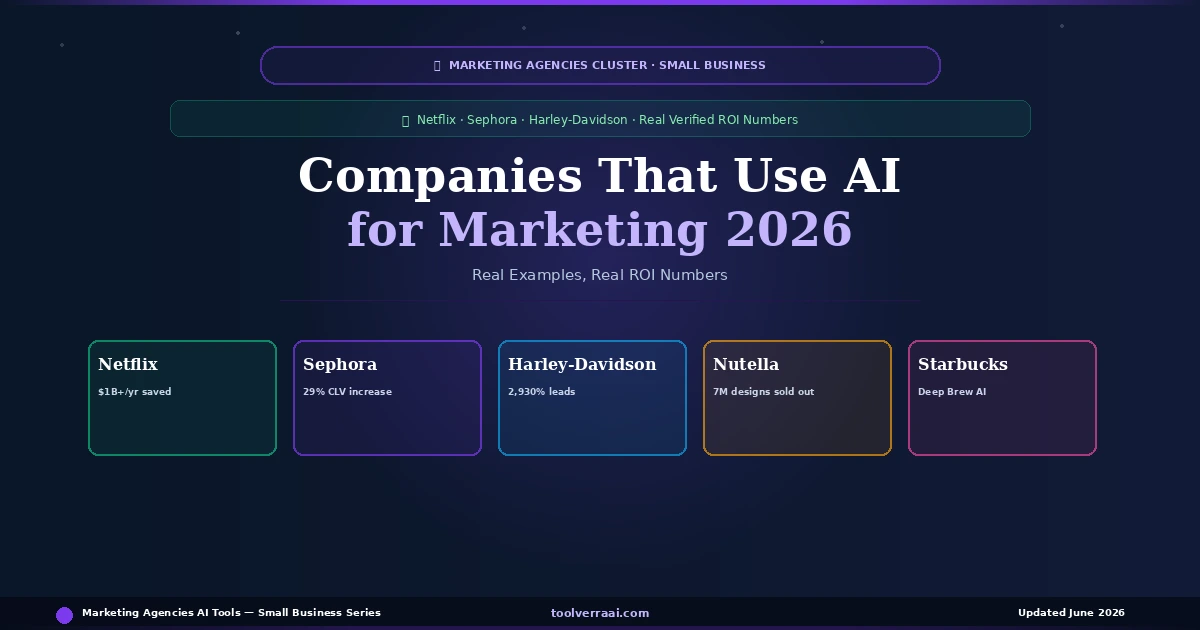
Looking at companies that use AI for marketing 2026 with real numbers attached — not vague claims — reveals a consistent pattern: the brands winning with AI are not using the newest models, they are building governed, repeatable workflows around proven ones. This guide covers companies that use AI for marketing 2026 with verified ROI data, exactly what each company does operationally, and how smaller businesses can apply the same principles without enterprise budgets.
Among companies that use AI for marketing 2026, the common thread across every documented success is that AI amplified existing expertise rather than replacing it. None of these results came from simply turning on a generic AI tool — each required training on brand-specific data inside a defined workflow.
🏆 Companies That Use AI for Marketing 2026 — 7 Proven Real Examples
Netflix is probably the most cited example among companies that use AI for marketing in 2026, and for good reason. Its recommendation engine influences over 80% of the content people watch on the platform, saving an estimated $1 billion or more per year in reduced churn. Beyond recommendations, Netflix runs a dedicated predictive churn modeling system that identifies at-risk subscribers and automatically triggers targeted retention campaigns before they cancel.
Sephora’s Beauty OS represents one of the most complete AI marketing ecosystems in retail — integrating predictive customer lifetime value modeling, AI-driven product recommendations, ModiFace virtual try-on technology, and Skin IQ diagnostics into one unified experience across web, app, and in-store. Customers using the virtual try-on feature convert at 3x the rate of those who don’t, and cross-category purchases increased 47% since rollout.
Harley-Davidson’s New York dealership used Albert.ai, an AI-powered marketing platform, to automate and optimize digital advertising across channels. The AI dynamically adjusted targeting, creative, and spend allocation in real time based on live performance signals — resulting in a 2,930% increase in leads and a 40% decrease in cost per lead, outcomes that would be impossible to replicate manually at this scale and speed.
Starbucks built its own proprietary AI engine, Deep Brew, to transform raw customer data into actionable marketing insights integrated directly into its mobile app and store operations. The system personalizes offers and recommendations at the individual customer level, demonstrating how a company can build internal AI capability rather than relying solely on third-party platforms.
Nutella used AI to create 7 million unique label designs for a limited-edition campaign — every single jar produced sold out. This is one of the clearest examples among companies that use AI for marketing in 2026 of generative AI creating genuine personalization at mass-production scale, not just incremental efficiency gains.
Mango produced campaign assets for its teen line collection using generative AI — photographing real products first, then using AI to build the full campaign visuals around those photographed items. The process kept product presentation accurate while speeding up creative production, positioning the workflow as a repeatable internal capability for future campaigns rather than a one-off experiment.
Nestlé uses AI to gain real-time insights into shifting consumer preferences, optimizing both global and local marketing campaigns to increase relevance, reduce media waste, and improve brand resonance across multiple markets simultaneously — a use case especially relevant for any multi-market or multi-region business.
🔍 Companies That Use AI for Marketing 2026 — The Honest Common Pattern
Looking across every documented case among companies that use AI for marketing 2026, four patterns repeat regardless of industry: AI amplifies existing human expertise rather than replacing it; the best results come from training AI on brand-specific data rather than using generic models; AI performs best applied to specific, well-defined tasks rather than broad organizational deployment; and results compound over time as the system learns from more data.
📊 Companies That Use AI for Marketing 2026 — Essential ROI Comparison
| Company | Primary Use Case | Key Result |
|---|---|---|
| Netflix | Churn prediction | $1B+/year saved |
| Sephora | CLV + AR try-on | 29% CLV increase |
| Harley-Davidson NYC | Autonomous ad spend | 2,930% lead increase |
| Starbucks | Proprietary AI engine | Personalized app offers |
| Nutella | Generative design | 7M designs, sold out |
| Mango | AI campaign visuals | Faster, repeatable production |
| Nestlé | Real-time consumer insight | Reduced media waste |
🚀 Companies That Use AI for Marketing 2026 — How Smaller Businesses Can Apply This
Companies that use AI for marketing 2026, as listed above, operate at enterprise scale, but the underlying principles apply directly to small businesses. Churn prediction logic (Netflix) scales down to a simple email automation flagging customers who haven’t purchased in 60 days. Personalized recommendations (Sephora) scale down to basic product suggestion logic in any e-commerce platform. Generative design at scale (Nutella) scales down to using accessible AI marketing tools like Canva’s Magic Studio for product variation mockups.
🎯 Key Takeaways — Companies That Use AI for Marketing 2026
- Companies that use AI for marketing 2026: Netflix, Sephora, Harley-Davidson, Starbucks, Nutella, Mango, Nestlé all show verified ROI
- Netflix’s recommendation engine influences 80%+ of viewing and saves $1B+/year via churn reduction
- Sephora’s Beauty OS delivered 29% CLV increase and 3x conversion on AI-powered virtual try-on
- Harley-Davidson NYC saw 2,930% lead growth using autonomous AI ad optimization (Albert.ai)
- Nutella’s 7 million unique AI-generated labels completely sold out — mass personalization at scale
- The common pattern: AI amplifies human expertise, trained on brand data, applied to specific tasks
- Companies treating AI as a governed workflow layer outperform those using it as a content shortcut
- Small businesses can apply the same principles at smaller scale — churn flags, product recommendations, design variation
- Results compound over time as AI systems learn from more brand-specific data
- None of these results came from a generic, untrained AI tool — brand-specific training is the differentiator
Companies That Use AI for Marketing 2026 ✅
Start with one specific bottleneck, not a full AI overhaul
Small Business AI Tools → Full Agency Tools Guide →Companies That Use AI for Marketing 2026 — Frequently Asked Questions
Best AI Tools for Marketing Agencies · AI Tools for Small Business · What Tools Do Agencies Use?