
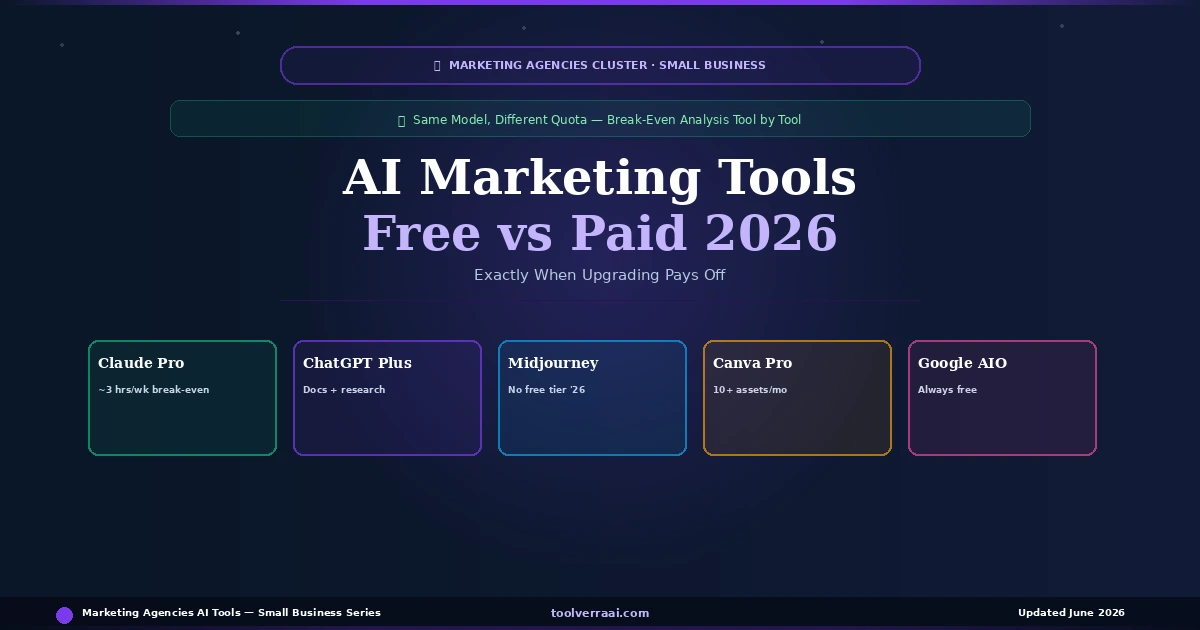
The debate over AI marketing tools free vs paid in 2026 is usually framed wrong. This guide to AI marketing tools free vs paid 2026 breaks it down tool by tool with an honest break-even analysis, so you know exactly when upgrading pays for itself — not just whether a paid tier exists.
The mistake most people make researching AI marketing tools free vs paid 2026 is treating it as a binary choice. It isn’t. Both free and paid AI tools have a real place in a working marketing stack — the actual mistake is choosing the wrong tier for what you specifically need to accomplish right now, not choosing free over paid or vice versa.
🔑 The key fact most comparisons skip: Claude’s free tier and Claude Pro run the exact same model. ChatGPT Free and Plus both tap GPT-4o. The difference isn’t quality — it’s how much you can do before hitting a quota wall, and what specific capabilities unlock beyond it.
🔍 AI Marketing Tools Free vs Paid 2026 — The Truth Nobody Tells You
Before any tool-by-tool breakdown of AI marketing tools free vs paid 2026, understand this: free and paid tiers of the same AI model are usually identical in raw capability. What changes is the usage ceiling before you hit a wall, and which specific features — file uploads, web browsing, longer context, higher resolution — unlock on the paid side. This reframes the entire decision: you’re not paying for “better AI,” you’re paying to remove a specific friction point in your actual workflow.
📊 AI Marketing Tools Free vs Paid 2026 — Tool-by-Tool Break-Even
Claude Pro’s $20/month pays back in roughly 3 hours of weekly work for most solo marketers. The 200K context window removes the single biggest daily friction point: re-prompting and manually re-entering brand context in every new conversation. If you’re doing any sustained content or strategy work for one brand, this single feature alone justifies the cost.
✓ Worth it for regular marketing workThe primary additions in ChatGPT Plus: file upload and analysis (PDFs, spreadsheets, CSVs), higher message limits on GPT-4o, live web browsing for research, and deeper agent capabilities. For marketing work involving document processing or structured research, Plus is a material upgrade. For simple conversational writing help, the free tier may be sufficient.
✓ Worth it if you process documents or research liveMidjourney has no free tier in 2026, so the real comparison is its $10/month Basic plan against free alternatives like Canva AI, Adobe Firefly, or DALL·E. Midjourney produces more stylistically consistent, commercially polished output than any free option available. Worth it if image generation is central to your ad creative workflow — not worth it for occasional, one-off image needs.
✓ Worth it for image-heavy ad workflows onlyCanva Pro is worth it specifically once you’re producing 10 or more branded assets per month. Below that volume, the free tier’s template library and basic Magic Studio features generally cover occasional needs without justifying the upgrade. The Brand Kit feature (saved logo, colors, fonts) is the single biggest reason teams upgrade once volume increases.
✓ Worth it at 10+ assets/month — skip below thatHubSpot’s free plan covers basic CRM features adequately for very small operations. AI-powered features are gated across paid tiers starting at $45/user/month for smart CRM tools. The upgrade is worth it specifically when you need AI-driven lead scoring or automated personalization — not for basic contact management, which the free tier already handles well.
✓ Worth it for AI lead scoring — not for basic CRM use💎 AI Marketing Tools Free vs Paid 2026 — Underrated Free Tools
Some of the most strategically valuable tools in the AI marketing tools free vs paid 2026 landscape cost nothing at all and are widely overlooked. Google’s AI Overviews and SGE Labs data is the standout example — it shows marketers exactly which search queries trigger an AI Overview, which sources Google’s AI cites, and how the summary is structured. This is primary data functioning as an explicit content brief for AEO positioning, and no third-party paid tool gives you this exact signal directly from the source.
📋 AI Marketing Tools Free vs Paid 2026 — Quick Decision Table
| Tool | Free Tier? | Paid Price | Upgrade Trigger |
|---|---|---|---|
| Claude | Yes (same model) | $20/mo | 3+ hrs/week of repeated context |
| ChatGPT | Yes (same model) | $20/mo | Document analysis or live research needed |
| Midjourney | None in 2026 | $10/mo Basic | Image gen central to ad workflow |
| Canva | Yes, generous | $12.99/mo | 10+ branded assets/month |
| HubSpot CRM | Yes, basic features | $45/user/mo | Need AI lead scoring |
| Google AI Overviews | Always free | — | — |
🎯 Key Takeaways — AI Marketing Tools Free vs Paid 2026
- AI marketing tools free vs paid 2026: free and paid tiers usually run the SAME underlying model
- The real difference is usage quota and which specific features unlock — not raw AI quality
- Claude Pro ($20/mo) pays back in ~3 hours/week via the 200K context window eliminating re-prompting
- ChatGPT Plus is worth it for document analysis and live research — not for simple chat
- Midjourney has no free tier in 2026 — only worth $10/mo if image gen is central to your ad workflow
- Canva Pro pays off specifically at 10+ branded assets per month — skip it below that volume
- HubSpot CRM’s free plan is genuinely sufficient until you need AI-driven lead scoring
- Google’s free AI Overviews data is the most underrated free AEO tool — no paid tool replicates it exactly
- The real question: what specific friction point does the paid tier remove, not free vs paid generally
- If you can’t name your specific friction point, stay on free until you can
Know Exactly When to Upgrade ✅
Match the paid tier to a specific friction point, not a vague feeling
Small Business AI Tools → Full Agency Tools Guide →Free vs Paid AI Marketing Tools Honest Comparison — Hidden Costs
Beyond the sticker price, several hidden expenses affect total cost of ownership — see G2’s Marketing AI category for independent user-reported cost breakdowns. Implementation and integration fees can add 20-30% to initial costs. Training expenses, ongoing maintenance, and API usage overages frequently catch buyers off guard — especially for teams that scale usage faster than anticipated after initial adoption.
AI subscriptions may require developer support for SSO, SCIM, or API access — adding real hidden costs beyond the listed subscription price. Freemium tiers may withhold key features like audit logs entirely, features many businesses only discover they need after a compliance review.
Switching from a free tier to paid (or between platforms entirely) can disrupt workflows already built around the free version’s specific limitations and quirks. This transition cost is rarely factored into the initial “free vs paid” decision but compounds significantly at team scale.
Free vs Paid AI Marketing Tools Honest Comparison — Commercial Use Risk
The risk most reviews skip entirely in a free vs paid AI marketing tools honest comparison: free AI image and content tools often carry unclear or restrictive licensing terms. Using such outputs for ads, websites, or client projects can be genuinely risky from a legal standpoint — a risk most marketers never think to check before publishing.
Free vs Paid AI Marketing Tools Honest Comparison — Lock-In Risk Both Ways
A frequently overlooked dimension of free vs paid AI marketing tools honest comparison: lock-in risk runs in both directions. Building your entire workflow around one expensive paid tool carries real financial risk — your operational costs could rise with little warning at renewal. But building a core workflow around a free tier carries equal risk in the opposite direction: the specific features you depend on could move behind a paywall or get severely limited overnight, with no warning and no negotiating leverage.
| Risk Type | Free Tools | Paid Tools |
|---|---|---|
| Commercial usage rights | Often unclear/restrictive | Usually explicit and clear |
| Feature paywall risk | High — can vanish overnight | Low — contracted terms |
| Price increase risk | None (it’s free) | Real, at renewal |
| Audit logs / compliance | Frequently withheld | Usually included |
| Integration/training cost | Lower but still present | Higher (20-30% on top) |
Free vs Paid AI Marketing Tools Honest Comparison — The 3-Step Audit
Before committing to either side of any free vs paid AI marketing tools honest comparison, run this audit:
🎯 Key Takeaways — Free vs Paid AI Marketing Tools Honest Comparison
- Free vs paid AI marketing tools honest comparison: the real question is total cost of ownership, not sticker price
- Hidden integration and training costs add 20-30% on top of any listed subscription price
- Free AI tools often carry unclear commercial licensing — risky for ads, client work, or public campaigns
- Lock-in risk runs both directions: expensive paid tools can raise prices, free tools can paywall features overnight
- Mitigate lock-in by choosing vendors with sustainable business models, not just attractive current pricing
- AI software prices have actually decreased 15% since 2024 per Gartner — the market is becoming more buyer-friendly
- Free tiers in 2026 (Microsoft Copilot, Google Gemini in Workspace) are genuinely more capable than two years ago
- Run a 3-step audit — needs audit, strategic testing, true cost calculation — before committing to either side
- If a tool doesn’t improve your work within the first week, it likely never will — drop it and reassess
- Agencies specifically should weigh commercial usage rights heavily — client deliverables carry real legal exposure
Audit Before You Commit ✅
The sticker price is rarely the real cost — check the fine print first
Tool-by-Tool Break-Even Guide → Full Agency Tools Guide →AI Marketing Tools Free vs Paid 2026 — Frequently Asked Questions
Best AI Tools for Marketing Agencies · AI Tools for Small Business · Companies Using AI for Marketing