
- The 5-Workflow Framework for Finance AI
- General Purpose AI: ChatGPT, Claude, Julius AI
- AP Automation: Ramp, Vic.ai, Stampli, BILL
- Bookkeeping & Close: QuickBooks, Xero, BlackLine, Numeric
- FP&A & Forecasting: Fathom, Cube, Datarails
- Outsourced AI Finance: Zeni, Pilot
- Documented ROI — What AI Actually Saves Finance Teams
- Full Comparison Table
- Recommended Stacks by Company Size
- FAQ
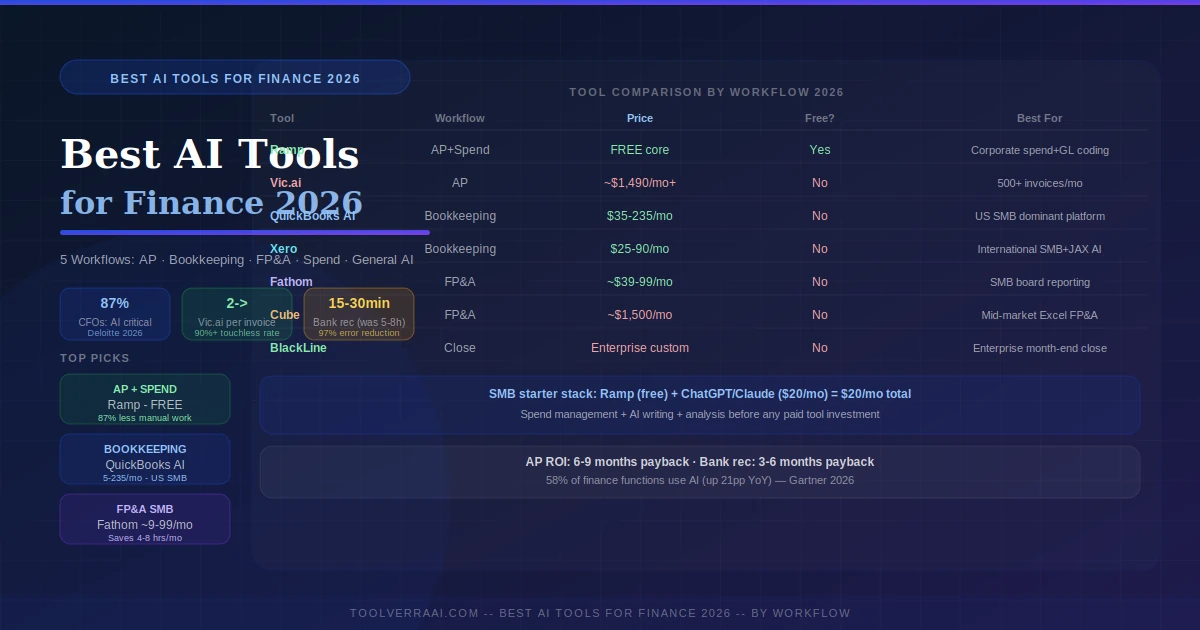
87% of CFOs believe AI will be extremely or very important to finance operations in 2026, according to Deloitte’s CFO Signals research. 58% of finance functions already used AI in 2024 — up 21 percentage points year over year (Gartner). The best AI tools for finance in 2026 span five distinct workflows: accounts payable automation, bookkeeping and close, FP&A and forecasting, spend management, and general-purpose financial analysis. The right tools depend entirely on company size and where your team’s time is going. This guide covers every major category with verified pricing and a clear stack recommendation by company stage.
🗂️ Best AI Tools for Finance 2026 — The 5-Workflow Framework
Finance AI tools don’t compete across categories — they serve distinct workflows. The best AI tools for finance match the bottleneck, not the hype. Identify where your team’s time is actually going before evaluating any tool.
Workflow 1
Invoice capture, GL coding, approval routing — highest ROI category
Workflow 2
Reconciliation, month-end close, anomaly detection, bank matching
Workflow 3
Budgeting, scenario modeling, board reporting, variance analysis
Workflow 4
Corporate cards, expense policy enforcement, real-time GL coding
Workflow 5
Financial memos, policy drafts, data analysis, modeling explanations
🤖 Best AI Tools for Finance 2026 — General Purpose AI
ChatGPT Plus / Claude Pro — Best General Finance AI
For most finance professionals, ChatGPT or Claude at $20/month covers 70-80% of routine AI needs: financial memo drafting, variance explanation narratives, board report summaries, policy document creation, and quick calculations. Claude Pro is stronger for nuanced long-form financial documents — annual report analysis, complex policy drafts, detailed board memos. ChatGPT is stronger for structured financial templates, automated workflows, and data analysis when paired with Advanced Data Analysis. The free tier of both tools is functional for basic financial content work.
Julius AI — Best AI Data Analysis Without Coding
Julius AI allows finance professionals to upload spreadsheets, CSV exports, or financial datasets and ask questions in plain English — generating charts, identifying trends, and running calculations without any coding. For finance teams without dedicated data science resources, Julius bridges the gap between raw financial data and presentation-ready insights. At $20/month, it’s accessible alongside any existing accounting tool stack.
📄 Best AI Tools for Finance 2026 — AP Automation
Ramp — Best Free AP & Spend Automation Tool
Ramp is the most accessible entry point among all best AI tools for finance because its core platform is genuinely free — not a limited trial. Ramp’s AI coding agent automatically categorizes card transactions to the correct GL codes, flags policy violations, detects potential fraud, and syncs end-to-end from card swipe to ERP. Finance teams using Ramp report 87% reduction in manual expense categorization time. The free tier handles corporate cards, basic AP, and spend management. Paid Essentials (from $15/user/mo) adds advanced features for larger teams.
Strengths
- Free core platform — genuinely functional
- AI GL coding — 87% reduction in manual categorization
- Fraud detection + price intelligence
- End-to-end: card swipe → ERP sync
- Fast implementation vs enterprise alternatives
Limitations
- US-focused (limited international support)
- Best for corporate spend, not high-volume vendor AP
Vic.ai — Best for High-Volume AP Automation
Vic.ai is purpose-built for autonomous AP processing at scale. Unlike rule-based AP automation, Vic.ai uses machine learning that improves over time — learning from past coding decisions without requiring templates or configuration updates. At scale (1,000+ invoices/month), Vic.ai achieves 90%+ straight-through processing rates, cutting invoice cost from approximately $12 per invoice to under $2. The ROI at this volume is compelling: AP automation payback documented at 6-9 months. For teams processing under 500 invoices/month, Vic.ai’s pricing and implementation complexity is overkill — Stampli or BILL cover that range effectively.
Stampli & BILL — Mid-Market AP Tools
Stampli’s differentiator is its communication-centric approach — invoice discussions, approvals, and AI coding all live alongside each other in one place, reducing the email chains that make manual AP processes slow. Starting at $49/month for teams with up to $100K monthly expenses, it’s the most accessible paid AP automation tool. BILL (formerly Bill.com) at $45/user/month covers both AP and AR automation in one platform with strong QuickBooks and Xero integration — the practical choice for SMBs wanting combined payables and receivables management.
📒 Best AI Tools for Finance 2026 — Bookkeeping & Close
QuickBooks + Intuit Assist — Best SMB Accounting AI
QuickBooks remains the dominant US small business accounting platform in 2026, and Intuit Assist — its built-in AI — adds cash flow forecasting, AI-drafted invoices, anomaly detection, and a conversational interface for financial questions directly within the QuickBooks dashboard. For most US SMBs already on QuickBooks, Intuit Assist is the most accessible AI starting point — no additional tool, no integration required. G2 rating 4.0/5 reflects mature, widely tested software. The $35/month Simple Start to $235/month Advanced range covers most SMB needs.
Xero — Best International SMB Accounting AI
Xero’s 2026 AI addition is Just Ask Xero (JAX) — a conversational AI agent within the Xero interface for querying financial data, understanding account balances, and getting guidance on accounting tasks in plain language. Bank reconciliation matching is automated and significantly improved in 2026. G2: 4.4/5, strong for cloud-based international accounting. The $25/month Starter to $90/month Ultimate plans are well-priced for SMBs, particularly outside the US where QuickBooks dominance is less absolute.
BlackLine & Numeric — Best Month-End Close Automation
BlackLine is the enterprise standard for financial close automation — AI-powered transaction matching, auto-certification, and close workflow management. The documented ROI is significant: bank reconciliation time drops from 5-8 hours to 15-30 minutes per cycle with a 97% error rate reduction. BlackLine’s custom enterprise pricing reflects a significant investment appropriate for mid-to-large companies where close efficiency has material business impact. Numeric is the mid-market alternative — offering AI-drafted flux analysis, instant reconciliations, and CFO-ready reporting at pricing accessible for teams that aren’t at BlackLine’s scale. See our Best SEO Tools for Small Businesses 2026 guide for how finance tools fit into broader SMB operations.
📈 Best AI Tools for Finance 2026 — FP&A & Forecasting
Fathom is the most accessible FP&A tool for SMBs that don’t need enterprise-grade planning software. It connects directly to QuickBooks, Xero, and MYOB to generate professional management reports, cash flow forecasts, and KPI dashboards at a price point accessible to businesses that can’t justify Cube or Datarails. Board presentation prep is a standout use case — Fathom auto-generates polished financial summaries from your accounting data. For CFOs and finance teams doing manual board report preparation, Fathom typically saves 4-8 hours per month.
Cube is unique among FP&A tools in that it works inside Excel and Google Sheets rather than replacing them — adding version control, multi-source data consolidation, scenario modeling, and AI-driven variance analysis to the spreadsheet tools finance teams already use. Agentic AI for forecasting answers natural language questions via Slack or Teams integrations. At approximately $1,500/month, Cube is priced for mid-market teams where the alternative is hiring additional FP&A headcount — the ROI calculation is typically straightforward at that scale.
🏢 Outsourced AI Finance: Zeni & Pilot
Zeni and Pilot offer outsourced AI bookkeeping services — a managed AI finance back office with human expert review, rather than self-serve software. Zeni provides real-time CFO dashboards, burn rate monitoring, cash runway visibility, and investor reporting in a model where the AI handles transaction processing and human accountants review the output. Pilot takes a similar approach. For Series A-B startups that need professional financial operations but don’t yet have — or want — a full-time controller, the outsourced AI finance model delivers institutional-quality financials without headcount investment.
📊 Documented ROI — What AI Actually Saves Finance Teams
💰 AI Finance ROI Data 2026 (Documented)
📊 Best AI Tools for Finance 2026 — Full Comparison
| Tool | Workflow | Price | Free? | Best For |
|---|---|---|---|---|
| ChatGPT / Claude | General | $20/mo | ✅ | Memos, analysis, policy drafts |
| Ramp | AP + Spend | Free core | ✅ | Corporate spend + GL coding |
| Vic.ai | AP | ~$1,490/mo+ | ❌ | 500+ invoices/month (enterprise) |
| Stampli | AP | From $49/mo | ❌ | SMB-mid AP with comms layer |
| BILL | AP + AR | $45/user/mo | ❌ | Combined SMB AP + AR |
| QuickBooks AI | Bookkeeping | $35-235/mo | ❌ | US SMB accounting (dominant) |
| Xero | Bookkeeping | $25-90/mo | ❌ | International SMB accounting |
| BlackLine | Close | Custom | ❌ | Enterprise month-end close |
| Numeric | Close | Mid-market | ❌ | Mid-market BlackLine alternative |
| Fathom | FP&A | ~$39-99/mo | ❌ | SMB management reporting |
| Cube | FP&A | ~$1,500/mo | ❌ | Mid-market Excel-native FP&A |
| Zeni / Pilot | Outsourced | Custom | ❌ | Startup outsourced bookkeeping |
| Julius AI | Data Analysis | ~$20/mo | ❌ | Finance data analysis, no code |
🏗️ Recommended AI Finance Stacks by Company Size
🔑 Match Your Company Stage to the Right Stack
📖 See also: Our Best AI Tools for Freelancers 2026 guide covers Wave (free bookkeeping) and FreshBooks ($17/mo) for solo freelancers and contractors managing their own finances outside an accounting team context.
🎯 Best AI Tools for Finance 2026 — Key Takeaways
- The best AI tools for finance 2026 work by workflow — AP automation, bookkeeping/close, FP&A, spend management, and general purpose AI each require different tools
- 87% of CFOs believe AI is extremely important to finance in 2026 (Deloitte); 58% of finance functions already use AI — up 21 points YoY (Gartner)
- Ramp’s free core platform is the best starting point — covers corporate spend, AP coding, and expense management at zero cost with genuine AI automation
- Vic.ai cuts invoice processing from ~$12 → under $2 per invoice at 90%+ straight-through rate — only justified for teams processing 500+ invoices/month
- Bank reconciliation AI (BlackLine, Numeric) reduces close time from 5-8 hours to 15-30 minutes with 97% error rate reduction — payback typically 3-6 months
- QuickBooks + Intuit Assist ($35-235/mo) is the default US SMB stack; Xero ($25-90/mo) is better for international businesses
- Fathom (~$39-99/mo) is the most accessible FP&A tool for SMBs — board report preparation is the highest-impact use case saving 4-8 hours/month
- Cube (~$1,500/mo) is the mid-market choice for Excel-native FP&A — adds version control, scenario modeling, and AI variance analysis inside existing spreadsheets
- Zeni and Pilot offer outsourced AI bookkeeping for VC-backed startups wanting real-time CFO dashboards without hiring a controller
- ChatGPT or Claude at $20/month covers 70-80% of routine finance writing tasks — variance explanations, memo drafting, policy writing — for any finance professional
Related Guides
FAQ — Best AI Tools for Finance
Not Sure Which AI Finance Tools Fit Your Team?
Get a free consultation — we’ll map the right AI finance stack to your company size, transaction volume, and workflows.
Get Your Free AI Audit →📚 Related AI Tools Guides on ToolVerraAI