
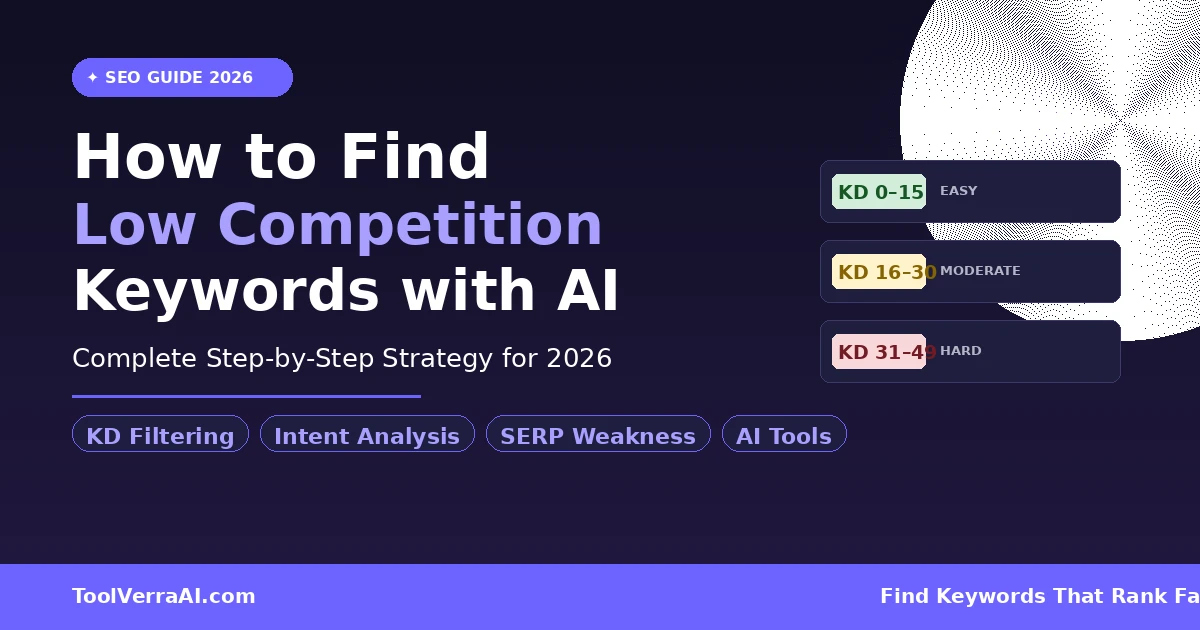
Learning how to find low competition keywords with AI in 2026 is the fastest way to generate Google traffic on a new or growing website. This guide covers the complete 5-step process — AI seed generation, KD filtering, intent matching, SERP weakness analysis, and topic clustering — with specific tools, real examples, and a keyword research checklist you can use today.
- What Is a Low Competition Keyword and Why It Matters
- The KD Score Framework: How to Read Keyword Difficulty
- Step 1 — Generate Seed Keywords with AI
- Step 2 — Filter by Keyword Difficulty Score
- Step 3 — Analyze Search Intent
- Step 4 — Check SERP Weakness Signals
- Step 5 — Cluster and Build Your Content Calendar
- AI Tools Comparison for Keyword Research
- GrandRanker Deep Dive
- Common Mistakes to Avoid
- Keyword Research Checklist
- FAQ
✅ What Is a Low Competition Keyword and Why It Matters
A low competition keyword is a search term that fewer authoritative websites are actively targeting. In practical terms, it means:
- Keyword Difficulty (KD) score of 0–30 — the standard benchmark across Ahrefs, SEMrush, GrandRanker, and Moz
- Top 10 results have weak backlink profiles — sites with low Domain Authority are ranking on page 1
- Content in the top 10 is thin or outdated — easy to beat with a thorough, up-to-date article
- Forums, Reddit, and Quora appear on page 1 — the strongest SERP weakness signal available
Most new bloggers make the same costly mistake: they target keywords that Forbes, HubSpot, or Neil Patel already dominate. The result is zero traffic, zero rankings, and zero revenue — despite months of hard work. The smarter play is to use AI to find the keywords your competitors have overlooked — low-KD terms with real search volume that you can rank for in weeks, not years.
📊 The KD Score Framework: How to Read Keyword Difficulty
Different tools calculate KD differently, but these thresholds work across GrandRanker, Ahrefs, SEMrush, and Moz:
Easy ✅
New sites (DA 1–20) can rank. Time to page 1: 2–8 weeks. Highest priority — write these first.
Moderate 🟡
Sites with some content (DA 20–40). Time to rank: 1–3 months. Good targets for month 2–3.
Hard 🔴
Established sites (DA 40–60). Time to rank: 3–9 months. Save for after you’ve built authority.
Very Hard ⛔
Authority sites (DA 60+) only. Time to rank: 6–18+ months. Avoid completely when starting out.
⚡ Step 1 — Generate Seed Keywords with AI
The first step in how to find low competition keywords with AI starts with broad ideation. The goal is volume — you want 30–50 raw keyword ideas before filtering. AI tools excel at this because they understand language nuance, user behavior, and niche-specific terminology at a scale impossible to replicate manually.
GrandRanker’s AI keyword engine is purpose-built for this step. Enter any seed topic (e.g., “ai writing tools”) and GrandRanker generates 50–100 semantically related keywords, groups them by topic cluster, shows KD scores for each, and identifies which ones have SERP weakness — all within 60 seconds. You skip the entire manual generation phase and go straight to filtering.
If you prefer manual research first, ChatGPT is an excellent seed generator. Use this prompt:
“Act as an SEO expert. Generate 30 long-tail keyword ideas for [your niche]. Focus on question-based keywords, how-to phrases, and comparison terms. Mix informational and commercial intent. Prioritize 4+ word phrases.”
ChatGPT doesn’t provide real KD scores — it’s for ideation only. You’ll still need a tool like GrandRanker to validate difficulty and search volume for each keyword it generates.
Google itself reveals what people are searching for — for free. The three most useful sources: People Also Ask (question-based keywords, often KD 5–20), Related Searches at the bottom of Google results (long-tail variations), and Google Autocomplete (type your keyword and note the dropdown suggestions). These aren’t random — they reflect actual search patterns Google has observed. Mining these sources for 20 minutes produces 30–50 keyword ideas for any niche.
🎯 Step 2 — Filter by Keyword Difficulty Score
The second step in how to find low competition keywords with AI is the filter. Take your raw keyword list and run it through a KD checker. Remove anything above KD 30 (unless your site already has domain authority above 40).
GrandRanker’s bulk KD filter processes your entire keyword list in one step. Set the range to KD 0–25 and the tool immediately highlights your “easy win” opportunities. You also see monthly search volume alongside each KD score — which lets you eliminate low-KD, low-volume keywords that won’t generate meaningful traffic even if you rank number one.
Priority tiers after filtering:
- KD 0–15 → Tier 1: Publish in month 1. Fastest rankings, build initial authority.
- KD 16–25 → Tier 2: Schedule for month 2–3 after initial content is indexed.
- KD 26–35 → Tier 3: Save for month 4+ when domain authority has grown.
🔍 Step 3 — Analyze Search Intent
The third step in how to find low competition keywords with AI is arguably the most important for rankings. Getting intent wrong means Google won’t rank your content regardless of how good it is — because it’s the wrong type of content for what the searcher wants.
📚 Want to Learn
Signals: “what is,” “how to,” “why,” “guide,” “tutorial.” Create blog posts, step-by-step guides, explainer articles. No hard sell.
🔍 Researching to Buy
Signals: “best,” “review,” “vs,” “top,” “alternatives.” Create comparison articles, ranked lists, tool reviews with affiliate links.
💳 Ready to Act
Signals: “buy,” “price,” “discount,” “free trial,” “coupon.” Create landing pages with clear CTAs. High commercial value.
🧭 Looking for Brand
Signals: brand names, “login,” “website,” “official.” Only target if it’s your own brand or a competitor comparison.
🔎 Step 4 — Check SERP Weakness Signals
KD score is an estimate based on backlink data — it doesn’t tell the full story. The real competition test is the actual SERP. The fourth step in how to find low competition keywords with AI is to Google your keyword manually and look for weakness signals in the top 10 results.
Open an incognito browser and search your target keyword. Check each of the top 10 results for these signals:
| Signal | What It Means | Opportunity? |
|---|---|---|
| Reddit or Quora in top 10 | No authoritative site is targeting this KW | ✅ Strong |
| Sites with DA under 30 ranking | Low-authority competition | ✅ Strong |
| Articles published before 2022 | Outdated content easy to beat | ✅ Strong |
| Short articles under 800 words in top 3 | Thin content gap you can exploit | ✅ Good |
| No images, video, or structured data | Rich media advantage available | ✅ Good |
| Forbes, HubSpot, Ahrefs in top 3 | High-authority competitors | ❌ Skip |
| Multiple DA 70+ sites with recent content | Well-defended keyword | ❌ Skip for now |
Rule of thumb: If you see 3+ green signals, target the keyword immediately — regardless of its KD score. If you see any red signals, move to the next keyword on your list.
📅 Step 5 — Cluster and Build Your Content Calendar
Individual keywords don’t build Google authority — topic clusters do. The fifth step in how to find low competition keywords with AI is to organize your validated keywords into a structured content calendar built around topic clusters.
A topic cluster consists of one pillar article (broader, higher-KD target you’ll rank for later) and 8–12 supporting articles (lower-KD, more specific subtopics you publish first). Publishing the supporting articles first builds topical authority that eventually helps the pillar rank — even for keywords the domain couldn’t target on its own.
Example cluster for “AI keyword research”:
- Pillar: “Best AI Keyword Research Tools 2026” (commercial, KD 38) ← Publish last
- Supporting: “How to find low competition keywords with AI” (how-to, KD 18) ← Start here
- Supporting: “AI keyword research for beginners” (informational, KD 12) ← Start here
- Supporting: “GrandRanker vs Ahrefs for keyword research” (commercial, KD 22)
- Supporting: “Long tail keyword strategy 2026” (informational, KD 15)
- Supporting: “What is keyword difficulty in SEO” (informational, KD 8) ← Start here
🚀 Find 100+ Low Competition Keywords in 30 Minutes
GrandRanker combines AI seed generation, bulk KD filtering, SERP analysis, and content briefs in one platform — starting at $24/month.
→ Try GrandRanker Free⚖️ AI Tools Comparison for Keyword Research
Not all tools are built the same for finding low competition keywords with AI. Here’s how the main options compare specifically for this use case:
| Tool | KD Accuracy | AI Keyword Generation | Bulk Research | AI Search Tracking | Price/Mo |
|---|---|---|---|---|---|
| GrandRanker ⭐ | Excellent | Full AI suite | ✅ Yes | ✅ Yes | From $24 |
| Ahrefs | Excellent | Limited | ✅ Yes | ❌ No | From $99 |
| SE Ranking | Very Good | Moderate | ✅ Yes | ❌ No | From $52 |
| LowFruits.io | Very Good | None | ✅ Yes | ❌ No | Pay per use |
| ChatGPT | None (no KD) | Excellent | ❌ Manual | ❌ No | $20 (Plus) |
| Google KW Planner | Rough estimates | None | Limited | ❌ No | Free |
Verdict: For bloggers and affiliate marketers who want to find low competition keywords with AI without spending $100+/month, GrandRanker is the standout choice. It’s the only tool under $30/month that combines real KD data, AI keyword generation, and AI search visibility tracking (ChatGPT, Gemini, Perplexity, Claude) in one platform.
🔬 GrandRanker Deep Dive: How It Finds Low Competition Keywords
GrandRanker isn’t a general-purpose SEO tool with keyword research bolted on — it was built from the ground up for content creators who need to find and rank for low competition keywords fast. Here’s what separates it from every other option:
AI Keyword Discovery Engine
Enter any seed topic and GrandRanker generates semantically related keywords you wouldn’t find manually — including latent semantic indexing (LSI) terms, question variants from PAA, and long-tail modifiers organized by intent cluster. This alone replaces 3–4 hours of manual research per niche.
Instant Bulk KD Filtering
Rather than checking keywords one by one, GrandRanker processes your entire list simultaneously. Set the KD filter to 0–25 and your “easy wins” list appears in seconds. Pair this with a minimum volume threshold and you’re left with only the keywords worth writing about.
SERP Weakness Analysis Built In
GrandRanker shows you who’s ranking for each keyword including their Domain Authority, backlink count, and content publication date — directly in the keyword research panel. You get SERP weakness analysis without opening 10 browser tabs per keyword.
Content Brief Generator
Once you identify a winning keyword, GrandRanker generates a complete content brief: recommended word count, H2 outline, related entities to include, and competitor content gaps. It tells you exactly what to write to outrank the current top 10.
AI Visibility Tracking
This feature is unique to GrandRanker in its price range: it tracks whether your content is cited in responses from ChatGPT, Gemini, Perplexity, and Claude. In 2026, AI search platforms drive a significant portion of content discovery — monitoring your AI citations alongside Google rankings is no longer optional for serious content businesses.
| GrandRanker Plan | Price | Best For | Full AI Features |
|---|---|---|---|
| Annual Plan ⭐ | $24/mo ($0.80/day) | Serious bloggers | ✅ Included |
| 6-Month Plan | $37/mo | Growing sites | ✅ Included |
| Monthly Plan | $49/mo | Testing the tool | ✅ Included |
The annual plan is the obvious choice. At $24/month it’s a fraction of Ahrefs ($99+) or SEMrush ($129+), while delivering the AI-powered keyword research features that matter most for content creators in 2026. Start your GrandRanker trial here.
⚠️ Common Mistakes to Avoid in AI Keyword Research
Mistake 1: Trusting KD Score as the Final Word
KD is a starting filter — not the final decision. I’ve seen KD 8 keywords where Forbes dominates (skip it) and KD 35 keywords where a Reddit post and a 2019 article are ranking (target immediately). Always run the manual SERP check before committing to a keyword.
Mistake 2: Ignoring Search Volume
A KD 2 keyword with 10 monthly searches isn’t worth a 1,500-word article unless it’s a perfect conversion keyword. For affiliate content, 100 searches/month is the minimum. For informational content supporting topical authority, 50+ is acceptable.
Mistake 3: Writing Individual Articles Instead of Clusters
Publishing isolated articles in random topics signals to Google that your site lacks topical depth. Clusters of 8–12 related articles around a central pillar topic build the topical authority that lets you eventually rank for harder, higher-volume keywords. Structure before you write.
Mistake 4: Skipping Intent Analysis
Writing an informational how-to article for a keyword with commercial intent (where Google ranks comparison tables) means your article won’t rank — not because the content is bad, but because it’s the wrong format. Match the format before you write the first word.
Mistake 5: Only Targeting Low-Volume Safe Bets
Some bloggers become so risk-averse they only target 50–100 search/month keywords. Build a tiered portfolio: 60% KD 0–20 (quick wins), 30% KD 20–35 (medium term), 10% KD 35–50 (long-term authority bets). Diversify your keyword difficulty just like you’d diversify a financial portfolio.
✅ Complete Keyword Research Checklist
📋 Keyword Research Checklist — How to Find Low Competition Keywords with AI
🎯 Ready to Find Your First 20 Low Competition Keywords?
GrandRanker’s AI handles seed generation, KD filtering, SERP analysis, and content briefs — all in one tool. Plans start at $24/month.
→ Start with GrandRanker🎯 Key Takeaways
- ✅ Low competition keywords = KD 0–30. New bloggers should start exclusively with KD 0–20.
- ✅ The 5-step AI process: seed generation → KD filtering → intent analysis → SERP weakness → clustering.
- ✅ KD score is a filter, not the final verdict — always check the actual SERP manually.
- ✅ Reddit/Quora in top 10 + outdated content = the strongest SERP weakness signal combination.
- ✅ Search intent matching is non-negotiable — wrong format means zero rankings even with perfect content.
- ✅ Topic clusters beat individual articles — write 8+ supporting pieces before expecting a pillar to rank.
- ✅ GrandRanker combines AI keyword discovery, KD filtering, and AI visibility tracking at $24/month.
- ✅ In 2026, AI search (ChatGPT, Gemini, Perplexity, Claude) drives significant content discovery — track both Google and AI rankings.
❓ Frequently Asked Questions
🏁 Conclusion: Start with the Keywords You Can Win
The bloggers ranking on page 1 in 2026 aren’t smarter than you — they’re more strategic about which battles they choose. They use AI to find the keywords that big publications overlook, write genuinely helpful content that matches search intent, and build topical authority systematically through clusters.
The 5-step process in this guide — AI seed generation, KD filtering, intent matching, SERP weakness analysis, and topic clustering — is exactly how they do it. And with GrandRanker, you can execute the entire process in under 30 minutes for any niche.
Stop targeting keywords you can’t win. Start finding the low competition opportunities where the playing field is level — and win there first. That’s how you build a sustainable traffic machine in 2026.
Your next step: Open GrandRanker, enter your niche topic, filter by KD 0–25, and pick your first 5 target keywords. Publish one article per week for the next month. Check back in 6–8 weeks and see exactly where you’re ranking.